

Every gardening problem — yellowing leaves, stunted growth, poor fruiting, persistent disease — has a soil component. Soil isn’t just the stuff plants sit in; it’s the living system that delivers oxygen, water, and nutrients to roots. Get the soil right and plants grow with minimal intervention. Get it wrong and no amount of watering or fertilizing compensates for the deficiency.
✅ Key Takeaways:
- Test before you amend— a 0 soil test prevents wasted money on amendments you may not need
- Fix structure first— compaction and drainage issues limit growth more than any fertilizer can overcome
- pH controls nutrient availability— nutrients locked in wrong pH soil can’t be absorbed regardless of quantity
- Match fertilizer NPK to plant stage— wrong ratios cause lush growth at the expense of fruit and flowers
- Compost solves most soil problems— it improves both clay and sandy soils while feeding soil biology
- Lawn problems are usually soil problems— test and amend before reseeding bare or thin patches
This guide covers everything from understanding what your soil type is and how to fix it, to choosing the right fertilizer for specific plants, managing lawn health, and building a composting system.
Every section links to our in-depth articles and to the best external research available.
🌿 Editor’s Note
“Most gardeners go straight to fertilizer when plants struggle. Nine times out of ten, the real fix is soil structure — compaction, drainage, or pH. A simple 0 soil test tells you more than a month of guessing.”
Soil Basics — What Plants Actually Need
Healthy soil is not just dirt. According to the USDA Natural Resources Conservation Service, productive garden soil is roughly 45% mineral particles, 25% water, 25% air, and 5% organic matter.
That organic matter fraction — though small — drives almost all soil fertility. It feeds soil microbes, improves structure, retains moisture, and slowly releases nutrients as it decomposes.
The three mineral particle types — sand, silt, and clay — exist in different ratios in every soil.
The ideal ratio is roughly 40% sand, 40% silt, and 20% clay: what’s called loam. Most garden soils are far from this ideal and need amendment to perform well for plants.
This is especially true for raised beds, where the contained soil mix you choose determines everything. Understanding which type you have is the starting point for every soil improvement decision.
💡 Quick Soil Test
Take a handful of moist soil and squeeze it into a ball, then poke it. Clay soil holds its shape and feels sticky. Sandy soil falls apart immediately. Loam holds its shape but crumbles with gentle pressure. Silt feels smooth, almost floury. This 30-second test identifies your soil type before spending anything on amendments.
Soil Types & How to Fix Them
Potting Soil vs Topsoil — Which to Use When
One of the most common beginner mistakes is using topsoil in containers or raised beds.
Topsoil is designed for in-ground use – it compacts in containers, reducing drainage and oxygen to roots. Even plants that tolerate low drainage struggle in compacted topsoil.
Potting mix is formulated to stay loose and drain well in confined spaces. The two are not interchangeable, and understanding the difference prevents a frustrating growing season before it starts.
Recommended Reads: Potting Soil vs Topsoil: Know What To Use & When
Compacted Soil — Till or No-Till
Compacted soil is one of the most damaging conditions for plant roots. Water pools on the surface instead of penetrating, roots can’t expand, and beneficial soil organisms suffocate. The debate between tilling and no-till methods is active in both home gardening and commercial agriculture.
University of Minnesota Extension research on soil compaction shows that repeated tilling can actually worsen compaction over time by destroying soil structure — making the no-till approach increasingly preferred for established garden beds.
You might also like: Till or No-Till: How to Loosen Compacted Soil in 3 Best Methods
Clay Soil — Working With It, Not Against It
Clay soil holds nutrients well but drains poorly and compacts easily when wet. The standard fix — adding organic matter year after year — works, but it’s slow. Specific amendments like gypite (calcium sulfate) can improve clay structure faster by causing clay particles to aggregate.
Our Guide: How to Improve Clay Soil for Lawns and Yards
Sandy Soil — Making It Hold Water & Nutrients
Sandy soil drains so fast that water and nutrients pass through before roots can absorb them. The fix is adding organic matter — compost, aged manure — which acts as a sponge between sand particles.
Some crops, like root vegetables that also adapt to poor drainage, can serve as indicators of what your soil handles best before committing to amendments. Some grasses, however, are specifically adapted to sandy conditions and can thrive where others fail.
Can Grass Grow in Sand & Stay Healthy?
Best Soil for Specific Plants
Recommended Reads:
Soil pH, Lime & Soil Testing
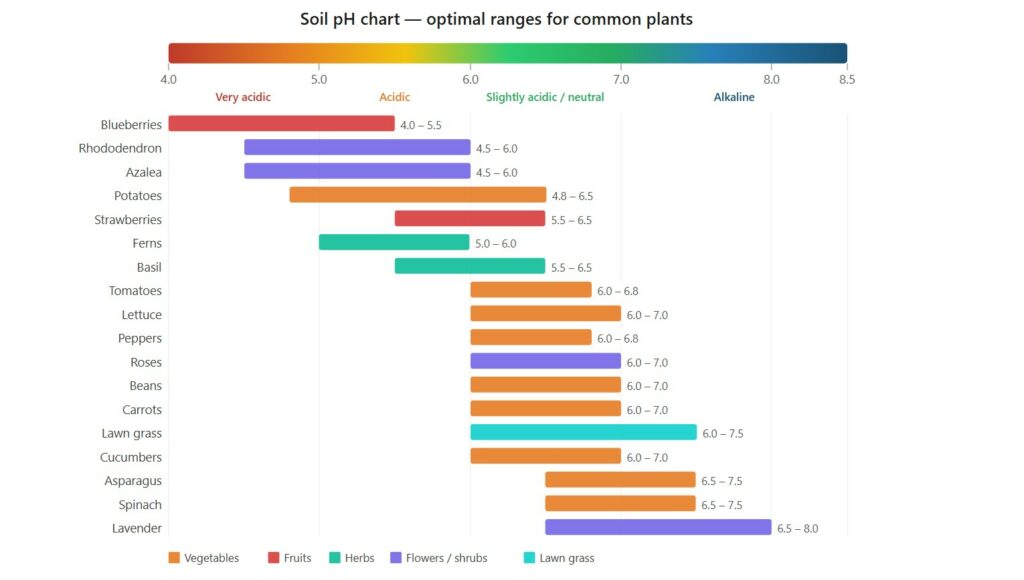
Soil pH controls which nutrients are available to plants. Even if your soil is rich in nutrients, they become chemically locked and unavailable at the wrong pH.
Most vegetables prefer a pH of 6.0–7.0; blueberries and azaleas want 4.5–5.5; lawn grasses prefer 6.0–6.5.
According to Penn State Extension’s soil testing program, pH imbalance is responsible for a significant portion of plant nutrition problems that gardeners misdiagnose as fertilizer deficiencies.
What Lime Does for Grass
Lime raises soil pH — making it less acidic and more available to grass roots. It’s one of the most overlooked lawn treatments, but for acidic soils (below pH 6.0), it’s more impactful than any fertilizer.
The same principle applies to flowering shrubs – knockout roses, rhododendrons, and gardenias all underperform on the wrong pH regardless of how well you fertilize them.
The mistake is applying lime without a soil test first — over-liming can push pH too high and create a different set of nutrient lock-out problems.
pH Management: What Does Lime Do for Grass & Is It Important?
Soil pH Testers
Product Guide: 8 Best Soil pH Testers for Your Gardening Needs — Reviews & Top Picks (2026)
Further Reading: Penn State Extension — Soil Testing Service – 0, tests pH + NPK + organic matter
Fertilizers — Understanding NPK and What Plants Need
Every fertilizer label shows three numbers: N-P-K (nitrogen, phosphorus, potassium).
Nitrogen drives leaf and stem growth. Phosphorus supports root development and flowering. Potassium improves overall plant health, disease resistance, and fruit quality — plants short on potassium produce fruit that splits, misshapes, or develops surface blemishes that are often mistaken for disease.
Different plants need these in different ratios at different stages of growth — a tomato in fruiting stage needs less nitrogen and more phosphorus than the same plant in its first weeks of vegetative growth.
The Michigan State University Extension’s fertilizer label guide is the clearest explanation of how to read a fertilizer bag and calculate application rates without over-fertilizing — one of the most common causes of fertilizer burn and nutrient imbalance in home gardens.
⚠️ Common Mistake
More fertilizer is not better. Excess nitrogen causes lush leafy growth at the expense of fruit and flowers — and in lawns, it creates a flush of growth that quickly weakens the grass. Always follow label rates and test your soil before adding amendments you may not need.
Vegetable Fertilizers
Recommended Reads:
Tree & Shrub Fertilizers
Recommended Reads:
- 10 Best Fertilizers for Citrus Trees — Reviews & Buying Guide 2026
- 10 Best Lemon Tree Fertilizers to Keep Your Citrus Thriving
- 10 Best Fertilizers for Pine Trees — Slow-Release Formulas That Work
- 10 Best Fertilizers for Arborvitae — Reviews 2026
- 9 Best Fig Tree Fertilizers — Reviews and Top Picks 2026
- Top 10 Best Fertilizers for Majesty Palms 2026
- 10 Best Plumeria Fertilizers 2026 — Reviews & Top Picks
Flowering Plant Fertilizers
Recommended Reads:
- 10 Best Rose Fertilizers — Reviews & Top Picks 2026
- 10 Best Fertilizers for Knockout Roses — Top Picks 2026
- 10 Best Fertilizers for Petunias That Will Make Your Garden Pop
- 10 Best Fertilizers for Peonies — Top Picks (2026)
- 10 Best Fertilizers for Rhododendrons to Keep Them Blooming Bright
- Top 10 Best Fertilizers for Geraniums 2026
- 10 Best Fertilizers for Gardenias — Reviews and Top Picks (2026)
- 10 Best Fiddle Leaf Fig Fertilizers — Reviews 2026
Drip Fertilizer Systems
Fertilizer injectors combine feeding and watering into one operation — nutrients are dissolved into the irrigation stream and delivered directly to the root zone. This method, called fertigation, is significantly more efficient than broadcast fertilizing because nutrients go exactly where roots can use them, with minimal waste. If you’re also considering growing in containers indoors, fertigation is one of the cleanest ways to feed plants without soil runoff.
Equipment: 6 Best Fertilizer Injectors for Drip Irrigation Systems (2026)
Composting & Mulch
Compost is the single most universally beneficial soil amendment — it improves drainage in clay soils, water retention in sandy soils, feeds soil biology, and slowly releases nutrients across the growing season. The EPA’s home composting guide estimates that food scraps and yard waste make up more than 28% of what Americans throw away — all of which could be composted to improve garden soil instead.
What Can Go in the Compost Bin
A well-run compost pile needs a balance of carbon-rich “browns” (dried leaves, cardboard, straw) and nitrogen-rich “greens” (food scraps, fresh clippings).
One important note: never add dandelion or nutsedge roots to the pile — they survive most home compost temperatures and can re-sprout when you spread the finished compost.
The question of what’s safe to add — especially with cooked or processed foods — is more nuanced than most guides admit.
Recommended Reads:
Mulch
Mulch is the most underutilized tool in home gardening. A 2–3 inch layer around plants conserves moisture, suppresses weeds, moderates soil temperature, and feeds soil biology as it breaks down.
Old mulch that’s partially decomposed is particularly valuable — it’s essentially free compost. Understanding whether to remove or reuse it changes how you approach bed prep each spring.
What to Do with Old Mulch: Reuse or Repurpose?
External Resource: EPA Home Composting Guide
Lawn Care & Grass Health
Lawn care is a subset of soil care. A healthy lawn is almost always the product of healthy soil underneath it — the right pH, good drainage, adequate organic matter, and appropriate fertilization.
Most lawn problems that appear to be grass problems are actually soil problems expressing themselves through the grass.
Even the question of whether your stored grass seed is still viable matters less than fixing the soil conditions that caused the bare patch in the first place.
Why Grass Won’t Grow
Bare or thin patches in a lawn are one of the most common garden frustrations. The cause is almost never the grass seed or variety — it’s almost always a soil, light, or watering issue at the root. Diagnosing the actual cause before reseeding saves money and time.
Why Is My Grass Not Growing? 10 Possible Reasons
Yellow Spots in Grass
Yellow lawn patches have five distinct causes — each requiring a different fix. Dog urine, fungal disease, compaction, fertilizer burn, and grub damage all produce yellow patches but respond to completely different treatments. Treating for the wrong cause wastes time and money.
Top 5 Causes of Yellow Spots in Grass (+ How to Fix Them)
Herbicides — Pre-Emergent & Weed & Feed
Pre-emergent herbicides work by forming a chemical barrier in the soil that prevents weed seeds from germinating — they have zero effect on weeds already growing.
Timing is everything: apply too late and weed seeds have already sprouted; apply too early and the barrier degrades before peak germination. The Clemson Extension pre-emergent herbicide guide provides specific timing windows by region and weed type.
Recommended Reads:
Grass Seed & Sod
Recommended Reads:
Lawn Fertilizers & Watering
Recommended Reads:
