

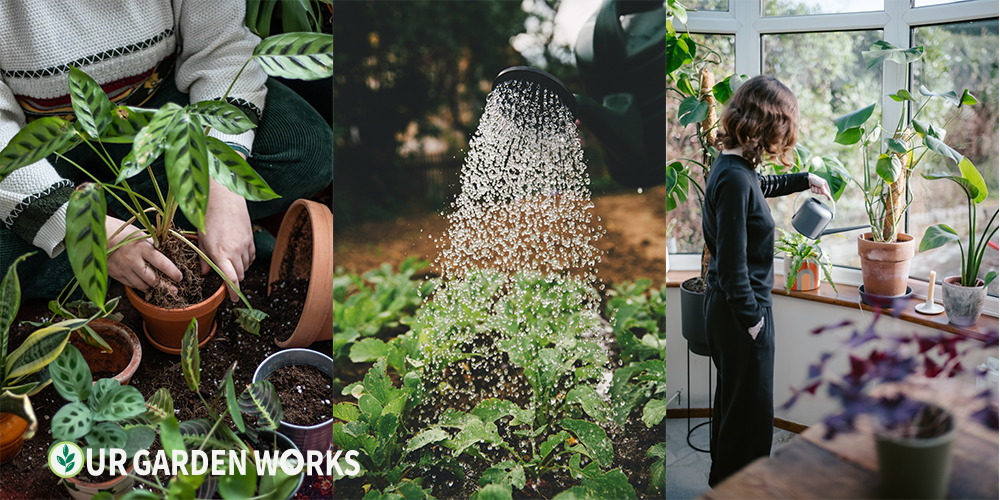
Most plants don’t die of neglect. They die of well-meaning neglect — too much water from someone who cared, too much fertilizer from someone who wanted to help, a spot chosen for beauty instead of light. The gap between a thriving plant and a struggling one is almost always knowledge, not effort.
This plant care guide collects everything we’ve learned about plant care at Our Garden Works into one place.
✅ Key Takeaways
- Check soil before watering— most houseplants die from overwatering, not underwatering
- Match light to plant needs— no amount of care compensates for wrong light placement
- Read the leaves— yellowing, browning, drooping, and spotting each point to different causes
- Repot when rootbound, not on a schedule— check roots annually and repot only when needed
- Deadhead flowering plants— removing spent blooms redirects energy to new flowers
- Know your toxic plants— several common houseplants are harmful to cats, dogs, and children. The ASPCA toxic plant database is the most reliable reference before introducing any new plant to a home with pets
Whether you’re keeping a single monstera alive or maintaining a full indoor garden, the principles here apply to virtually every plant you’ll ever grow.
Follow the links in each section on the right sidebar to go deeper on any specific plant or problem.
🌿 Editor’s Note
“The question I get most often is: Why is my plant dying? Nine times out of ten, the answer is watering. Learn to read your plant’s soil and leaves before you reach for the watering can, and you’ll solve most problems before they start.”
The 4 Fundamentals Every Plant Needs
Before diving into specific plants and problems, it’s worth establishing the framework. Every plant, from a money tree to a staghorn fern, needs the same four things — in the right amounts and the right balance.
1. Light — The Non-Negotiable
Light is the one thing you can’t compensate for with anything else. A plant that doesn’t get enough light will slowly decline regardless of how well you water or fertilize it.
A widely cited NASA Clean Air Study also found that many common houseplants absorb airborne pollutants most effectively when placed in bright indirect light — making placement a dual consideration for both plant health and air quality.
Before placing any plant, spend a day observing where the sun hits in your space, for how long, and at what intensity. South-facing windows get the most light in the Northern Hemisphere. North-facing windows get the least.
One of the most practical questions for indoor growers is whether plants actually need UV light — the answer affects decisions about grow lights, window placement, and supplemental lighting significantly.
You might like: 10 Best Heating Lamps for Plants to Protect Against Winter Chill
2. Water — Quality Over Quantity
Plants don’t need a schedule. They need water when the soil is ready for it. The most reliable indicator is soil moisture, not time elapsed since last watering.
Stick your finger 2 inches into the soil. Bone dry? Water thoroughly. Still moist? Leave it. This single habit prevents the majority of houseplant deaths.
3. Soil & Drainage
Most houseplants fail not because of bad soil but because of bad drainage. A plant in a pot without drainage holes, or in heavy soil that holds water, will develop root rot almost inevitably.
Some plants, however, are genuinely adapted to low-drainage environments — knowing which plants don’t need drainage helps you choose the right container for each plant.
4. Nutrients — Less Is Usually More
Most houseplants in a quality potting mix don’t need fertilizing for the first 6–12 months.
Over-fertilizing is as common a problem as under-fertilizing, and the symptoms look almost identical — both cause leaf burn, poor growth, and stress. When you do fertilize, use a diluted solution and err on the side of less.
Watering — The Most Common Mistake
Overwatering kills more houseplants than any other cause, and it’s almost always accidental — the product of love and routine rather than carelessness.
According to University of Maryland Extension, the most reliable test for watering readiness is the finger test: insert a finger 2 inches into the soil — if it feels moist, wait; if it feels dry, water thoroughly until it drains from the bottom.
The problem isn’t water itself but what happens when roots sit in saturated soil: oxygen is displaced, roots begin to rot, and the plant can no longer take up water even when it’s present.
Tulips & Bulb Plants
Bulb plants are particularly sensitive to overwatering. Tulips famously dislike “wet feet” — their roots need moisture but the bulbs themselves will rot if left in standing water. Knowing how often to water tulips correctly, and whether they prefer sun or shade, are the two foundational care questions for this plant.
Poinsettias
Poinsettias are the classic holiday plant that most people kill within weeks — almost always by watering incorrectly. Their bracts and leaves are highly sensitive to too much moisture.
Understanding how often to water poinsettias and whether they tolerate wet soil is the difference between a plant that lasts through January and one that drops leaves by Christmas.
Misting for Humidity
Many tropical houseplants — ferns, calatheas, orchids, bromeliads — prefer humidity higher than most homes provide.
A plant atomizer is one of the simplest and most effective tools for raising local humidity without running a humidifier. Finding the right plant atomizer for misting makes a real difference for humidity-loving species.
12 Best Plant Atomizers for Healthy Growth — Mist Like a Pro (2026)
Light Requirements by Plant Type
Matching a plant to the right light conditions is the single most important placement decision.
The language used on plant labels — “full sun,” “bright indirect light,” “low light” — has specific meanings that are worth understanding before you buy.
Philodendrons — The Adaptable Tropical
Philodendrons are often described as low-light plants, but they’ll grow significantly faster and healthier with bright indirect light. The real question most gardeners face is whether philodendrons can grow outside — the answer depends entirely on your climate zone and what time of year it is.
Peace Lilies — Masters of Low Light
Peace lilies are one of the few plants that genuinely thrive in low-light conditions. Beyond their adaptability, they’ve gained attention for their potential air-purifying properties.
The research on whether peace lilies actually clean the air is more nuanced than plant labels suggest — and worth understanding if that’s a key reason you’re growing them.
Peace Lily — Full Care Series
Peace lilies have become one of our most-read plant families at Our Garden Works. Whether you’re growing them from seed, propagating, or wondering about their mature size, we’ve covered every angle.
Recommended Reads:
Reading Your Plant’s Leaves
A plant’s leaves are its primary communication system. Before reaching for a product or changing your care routine, spend two minutes examining the leaves closely — the pattern and type of discoloration tells you more than any symptom checker can.
Yellow Leaves — The Most Common Symptom
Yellow leaves are so common they deserve their own breakdown by plant type, because the cause differs significantly depending on what you’re growing.
The Royal Horticultural Society’s yellow leaves guide identifies overwatering, nutrient deficiency, and insufficient light as the three most statistically common causes across all plant types — in that order.
Yellowing in a money tree almost always points to one of a specific set of environmental factors — understanding what causes money tree yellow leaves saves hours of guesswork. The same symptom in an orchid has a completely different set of likely causes.
Recommended Reads:
Brown Leaves & Tips
Brown tips usually indicate a humidity or watering problem. Brown patches or spots suggest something different — fungal issues, sun scorch, or pests.
Monstera leaves turning brown is one of the most frequently searched problems we cover, and the distinction between dehydration and fungal browning is critical because the treatments are opposite.
Recommended Reads:
Spots on Leaves
Recommended Reads:
Drooping & Curling
Recommended Reads:
Propagation & Repotting
Propagation is one of the most satisfying skills in plant care — turning one healthy plant into many. The method depends entirely on the plant species.
Missouri Botanical Garden’s propagation guide is the most comprehensive free reference for understanding which method — cutting, division, layering, or seed — suits each type of houseplant.
Some propagate from cuttings, some from division, some from seed. Getting it wrong doesn’t usually mean failure, but getting it right means much faster results.
Money Tree Propagation
Money trees are one of the most popular houseplants for propagation because a single mature plant can produce multiple offshoots.
Propagating a money tree correctly involves taking stem cuttings at the right node and rooting them in water or soil — the technique is straightforward once you know what to look for.
Fig Propagation
Growing figs from cuttings is genuinely one of the most rewarding propagation projects you can take on.
A mature fig cutting roots readily in late winter, and within two growing seasons you have a fruit-producing tree. How to grow figs from cuttings is covered step by step in our guide.
Spider Plants in Water
Spider plants are among the easiest plants to propagate — their babies (spiderettes) root readily in water or directly in soil.
Whether spider plants can grow entirely in water long-term is a different question from propagating in water, and the answer is more nuanced than most guides suggest.
Root Bound Plants
Knowing when to repot is as important as knowing how. Some plants — spider plants among them — actually bloom better when slightly root bound.
Understanding whether spider plants like being root-bound prevents unnecessary repotting that stresses the plant without benefit.
Transplant Shock
Even a perfect repot can cause transplant shock — a period where the plant looks worse before looking better.
The good news is transplant shock is almost always temporary. How long the transplant shock recovery time takes depends on plant size, species, and how carefully the roots were handled during the move.
Houseplant Deep Dives
Monstera — The Iconic Houseplant
Monstera became the houseplant of the pandemic era and hasn’t slowed down. The most common care question after “why are my leaves brown?” is why monstera plants don’t have holes — a phenomenon called fenestration that’s directly tied to light levels and plant maturity.
Spider Plants — The Beginner’s Best Friend
Spider plants tolerate low light, irregular watering, and months of neglect. They’re the plant that teaches beginners what “thriving” looks like without demanding perfection. Pruning spider plants properly keeps them from becoming a tangled mess and stimulates new growth.
Orchids — The Rewarding Challenge
Orchids have an undeserved reputation for being difficult. The truth is that they’re misunderstood — they don’t want what most plants want, and caring for them like a typical houseplant is exactly why they die.
Reviving a dying orchid is genuinely possible in most cases, and the right orchid pot makes a significant difference in long-term health.
You might also like: 15 Best Orchid Pots & Planters — Reviews & Buying Guide
Staghorn Fern
Staghorn ferns are mounted, epiphytic plants that grow on bark rather than in soil — completely unlike most houseplants. When they struggle, the approach to saving a dying staghorn fern is specific to their unusual growing habit and can’t be approached the same way as a potted plant.
Aloe Vera & Look-alikes
Aloe vera is one of the most commonly purchased succulents — and one of the most commonly misidentified. Several plants closely resemble aloe, and some of those look-alikes are toxic. Knowing which plants look like aloe vera and which are poisonous is essential if you have children or pets.
Dumb Cane — A Common Toxic Plant
Lily Seeds
Flowering Plants — Getting More Blooms
The two most common questions about flowering plants are: “why won’t it bloom?” and “how do I get more flowers?” Both come down to understanding what triggers flowering in each species — light cycles, deadheading, pruning, and seasonal cues all play a role.
Roses
Knockout roses are among the most popular garden roses precisely because they’re low maintenance — but “low maintenance” doesn’t mean no maintenance.
Roses that won’t bloom are almost always lacking something specific: light, deadheading, or the right pruning approach. Knowing how to deadhead knockout roses correctly is the single most effective way to extend their bloom season.
Geraniums
Hydrangeas
Common Hydrangea Problems: Why Is My Hydrangea Not Growing?
10 Best Fungicides For Hydrangeas — Reviews & Top Picks (2026)
Peonies
Petunias
Sunflowers
Gardenias
Unique Flowers
Trees, Palms & Larger Plants
Palm Trees
Palm trees are often misunderstood as purely tropical, but many varieties grow well in temperate climates and even in containers.
Two foundational questions about palms come up constantly: whether palm trees have roots (and what kind), and whether all palm trees produce coconuts — the answer to both is more interesting than most people expect.
Recommended Reads:
Troubleshooting — Diseases, Pests & Pet Safety
Tomato Pests & Problems
Recommended Reads:
- Tomato Stem Rot: What Causes It And How To Treat Your Plant
- Best Tomato Blight Spray Recipes (9 Recipes Revealed)
- Tomato Pesticides: Everything You Need To Know
- What Causes The Small Holes In Tomato Leaves?
- What Are The Effective Ways To Remove Ants On Tomato Plants?
- How to Get Rid And Prevent Black Worms In Tomatoes
