

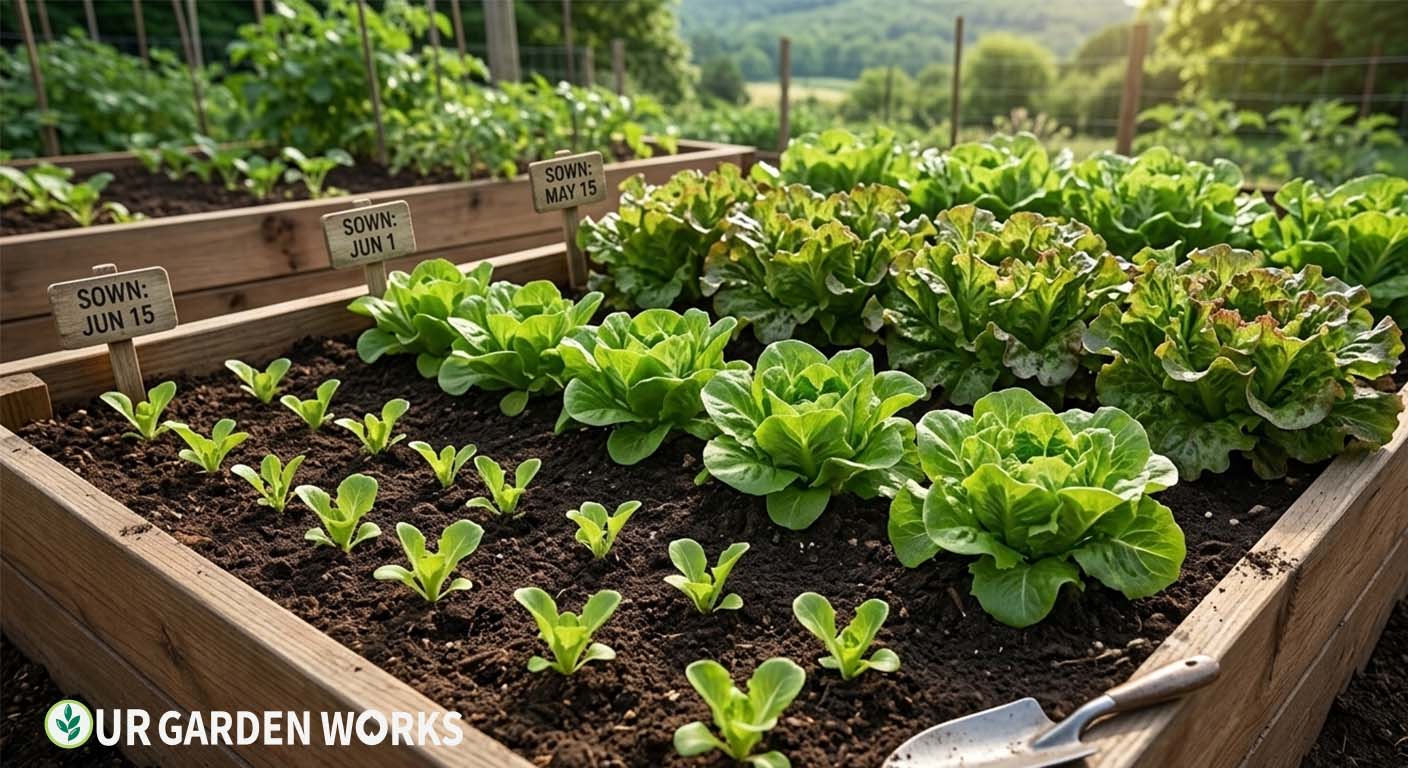
If you’ve ever had 3 weeks of more lettuce than you can possibly eat, followed by no lettuce at all for the rest of the summer, you understand the problem succession planting solves.
The same thing happens with radishes, cilantro, spinach, and any other crop with a fixed harvest window.
Succession planting is the practice of sowing the same crop at regular intervals throughout the season so you have plants maturing continuously rather than all at once.
It’s one of the highest-leverage changes you can make to a vegetable garden — and once you understand how to do it, the planning becomes almost automatic.
What is Succession planting?
Quick Answer: Succession planting means sowing small amounts of the same crop every 2–3 weeks instead of all at once. For a continuous harvest: sow every 2 weeks for fast crops (radishes, lettuce, cilantro) or every 3–4 weeks for slower crops (beans, beets, carrots). Stop sowing when you don’t have enough season left for the final planting to mature.
💡 Skip the manual math
Everything below — finding your last sowing date, counting back intervals, spotting the midsummer gap — is exactly what our succession planting scheduler does automatically.
Enter your zip code and the crops you want, and it builds the staggered calendar for you. The explanations in this guide are still worth reading so you understand why the dates land where they do.
Why a Single Sowing Date Creates the Feast-or-Famine Problem
Most fast-maturing vegetables, left to their own devices, follow a remarkably tight internal clock. Seeds sown on the same day, in the same conditions, mature within just a day or two of each other, almost regardless of minor variation in soil or sun exposure within the bed.
This tight synchronization is actually a useful trait from the plant’s evolutionary perspective — it means an entire population matures and sets seed together — but it’s exactly the opposite of what a household eating from that bed actually wants.
A single sowing of 20 radish seeds doesn’t trickle in a few radishes per week for two months. It gives you roughly 20 radishes within a 3–4 day window, all demanding to be used or preserved at once, followed by nothing until you plant again.
Succession planting simply works around this built-in synchronization by treating “the crop” as a series of smaller, intentionally staggered cohorts rather than one large population — each cohort still matures in its own tight window, but because you started them weeks apart, those windows themselves are spread across the season instead of stacked on top of each other.
The total amount of food produced doesn’t necessarily increase dramatically; what changes is the shape of the harvest curve, smoothing a single sharp spike into a series of smaller, more manageable peaks.
Three Types of Succession Planting
Type 1 — Staggered Sowings of the Same Variety
The classic method. Sow 1/3 of your lettuce seeds today, another 1/3 in 3 weeks, and the final 1/3 three weeks after that.
Three harvests stretched across 9 weeks instead of one big harvest followed by nothing. This is what most gardeners mean when they say “succession planting.”
Type 2 — Different Varieties with Different Maturity Times
Plant an early-maturing variety, a mid-season variety, and a late variety simultaneously. They all go in the ground the same day but mature at different times — built-in succession without staggered sowing.
Works especially well for corn (which doesn’t succession-sow well), tomatoes, and winter squash.
Type 3 — Same Space, Different Crops (Crop Rotation Through the Season)
Plant a spring crop. When it’s done, immediately replant the same space with a summer crop. When the summer crop finishes, plant a fall crop. One bed produces three complete growing cycles per year. This requires planning a full-season crop map, but maximises productivity dramatically.
This third type asks for the most upfront planning of the three, since you’re effectively designing an entire year’s rotation for a single piece of ground rather than just scheduling repeated sowings of one crop.
A practical approach many gardeners use is sketching out the bed’s three seasonal occupants before the year even starts — say, peas in early spring, then bush beans through summer, then a fast brassica like kale or mustard greens for fall — checking that each transition leaves enough time for soil refreshing (a light compost top-dressing between crops) without forcing you to rush a new planting before the bed is genuinely ready.
Our raised bed soil calculator is useful here too, since topping off a bed between rotations is a different, smaller volume than filling it from scratch, and it’s easy to over-order compost without checking the math first.
Best Crops for Succession Planting
| Crop | Interval | Notes |
|---|---|---|
| Radishes | Every 1–2 weeks | 25-day crop — succession is almost mandatory |
| Lettuce | Every 2–3 weeks | Bolts in heat — stop spring succession in May, restart in August |
| Spinach | Every 2–3 weeks | Same heat considerations as lettuce |
| Cilantro | Every 2–3 weeks | Bolts extremely fast — frequent sowing is the only way to maintain supply |
| Bush beans | Every 3 weeks | All beans in a planting mature simultaneously — succession gives you a steady supply |
| Beets | Every 3 weeks | Good succession crop; harvest size remains consistent |
| Carrots | Every 4 weeks | Longer to mature — 3–4 successions maximum in a long season |
| Basil | Every 4 weeks | Keeps you in fresh young leaves through the season |
Once you’ve got 3 or 4 successions of the same crop growing at staggered stages, keeping track of which planting is closest to harvest gets harder than it sounds — they all look similar at a glance, just at different heights.
Our harvest countdown calendar tracks days-to-harvest for every crop and succession you’ve logged, so you can see at a glance which planting needs checking first without having to mentally calculate planting dates against maturity windows for each one separately.
How to Plan a Succession Schedule
Step-by-Step Planning
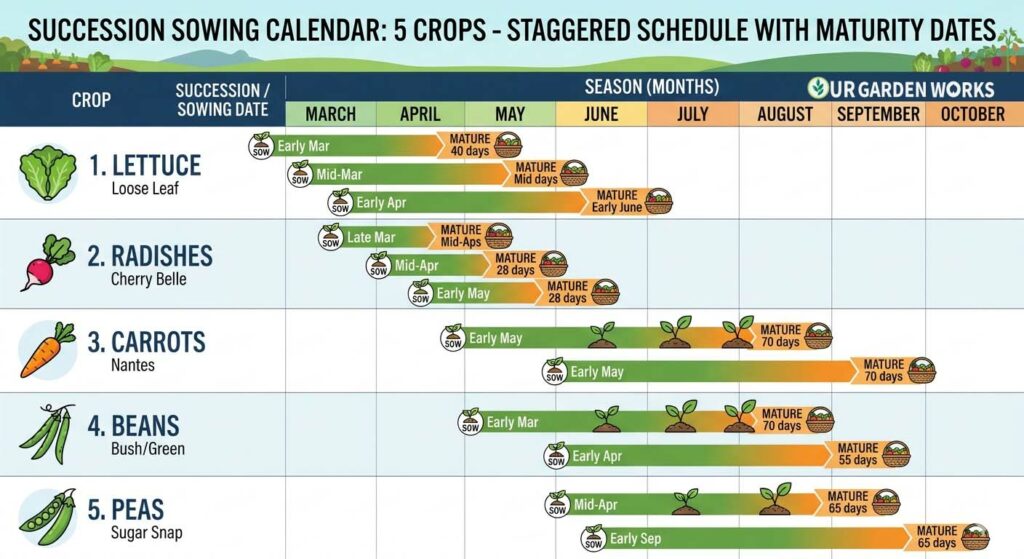
- Find your last planting date: Work backward from your first expected frost. If your frost is October 15 and lettuce takes 45 days to mature, your last lettuce sowing date is September 1. Our frost dates lookup tool finds your specific average first and last frost dates by zip code, so you’re not working from a regional guess.
- Count back your successions: If you want 3 successions at 3-week intervals, count back 9 weeks from September 1 = start first sowing June 24.
- Note the midsummer gap: Many cool-season crops (lettuce, spinach, cilantro) can’t be grown in the height of summer. Plan a gap and restart in late summer for fall harvests.
- Mark your calendar: Write the actual sowing dates on your garden calendar, not just “every 3 weeks.” When those dates arrive, sow — even if conditions seem imperfect. Our succession planting scheduler can generate this entire staggered calendar for you automatically once you enter your frost dates and chosen crops, which saves you from doing the backward math by hand for every single succession.
Why “Days to Maturity” Isn’t the Whole Picture
Seed packets list days-to-maturity as if it’s a fixed number, but that figure assumes ideal growing conditions that rarely hold steady across an entire season.
A radish packet might say 25 days, and that’s roughly accurate in the mild temperatures of late spring — but the same variety sown in the heat of midsummer can mature noticeably faster, sometimes in 20 days, while a fall sowing into cooling temperatures might take 30 days or more to reach the same size.
This matters for succession planning because rigidly counting out your next sowing date based purely on the packet’s days-to-maturity number, without accounting for the season’s actual temperature trend, can leave you with either an awkward gap (if your crops matured faster than expected) or an overlapping glut (if they matured slower).
Experienced succession planters treat the packet number as a starting estimate, then adjust their interval slightly based on how the current season’s actual maturity times are tracking, tightening the gap between sowings during the fast-growing peak of summer and widening it again as days shorten and cool in fall.
Combining Succession Planting with Interplanting
Succession planting and interplanting (growing two compatible crops in the same space at the same time) work well together rather than being competing strategies.
A classic combination: sow a fast succession crop like radishes or lettuce in the same row as a slower-maturing crop like carrots or onions. The fast crop matures and gets harvested out within a few weeks, right around the time the slower crop needs the additional root and leaf space it was previously sharing.
This approach effectively gets you two plantings from the same physical bed space without waiting for one crop to fully finish before starting the next, which is especially valuable in smaller gardens where bed space is the limiting factor rather than time or labor.
The key constraint is choosing combinations where the fast crop’s brief presence doesn’t meaningfully shade or crowd the slower crop during its own critical early growth period — radishes and lettuce, both low-growing, rarely cause problems for taller companions like carrots or beets growing alongside them.
The same logic extends to using a fast succession crop as a living marker for slow-germinating seeds like carrots, since the quick-sprouting radishes show you exactly where the row is before the carrots themselves have even emerged.
Frequently Asked Questions
What space do I need for succession planting?
Succession planting works in any size garden because you’re planting smaller amounts more frequently rather than all at once. A 4×8 raised bed is sufficient for a full succession of lettuce, radishes, and beans alongside other vegetables.
One full bed per crop isn’t necessary — a single row or small section repeated every few weeks works perfectly. Our garden planner can help you map out exactly where each succession will go and confirm the layout still fits before you commit seed to soil.
Can I succession plant tomatoes and peppers?
Generally no — their long maturation time (70–90 days) means a second planting started 3–4 weeks after the first would mature too close to first frost in most climates to produce a meaningful harvest. The exception: in Zones 9–11 with 12-month growing seasons, succession planting tomatoes and peppers is entirely practical.
How many seeds should I plant in each succession?
Enough to supply your household during the harvest window for that succession. For a family of 4 with 3-week succession intervals: 4–6 lettuce plants, a 3-foot row of radishes, or a 4-foot row of beans per succession gives you enough without overwhelming surplus.
If you’re unsure how many plants actually fit in your available row length at proper spacing, our plant spacing calculator works out exact counts per crop so each succession is sized correctly from the start.
What if I miss a planned succession sowing date by a week or two?
It’s rarely a serious problem — succession planting is a flexible framework, not a rigid schedule that breaks if disrupted. A missed sowing simply means a slightly wider gap in that part of your harvest timeline.
Sow as soon as you remember, and consider shortening the interval before your next planned sowing slightly to help close the gap sooner.
Related Articles in Our Vegetable Gardening Guide:
Free Tools to Plan Your Succession Schedule
Final Thoughts
We hope this guide transforms the way you think about your garden’s harvest cycle. Succession planting is one of those techniques that once you understand it, you can’t unlearn — and it fundamentally changes how much you get out of the same amount of space.
For all our vegetable growing guides, our vegetable gardening guide links to everything.
Share this post with a fellow gardener who’s ready to get growing — and let us know in the comments which crops you’re succession planting this season and your interval. Happy growing!
