

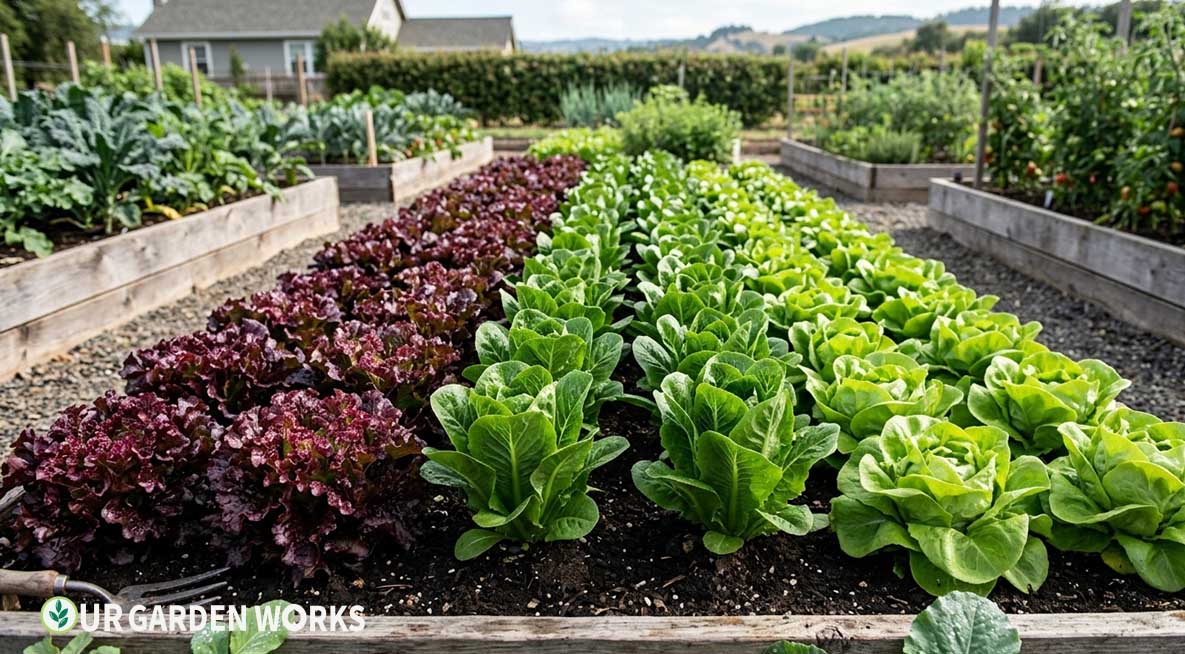
Lettuce is the crop that proves you don’t need much space or experience to grow your own food.
A 2×4 foot raised bed planted with three or four lettuce varieties gives you more salad than a family of four can eat — and if you plant in succession, you’ll have fresh leaves from April through November in most climates.
The one skill that separates good lettuce growers from frustrated ones is understanding bolting — when lettuce transitions from producing leaves to producing a flower stalk.
Once it bolts, the leaves turn bitter and the plant is done. We’ll show you exactly how to prevent it through timing and variety selection.
Quick Guide (How to Grow Lettuce): Sow lettuce seeds ⅛ inch deep in cool weather — soil 40–65°F is ideal. It’s a cold-season crop that bolts in heat. Sow every 2–3 weeks from early spring through summer for continuous harvest. Cut-and-come-again harvesting keeps a single plant producing for 4–6 weeks.
Why Lettuce Is the Best First Crop for New Gardeners
If you’re choosing what to plant in your very first vegetable bed, lettuce deserves serious consideration over the more commonly recommended tomato or pepper.
It germinates faster than almost anything else in the vegetable garden, tolerates a wider range of soil conditions, and gives you a usable harvest within a month rather than the two to three months most fruiting crops require.
That speed matters more than it might seem — a new gardener who sees results in three weeks stays motivated through the rest of the season in a way that someone still waiting on their first tomato sometimes doesn’t.
Lettuce also forgives mistakes more readily than most vegetables. Plant it slightly too deep, water it a bit inconsistently in its first week, or thin it a little late, and you’ll still get a reasonable harvest — the plant simply isn’t operating with the narrow margins that something like cauliflower or carrots demands.
That combination of speed and forgiveness is exactly why we recommend it as the crop to build early gardening confidence around, even if salad greens aren’t ultimately going to be the centerpiece of your garden.
Choosing Your Lettuce Type
| Type | Best Varieties | Days to Harvest | Notes |
|---|---|---|---|
| Looseleaf | Black Seeded Simpson, Red Sails, Salad Bowl | 45–55 days | Best for cut-and-come-again; most heat-tolerant |
| Butterhead | Buttercrunch, Tom Thumb, Merveille des Quatre Saisons | 55–75 days | Silky texture, mild flavor; favorite for home gardens |
| Romaine | Parris Island, Little Gem, Fordhook Giant | 70–85 days | Most heat-tolerant lettuce; crisp texture |
| Crisphead | Iceberg, Summertime, Ithaca | 80–100 days | Hardest to grow; needs sustained cool weather |
Buttercrunch is our top recommendation for new growers — it’s heat-tolerant relative to other butterheads, rarely bolts prematurely, and the flavor is exceptional. Black Seeded Simpson is the fastest and most forgiving for cut-and-come-again harvesting.
Lettuce Growing Requirements
What Lettuce Needs
- Temperature: 45–65°F is ideal. Germinates at 40°F. Bolts when temperatures consistently exceed 75°F.
- Sunlight: 6 hours minimum. Tolerates partial shade — in fact, afternoon shade extends the season in warmer climates.
- Watering: Keep soil consistently moist. Lettuce has shallow roots and dries out fast. Inconsistent moisture = bitter leaves.
- Soil pH: 6.0–7.0. Broadly tolerant. Work in compost for best leaf production.
- Succession: Sow every 2–3 weeks for continuous harvest rather than one massive planting.
How to Grow Lettuce: Step by Step
Step 1 — Direct Sow in Early Spring (or Late Summer for Fall Crop)
Lettuce is one of the few crops you can sow directly outdoors before your last frost date. The seeds germinate in soil as cold as 40°F, making it the first vegetable you can plant each spring.
Directions
- Prepare a fine seedbed — rake out all clumps so the tiny seeds make good contact with soil.
- Scatter seeds thinly over the surface or in rows, ⅛ inch deep. Lettuce seeds need light to germinate — don’t bury them more than ¼ inch.
- Thin seedlings when they’re 2–3 inches tall. Looseleaf: 6 inches apart. Butterhead/romaine: 8–10 inches. Use the thinnings as baby salad greens — they’re excellent at this stage.
- Start your succession sowing: 2–3 weeks after the first planting, sow another row. Repeat through late spring. Stop when daytime temperatures consistently hit 75°F.
- Restart succession sowing in late summer for a fall crop — 8 weeks before your first expected frost.
Step 2 — The Cut-and-Come-Again Harvesting Method
This is the single most useful lettuce technique in the home garden. Instead of harvesting the whole plant, take outer leaves from each plant and leave the center growing point intact. The plant continues producing new leaves for another 3–4 harvests before eventually bolting or declining.
How to harvest cut-and-come-again
- Wait until plants are 4–6 inches tall.
- Use clean scissors to cut leaves 1 inch above the soil surface — or remove individual outer leaves by snapping them downward.
- Leave the center “crown” of young leaves completely untouched.
- Return in 1–2 weeks for the next harvest. The same plant will have rebounded.
For the full harvesting guide including timing signals for each variety, see our harvest lettuce and keep it growing guide.
Step 3 — Preventing Bolting
When days lengthen and temperatures rise above 75°F, lettuce shifts its energy from leaf production to flowering (bolting). Bolted lettuce turns bitter and is effectively done. Here’s how to extend your harvest window:
- Choose slow-bolt varieties: Jericho, Concept, and Nevada romaine are bred for heat tolerance. Buttercrunch bolts more slowly than most butterheads.
- Provide afternoon shade: A shade cloth (30–40%) or natural shade from taller plants extends lettuce season by 2–3 weeks in warm climates.
- Succession sowing: Your last spring sowing should go in 6 weeks before temperatures regularly hit 75°F. By the time those plants mature, your fall succession will be starting.
- Water consistently: Heat stress from dry soil accelerates bolting faster than temperature alone. Keep soil evenly moist.
Growing Lettuce in Containers and Small Spaces
Lettuce is genuinely one of the best container vegetables available, and it solves a problem that plagues many small-space gardeners: the temptation to grow heat-loving vegetables in spots that simply don’t have enough sun or warmth to support them well.
A shallow container as little as 6 inches deep is enough for looseleaf varieties, since the root system stays compact compared to almost anything else in the vegetable garden.
The real advantage of container lettuce is mobility combined with succession. A row of three or four containers, each started two weeks apart, lets you rotate harvest and replanting without ever needing more than a small balcony or sunny windowsill ledge.
When one container’s lettuce starts showing the first signs of bolting, it’s nearly always time to harvest it completely and replant, while the next container in the rotation is just reaching peak harvest size.
Frequently Asked Questions
Can I grow lettuce indoors?
Yes — lettuce is one of the best crops for indoor growing under grow lights. Use a shallow tray with seed-starting mix, thin to 6-inch spacing, and harvest cut-and-come-again. A single 2-foot grow light shelf can produce enough lettuce for regular salads.
Why is my lettuce bitter?
Bitterness is almost always caused by heat stress or bolting. Lettuce that has started forming a tall central seed stalk is bolting — harvest immediately and pull the plant.
Future prevention: choose heat-tolerant varieties, provide afternoon shade, and keep up with succession sowing so you always have young plants.
When should I harvest lettuce?
For looseleaf: begin harvesting outer leaves when plants are 4–6 inches tall. For butterhead/romaine: harvest when the head is firm and full-sized but before a central stalk begins forming. See our when to harvest lettuce guide for variety-specific timing.
How many lettuce plants do I need to keep a family of four in salad all season?
A rolling succession of 8–12 plants at any given time, replanted every 2–3 weeks as you harvest, generally keeps a family of four well supplied with fresh salad greens.
The exact number depends heavily on variety — looseleaf types like Black Seeded Simpson produce more total leaf mass per plant over their cut-and-come-again lifespan than a single-harvest crisphead variety, so factor that into how many of each type you plant.
🥬 Related Articles in Our Vegetable Gardening Guide
Final Thoughts
We hope this guide has shown you how easy and satisfying growing your own lettuce can be. Once you master the cut-and-come-again technique and succession sowing, you’ll have more fresh greens than you know what to do with.
For all our vegetable growing guides, our vegetable gardening guide links to everything.
Share this post with a fellow gardener who’s ready to grow their own — and let us know in the comments which lettuce variety you’re starting with this season. Happy growing!
