

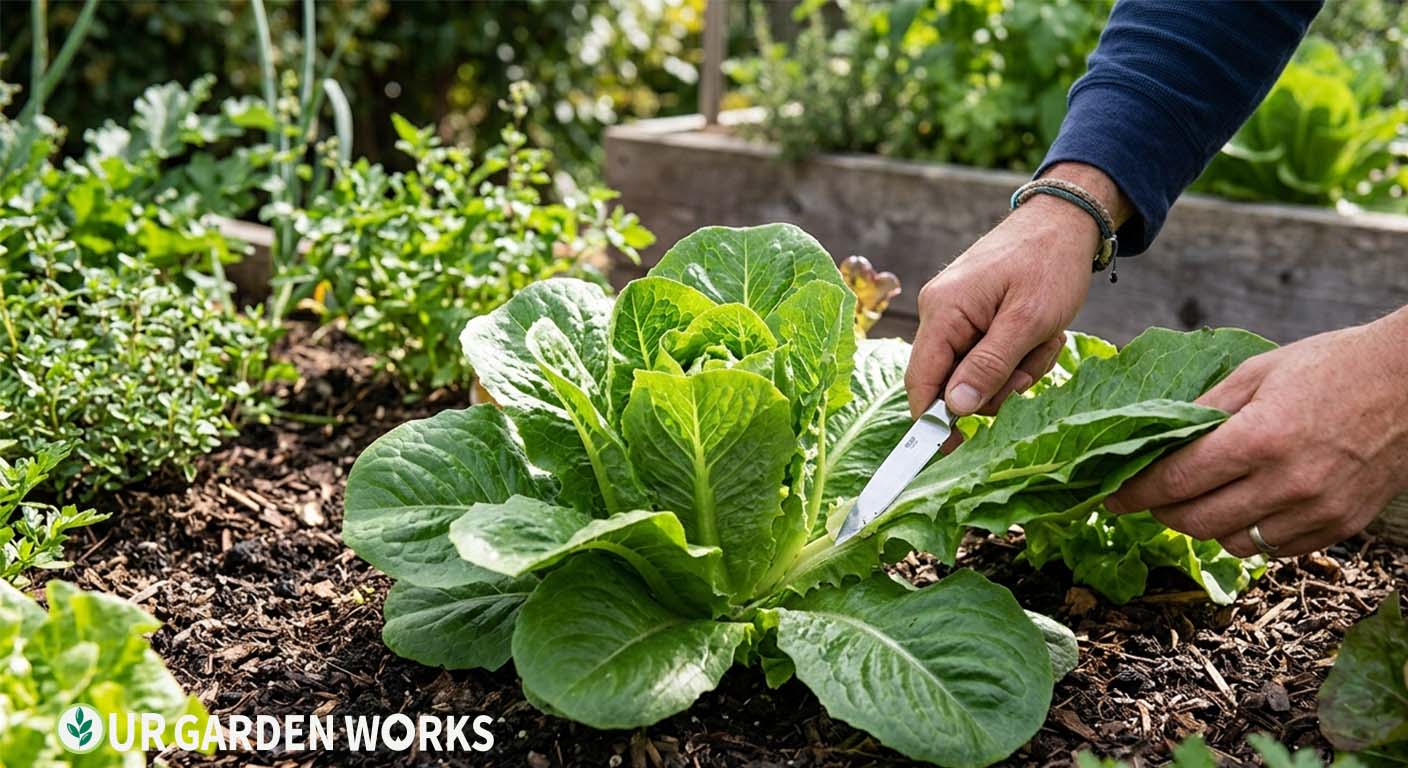
Lettuce is the rare garden crop where harvesting correctly actually increases your total yield.
The cut-and-come-again method — taking outer leaves while leaving the growing center — can give you 3–4 times the harvest from the same plant compared to pulling the whole head at once. And it’s genuinely one of the easiest techniques in the vegetable garden to get right.
When to Harvest Lettuce – Quick Answer: For loose-leaf and butterhead lettuce: start harvesting outer leaves when plants are 4–6 inches tall. Take the outer 30% of leaves, leaving the center crown intact to regrow. For romaine and head lettuce: harvest the whole head when it feels firm and full, before temperatures exceed 80°F consistently.
Why Cut-and-Come-Again Actually Multiplies Your Harvest
Lettuce, like kale and many other leafy crops, grows from a central crown — a tight cluster of developing leaves at the base of the plant that continuously pushes out new growth as long as it remains intact and the plant has energy to spare.
The outer leaves you see on a mature lettuce plant are simply the oldest ones, having been produced first and pushed outward as newer leaves emerged from the center behind them.
When you harvest only the outer leaves and leave the crown untouched, you’re removing tissue the plant was already finished investing in, while leaving its actual growth engine fully intact and able to keep producing.
This is fundamentally different from pulling an entire head, which removes the crown along with everything else and ends that plant’s productive life in a single harvest. The math is straightforward once you see it this way: a head pulled whole gives you one harvest, while the same plant managed with cut-and-come-again can realistically give you three or four over several weeks, simply because you’re harvesting in sync with how the plant actually grows rather than against it.
The tradeoff is patience — a cut-and-come-again bed never gives you the single dramatic haul a whole-head pull does, but the cumulative total from the same footprint is considerably higher.
Harvest by Lettuce Type
Lettuce isn’t a single uniform crop when it comes to harvest strategy — the various types differ enough in growth habit that the right approach for one would shortchange another.
Loose-leaf varieties are built for repeated cutting; crisphead types are built for one decisive harvest. Knowing which category your variety falls into before you start picking saves you from either harvesting too cautiously or accidentally ending a plant’s productive life early.
| Type | Harvest Method | When Ready | Regrowth? |
|---|---|---|---|
| Loose-leaf (Oak Leaf, Salad Bowl) | Cut outer leaves | 4–6 inches tall | Yes — 3–4 cuts per plant |
| Butterhead (Bibb, Boston) | Cut outer leaves or whole head | 6–8 inches across | Partial |
| Romaine | Cut whole head or outer leaves | 8–10 inches tall, firm center | Yes — side shoots |
| Iceberg / crisphead | Cut whole head | Head feels firm when squeezed | No |
| Mesclun / spring mix | Scissors, cut 1 inch above soil | 4–6 inches tall | Yes — 2–3 cuts |
The Cut-and-Come-Again Method
Directions
- Wait until plants are 4–6 inches tall and have at least 6 developed leaves.
- Working from the outside in, snap or cut individual outer leaves 1 inch above the soil level. Never cut the central growing point — that’s where regrowth comes from.
- Take no more than one-third of the plant at each harvest session. More than that slows regrowth significantly.
- Return in 10–14 days for the next harvest as the center grows outward to replace what you took.
- Continue until the plant begins to bolt (send up a tall flowering stalk) — at this point leaves become bitter and the harvest is over.
💡 Harvest in the morning
Lettuce has the highest water content — and therefore the best crunch and flavor — early in the day before heat draws moisture from the leaves. Harvesting in the afternoon on a hot day produces limp, lower-quality leaves. Morning harvest + immediate refrigeration = grocery-store-quality lettuce from your own garden.
Why Morning Timing Makes a Measurable Difference
Plants lose water continuously through tiny pores in their leaves called stomata, a process called transpiration that increases dramatically as temperature and sunlight intensity rise through the day.
Overnight, with no sun driving that water loss, lettuce leaves rehydrate to their fullest, most turgid state — which is exactly the condition that gives you that satisfying crunch when you bite into a fresh leaf.
By midday, especially on a warm, sunny day, a lettuce plant can already be measurably more dehydrated than it was at dawn, even with adequate soil moisture available, simply because transpiration is outpacing the roots’ ability to resupply water to the leaves in real time.
Harvesting at this point locks in that partially dehydrated state, and refrigeration afterward can slow further wilting but can’t reverse the water loss that already happened in the garden. This is also part of why farmers market lettuce, often harvested before dawn for an early market, tends to be noticeably crisper than the same variety picked at 2pm and sold a few hours later.
How to Prevent Bitter Lettuce
Bitterness in lettuce is caused by a compound called lactucin, which the plant produces when stressed — specifically when it bolts in response to heat and long days. Prevention strategies:
- Plant in early spring and again in late summer/fall — lettuce struggles above 75°F. Our succession planting scheduler can lay out both windows for you automatically based on your zip code, including the midsummer gap where lettuce shouldn’t be sown at all
- Provide afternoon shade in warm climates using shade cloth or natural shading from taller plants
- Harvest regularly — older outer leaves are always more bitter than young inner ones
- Water consistently — drought stress accelerates bolting
- For the cut-and-come-again guide in more depth, see our harvest lettuce and keep it growing guide
Why Lactucin Production Is a Defense Mechanism, Not a Flaw
It’s worth understanding lactucin for what it actually is: a chemical defense the plant ramps up specifically when it perceives that reproduction (bolting and seed production) is imminent.
The bitter taste discourages animals from eating the plant right when it’s making its one shot at producing viable seed, which from an evolutionary standpoint matters far more to the plant than your salad does.
This is also why lactucin concentrates most heavily in the milky sap near the stem and in older leaves close to a developing flower stalk, rather than being distributed evenly throughout the plant.
This explains a pattern many gardeners notice but don’t always connect: a lettuce plant showing the very first signs of bolting (a slight central stem elongation, before any visible flower buds) often still has perfectly sweet young inner leaves even as its oldest outer leaves have already turned noticeably bitter.
Harvesting selectively at this stage — taking only the youngest, innermost leaves and discarding the rest — can buy you a few more usable harvests even from a plant that’s clearly transitioning toward bolting, though this window closes quickly once the flower stalk itself becomes visible.
Storing Harvested Lettuce
Lettuce loses crispness fast once cut, mostly through simple water loss through the cut surfaces and leaf pores.
Wash leaves, spin or pat them thoroughly dry, then store in a container lined with paper towels or a breathable produce bag in the crisper drawer. Excess moisture left on the leaves actually accelerates rot rather than preventing wilting, so the drying step matters as much as the washing itself.
Stored this way, most lettuce types hold reasonable quality for 5–7 days, with sturdier types like romaine lasting somewhat longer than delicate butterhead or loose-leaf varieties.
Lettuce doesn’t freeze or preserve well in any form — its high water content and delicate cell structure simply don’t survive freezing with any usable texture remaining, which is part of why succession planting (covered in our dedicated guide) matters so much for keeping a continuous fresh supply rather than trying to store a single large harvest.
Frequently Asked Questions
How many times can I harvest the same lettuce plant?
Loose-leaf varieties: 3–4 harvests over 4–6 weeks before the plant bolts. Mesclun cut above the soil: 2–3 cuts. Head lettuce: one harvest total. The window ends when the plant sends up a flowering stalk.
Can I regrow lettuce from the stem?
Yes — place a cut lettuce stem in a shallow dish of water (just the base, ½ inch deep). New leaves will emerge from the center within 7–10 days. It won’t produce as much as an intact plant but it’s a great way to extend your harvest from heads you’ve already cut.
My lettuce has gone bitter — can I fix it?
Once bolted, the bitterness doesn’t reverse. Use bitter leaves in cooked preparations (soup, wilted salads with acid dressings) where the bitterness is less apparent. Pull the plant and replant for a fall harvest — the new crop in cooler weather will be sweet again.
Should I water lettuce right before harvesting for better quality?
Consistent watering in the days leading up to harvest matters more than a single watering right beforehand — lettuce can’t rapidly rehydrate in the way some root vegetables can. Maintaining steady soil moisture throughout the growing period is what actually produces crisp, high-water-content leaves at harvest time.
Is it better to harvest the whole plant at once if I know I won't get back to the garden for a week?
If you genuinely can’t return for an extended stretch and the plant is at risk of bolting in that time, harvesting more generously than usual (even most of the plant) is reasonable, since unused bolting potential is wasted regardless.
For a normal schedule, sticking with the lighter, one-third-at-a-time approach still produces a better total yield over the full season.
Related Articles in Our Vegetable Gardening Guide
- How to Grow Lettuce: Succession Planting for Leaves All Season (2026)
- How To Harvest Lettuce So It Keeps Growing
- Unlimited Greens: How To Cut Lettuce From The Garden in 3 Easy Methods
- How to Keep Lettuce Cool in Summer Heat (6 Methods That Work)
- When to Harvest Kale — How to Pick for Continuous Production All Season
- Vegetable Gardening Guide
Free Tools for a Continuous Lettuce Harvest
Final Thoughts
We hope this guide means you never pull a whole lettuce plant prematurely again — the cut-and-come-again method genuinely multiplies your harvest from the same amount of garden space. For all our vegetable growing guides, our vegetable gardening guide links to everything.
Share this post with a fellow gardener who’s ready to get growing — and let us know in the comments how many cuts you’ve gotten from a single plant this season. Happy growing!
