

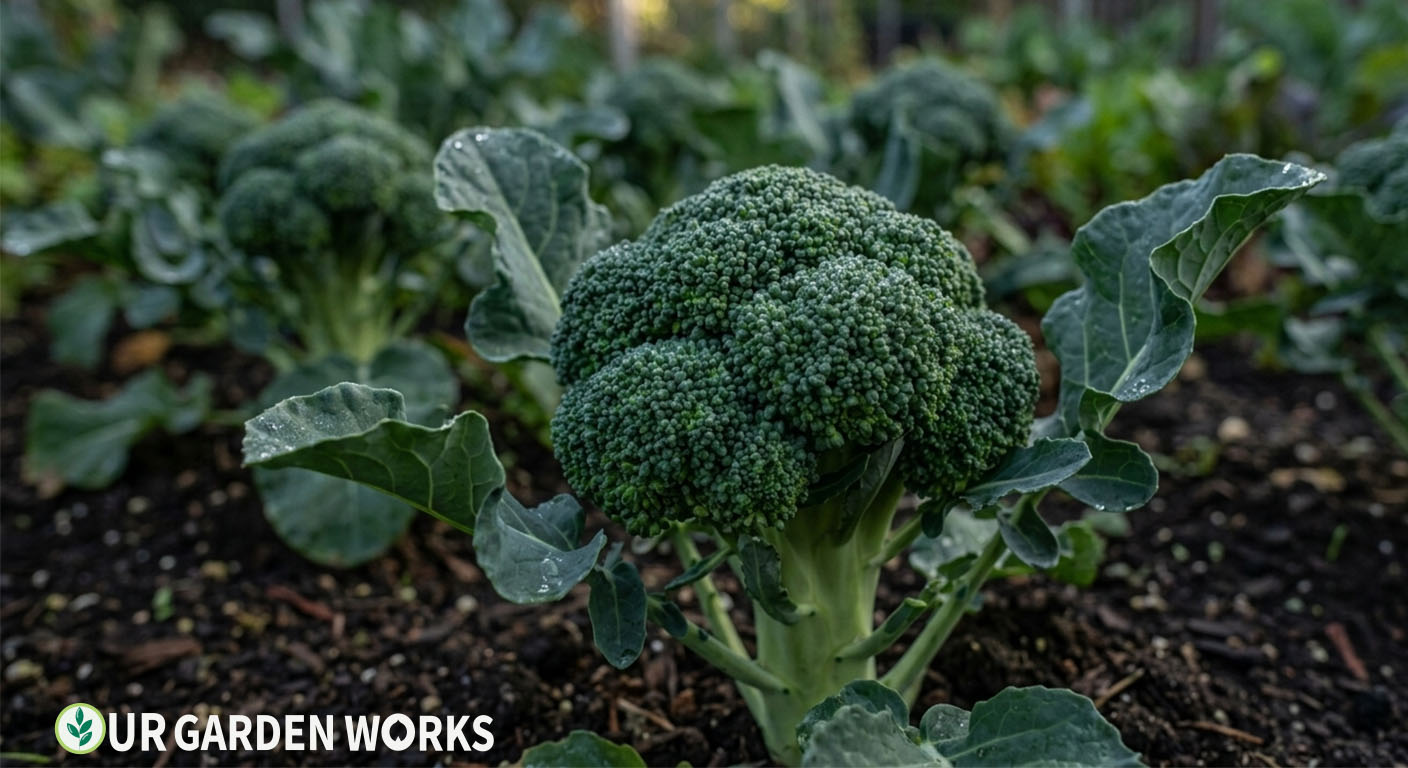
Broccoli has a narrow harvest window — maybe 3–5 days between “perfect” and “flowering.” Miss it and you’ll find yellow flowers where a firm green head used to be. Get it right and you can have fresh broccoli from one plant for weeks, because after the main head comes a flush of smaller side shoots that keep producing until frost.
In this guide, we’ll walk you through the exact signs that tell you broccoli is ready, what happens if you wait too long, and the cutting technique that triggers that second flush of side shoots.
When to Harvest Broccoli – Quick Answer: Harvest broccoli when the head is 3–8 inches across, deep green, and the individual beads (florets) are tightly closed. Do not wait for it to turn darker or larger — once beads start to loosen or yellow tinting appears, harvest immediately. Cut on a diagonal 5–6 inches below the head.
Why the Harvest Window Is So Narrow
That broccoli head sitting in your garden isn’t a static structure waiting patiently for you to notice it — it’s a tightly packed cluster of immature flower buds, and the plant’s entire biological purpose is to open those buds into flowers and set seed as quickly as conditions allow.
Every bead you see is a future yellow flower, compressed and held shut for only as long as the plant’s hormonal signals tell it to wait.
Once a head reaches its genetically programmed size for that variety, the plant has essentially finished the “build” phase and shifts into the “bloom” phase.
This transition isn’t gradual — it’s closer to a switch flipping, which is exactly why a head can look perfect on Tuesday and show visible yellow streaks by Friday. Warm temperatures accelerate this shift dramatically, since the enzymatic processes driving flower opening simply run faster in heat.
This is also why fall-grown broccoli, maturing into cooling temperatures rather than warming ones, tends to give you a noticeably more forgiving harvest window than a spring crop racing the arrival of summer.
Day length plays a supporting role too — broccoli, like many brassicas, is somewhat sensitive to the longer daylight hours of late spring and early summer, which can nudge an already heat-stressed plant toward flowering even faster.
None of this means you need to track sunrise tables, but it does explain why the exact same variety, planted just a few weeks apart, can give you wildly different harvest windows depending on what the weather happened to do that particular season.
What to Look For: The Broccoli Harvest Checklist
- Size: Main head has reached 3–8 inches across (varies by variety — check your seed packet)
- Color: Deep, uniform blue-green. Any yellowing = it’s already going to seed
- Bead texture: Tightly closed, like a fist. If you can see gaps between individual florets, harvest today
- Feel: Firm and dense when you press it gently. Soft = past peak
- Temperature cue: Broccoli bolts faster in warm weather — check daily once heads begin forming in summer
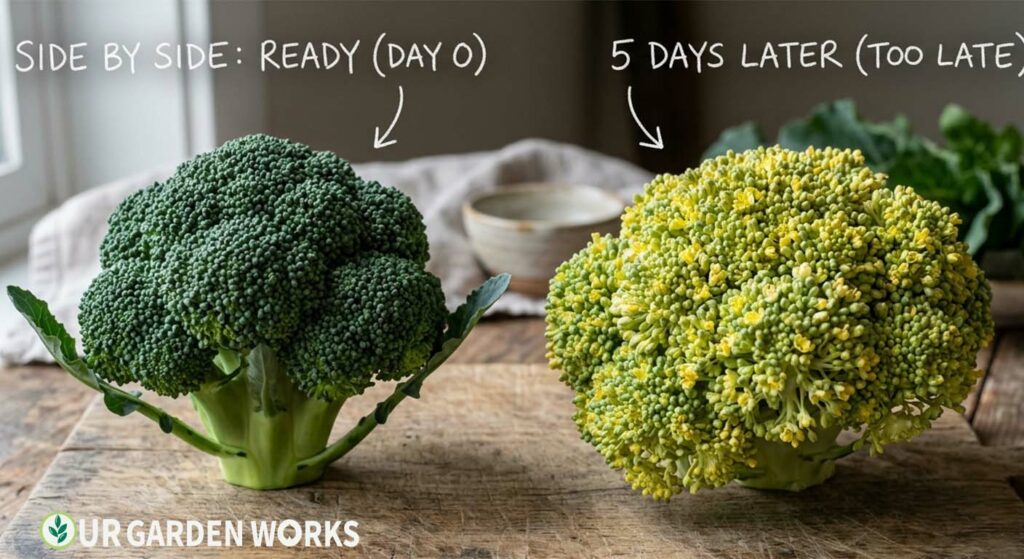
💡 Check every morning
Once a broccoli head reaches harvest size, check it every single day. In warm weather (above 75°F), a head can go from perfect to flowering in 48 hours. Don’t skip garden checks during hot spells.
Our harvest countdown calendar tracks days-to-harvest for broccoli alongside everything else you’re growing, so you get a clear warning as the window approaches instead of relying purely on memory.
How to Cut Broccoli to Encourage Side Shoots
Directions
- Use sharp, clean pruning shears or a knife. Dull tools crush the stem and slow regrowth.
- Cut the main stem on a diagonal angle, 5–6 inches below the head. The diagonal cut prevents water from pooling on the cut surface and causing rot.
- Leave the outer leaves and lower stem intact — this is where side shoot production comes from.
- After the main head is cut, continue watering and feeding the plant normally.
- Within 1–3 weeks, side shoots will begin emerging from the leaf axils along the remaining stem. Harvest these when they reach 2–3 inches across — before beads loosen.
A well-managed broccoli plant can produce side shoots for 4–8 additional weeks after the main head harvest. This doubles or triples your total yield from the same plant.
Why Cutting the Main Head Triggers Side Shoots at All
This isn’t a trick or a special technique — it’s basic plant hormone biology working in your favor.
The main, central head exerts what’s called apical dominance over the rest of the plant: as long as it’s intact and developing, it suppresses growth at the lower leaf axils by monopolizing the plant’s auxin hormone supply.
The moment you remove that main head, the suppression lifts, and dormant buds along the stem that had been waiting in the wings suddenly receive the hormonal green light to start developing into their own smaller flower heads.
This is the exact same mechanism gardeners exploit when pinching the growing tip off a tomato sucker or a basil plant to force bushier side growth — removing the dominant growth point redirects the plant’s resources outward and downward.
The practical upshot for broccoli is that a single well-tended plant, harvested correctly at the main head and then left with its leaves and lower stem intact, behaves almost like several smaller broccoli plants growing in succession from the same root system.
Continuing to water and feed the plant normally after the main harvest matters more than most gardeners assume — a plant that’s allowed to dry out or go hungry right when it should be redirecting energy into side shoots often produces a noticeably weaker second flush than one that receives steady care straight through.
What Happens If You Harvest Too Late
If the beads loosen and yellow flowers open, the plant has bolted. The head is no longer good for eating as fresh broccoli — it’s bitter and tough.
However, the plant can still produce usable side shoots below the flowering area. Cut the main stem below the bolted section, let the side shoots develop, and harvest those before they bolt too.
Preventing “Buttoning” Before It Starts
Buttoning — when a plant produces a tiny, premature head and rushes straight to flowering instead of building a full-sized one — is essentially the plant deciding it’s under enough stress that it should reproduce immediately rather than invest further in growth.
Heat stress, drought, root disturbance from transplanting too late or too roughly, and nutrient deficiency in the early seedling stage are the most common triggers.
The fix is almost entirely preventive rather than something you can correct once buttoning has started. Start broccoli early enough that it matures before serious summer heat arrives, transplant seedlings while they’re still small (4–6 true leaves) to minimize root shock, and keep soil consistently moist rather than letting it swing between dry and saturated during the critical early growth period.
Our garden planting calendar can generate the right transplant window for broccoli based on your zip code, which takes the guesswork out of “early enough.”
A plant that experiences a setback severe enough to button rarely recovers to produce a normal-sized head — at that point, the most productive move is usually to let it run its course and focus on a better-timed planting next season, taking note of exactly when the stress occurred so you can adjust timing accordingly.
Storing Broccoli After Harvest
Broccoli loses sugar content and crispness quickly once cut, so getting it cool fast matters more than it does for many other vegetables. Harvest in the early morning when temperatures are coolest and the head is most hydrated, then refrigerate within an hour if possible.
Don’t wash heads before storing — moisture trapped against the beads accelerates yellowing and rot. Store unwashed in a perforated bag in the crisper drawer, where it keeps well for 5–7 days.
For longer storage, broccoli freezes well after a brief blanch (2–3 minutes in boiling water, then an immediate ice bath to stop the cooking).
Blanching deactivates the enzymes that would otherwise continue breaking down the broccoli’s texture and flavor in the freezer, so don’t skip this step even though it adds an extra task between harvest and the freezer bag.
Broccoli also pickles and ferments well if you find yourself with a sudden surplus from several side-shoot harvests landing close together — a quick vinegar brine on small florets preserves both texture and the slightly peppery bite raw broccoli has, in a way that cooking tends to mute.
Frequently Asked Questions
Can I eat broccoli after it flowers?
The yellow flowers are edible — they’re just past their best texture for fresh eating. You can add them to stir-fries or soups where appearance matters less. The leaves are also edible and nutritious at any stage.
My broccoli heads are small and immediately flowering — why?
This is called “buttoning” — plants stressed by heat, drought, or root disturbance produce tiny heads and rush to seed. Broccoli is a cool-season crop and struggles above 80°F. Plant earlier in spring or as a fall crop for larger, slower-developing heads.
How do I know if broccoli side shoots are ready?
Same rules as the main head — tightly closed beads, dark green color, firm texture. Side shoots are typically ready 1–2 weeks after the main harvest. Check every 2 days once you see them developing.
Should I remove leaves to encourage side shoot growth?
No — leave the leaves in place. They’re actively photosynthesizing and feeding the energy that side shoots need to develop. Only remove leaves that are clearly yellowed, damaged, or diseased, and even then, just the individual leaf rather than a wider trim around it.
Does variety affect how many side shoots I'll get?
Yes, significantly. Some varieties (often labeled “sprouting” or “spear” broccoli) are bred specifically to produce abundant, vigorous side shoots after the main harvest, while others bred for a single large head produce comparatively few. If continuous harvest matters to you, check the variety description before planting rather than assuming all broccoli performs the same way after cutting.
Related Articles in Our Vegetable Gardening Guide
- How to Grow Broccoli: Timing, Side Shoots & Harvesting Right (2026)
- How To Grow Broccolini In Your Vegetable Garden At Home
- Growing Broccolini From Seed: A Step-By-Step Guide
- When to Harvest Lettuce — Cut-and-Come-Again vs. Full Head Harvesting
- Tomato Varieties Guide — Best Types for Every Garden (2026)
- Vegetable Gardening Guide
Free Tools to Time Your Harvest
Final Thoughts
We hope this guide means you never miss a broccoli harvest window again. That tight 3–5 day window between perfect and flowering is the whole game — check daily and you’ll get it right every time. For all our vegetable growing guides, our vegetable gardening guide links to everything.
Share this post with a fellow gardener who’s ready to get growing — and let us know in the comments whether you’ve successfully kept a plant producing side shoots all season. Happy growing!
