

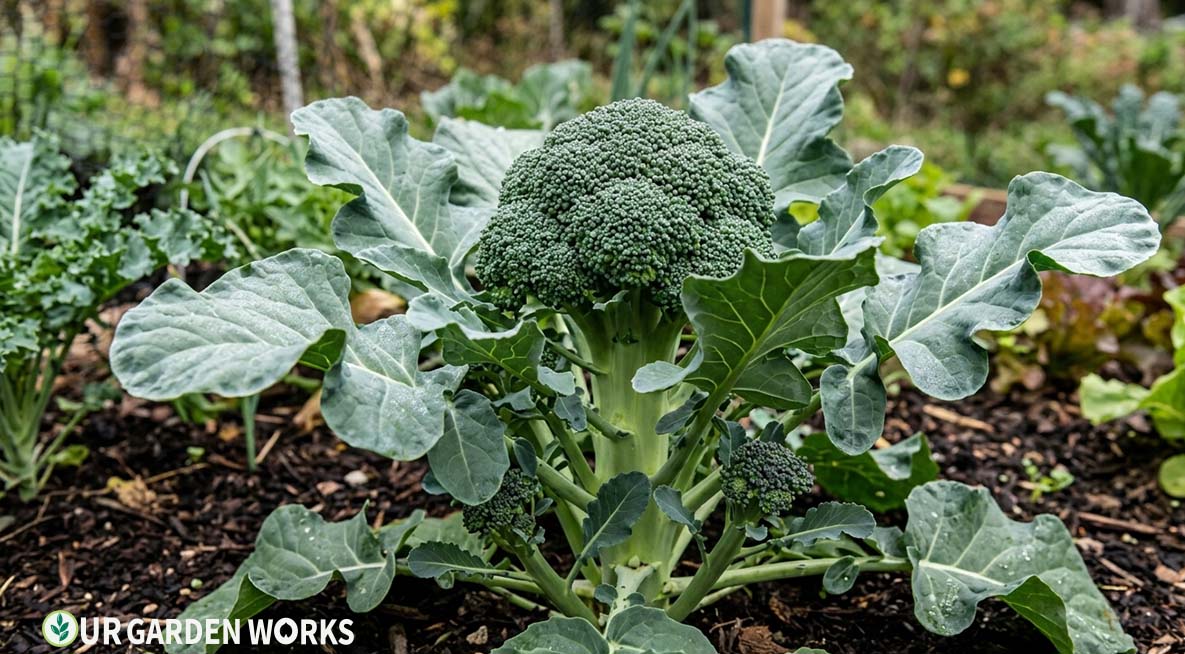
Broccoli is a cool-season crop with a reputation for being fussy about timing — and honestly, that reputation is earned. Plant it in the wrong window and it either buttons (produces tiny premature heads) or bolts to seed before the head ever develops properly.
But nail the timing? You get one of the most productive crops in the garden, with a main head harvest followed by weeks of side shoot production from a single plant.
The side shoot harvest is what most people don’t know about — and it’s what makes broccoli genuinely worth growing at home.
Once you cut the main head, the plant redirects energy into a dozen smaller side shoots, each producing a mini broccoli floret over the following 4–6 weeks. You’ll be harvesting long after a grocery store broccoli would have been composted.
How to Grow Broccoli: Transplant broccoli starts outdoors 3–4 weeks before last frost (spring crop) or 6–8 weeks before first frost (fall crop — usually better). It needs daytime temps of 65–75°F for proper head development. Harvest the main head when florets are tight and dark green, before any yellowing. Cut at an angle to encourage side shoot production.
Why Fall Broccoli Often Outperforms Spring Broccoli
Most new vegetable gardeners default to spring planting for everything, simply because that’s when the gardening season feels like it begins.
Broccoli is one of the clearest exceptions to that instinct. A spring crop has to race against rising temperatures — the window between “soil warm enough to transplant” and “too hot for proper head development” can be uncomfortably narrow, especially in regions where spring shifts quickly into summer heat.
A fall crop flips that pressure entirely in your favor. You transplant into warm late-summer soil, and the plant develops its head as temperatures are cooling rather than climbing.
Cooler conditions during head formation produce tighter, denser florets and a noticeably sweeter flavor, since broccoli — like many brassicas — responds to cool weather by concentrating sugars rather than developing the slightly bitter, sometimes woody quality that heat-stressed heads can have.
If you’ve only ever grown spring broccoli and found the results underwhelming, a fall crop is worth trying before giving up on the vegetable entirely.
Choosing Your Broccoli Variety
| Variety | Days to Harvest | Notes |
|---|---|---|
| Calabrese (Green Sprouting) | 58–65 days | The classic type; excellent side shoot production after main head |
| Belstar | 65 days | Exceptional side shoot producer; top home garden variety |
| Waltham 29 | 74 days | Heirloom; very cold-hardy; excellent fall variety |
| DiCicco | 48 days | Fast-maturing heirloom; continuous side shoots; heat-tolerant |
| Romanesco | 70–100 days | Stunning fractal head; nutty flavor; longer growing window |
Belstar is the single best home garden broccoli we know of — it’s reliable, produces a large main head, and then keeps producing quality side shoots for 6+ weeks. It’s a hybrid with good disease resistance and wide climate adaptability. Start here.
How to Grow Broccoli: Step by Step
Step 1 — Start Indoors (Spring Crop) or Direct Sow (Fall Crop)
Spring crop: Start seeds indoors 5–7 weeks before your last frost date. Broccoli transplants outdoors 3–4 weeks before last frost — it’s one of the cold-hardiest transplants you’ll grow. Frost is fine; hard freezes damage it.
Fall crop: Direct sow or transplant 6–8 weeks before your first expected fall frost. This is often the better crop — broccoli heads develop in cooling temperatures, which produces tighter, more flavorful heads and avoids the bolting pressure of spring. Count back from your first frost date and sow accordingly.
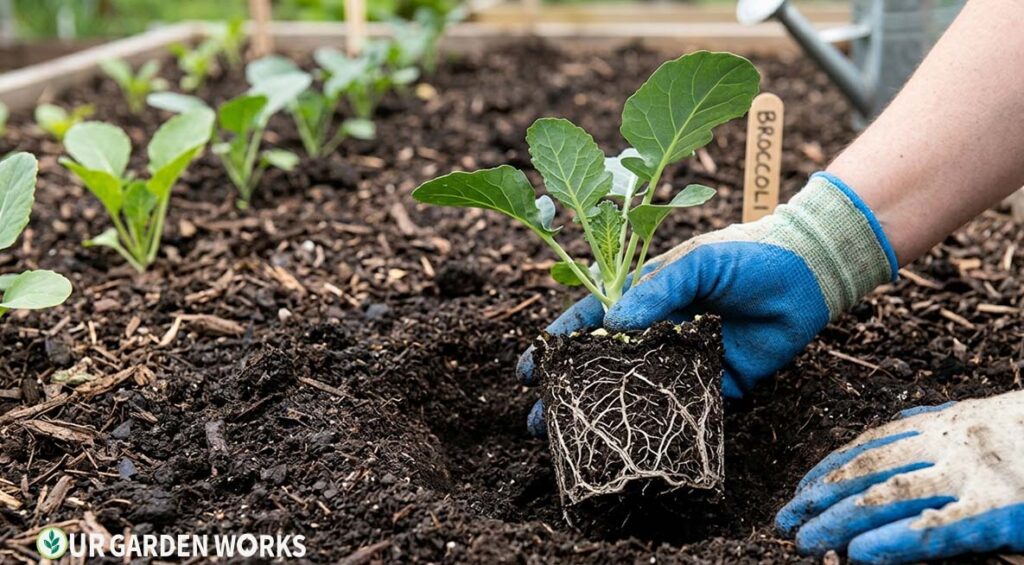
Transplanting Directions
- Transplant seedlings into prepared beds when they’re 3–4 inches tall with 2–3 true leaves.
- Space 18–24 inches apart in rows 24–36 inches apart. Broccoli is larger than it looks in a seedling tray.
- Work compost and balanced fertilizer into each planting hole.
- Plant slightly deeper than the seedling was in its pot — a slightly buried stem develops additional roots.
- Water immediately. Keep soil consistently moist for the first week while roots establish.
Step 2 — Watering and Fertilizing
Watering: 1–1.5 inches per week, consistently. Broccoli heads are primarily water — irregular watering during head development produces hollow, open heads with poor density. Keep soil evenly moist through the full growing season.
Try our free tool: Garden Watering Calculator — How Much Water Your Crops Actually Need
Fertilizing: Broccoli is a heavy nitrogen feeder. Apply a nitrogen-rich fertilizer (21-0-0 or 10-10-10) 3–4 weeks after transplanting and again when you see the first head beginning to form. Consistent feeding = tight, dark green, productive heads.
Try our free tool: Fertilizer Calculator – How Much Fertilizer to Apply (By Crop & Bed Size)
Step 3 — Watch for Heading (and Don’t Wait)
Broccoli heads develop fast — a head that looks 2 weeks away can be ready in 5 days in warm weather. Check plants daily once you see any sign of head formation.
Harvest before you see any yellowing (yellowing = florets are beginning to open, flavor declines rapidly) and before the head becomes dome-shaped and loose. The ideal is tight, deep green, slightly domed, still compact.
Step 4 — Harvest for Side Shoots (The Extended Payoff)
Cut the main head with a sharp knife, making an angled cut on the stem about 5–6 inches below the head. The angle allows water to run off and reduces rot on the stump.
Within 1–2 weeks, you’ll see side shoots emerging along the stem. These produce smaller but perfectly edible florets — harvest them at 2–4 inches when still tight. One plant can produce side shoots for 4–6 weeks after the main head is cut. See our dedicated when to harvest broccoli guide for detailed timing.
⚠️ Buttoning — what it is and how to prevent it
Buttoning is when broccoli produces a tiny premature head (sometimes the size of a quarter) instead of a normal-sized one. It’s caused by cold stress — transplants exposed to extended temperatures below 40°F for several weeks may be triggered into early heading. Prevent it by hardening off properly before transplanting and not putting plants out too early in cold climates.
Common Broccoli Problems Beyond Pests
Loose, “ricey” heads where the individual florets look open and grainy rather than tight and uniform almost always trace back to a stretch of unusually warm weather during head formation, sometimes combined with inconsistent watering.
There’s not much to be done once a head has already gone loose — harvest and use it, since the flavor is still fine even if the texture is past its prime, and adjust your planting date earlier or later next season to avoid the same heat window.
Bolting — where the plant skips straight to flowering without forming a usable head — is almost always a timing problem rather than a care problem. It happens when broccoli experiences a prolonged cold spell as a young transplant, which can trick the plant into behaving as though it’s already been through a full winter and is ready to flower.
This is more common with spring crops planted too early than with fall crops, which is one more reason fall planting tends to be the more forgiving choice for less experienced growers.
Frequently Asked Questions
Why is my broccoli turning yellow?
from a slightly loose appearance to fully open flowers within 2–4 days in warm weather. Yellowed broccoli is still edible but noticeably less flavorful and more fibrous. Taste one to decide if it’s worth using.
Can I grow broccoli in pots?
2 weeks. Container broccoli works best for compact varieties (Di Cicco) or as a fall container crop on a patio that gets full sun and cool fall temperatures.
What's eating holes in my broccoli leaves?
Almost certainly cabbage worms (white butterfly caterpillars) or cabbage loopers (green caterpillars). Both are brassica pests. Check the underside of leaves and hand-pick, or spray with Bt (Bacillus thuringiensis) — it’s organic, kills caterpillars only, and safe for pollinators. Row covers prevent them entirely when installed at planting.
How many broccoli plants should I grow for a family of four?
Plan for 6–8 plants if you want a meaningful main head harvest plus several weeks of side shoots for fresh eating. If you’re hoping to freeze some for winter use, 12–16 plants gives a more substantial surplus.
Because each plant keeps producing side shoots for weeks after the main head is cut, broccoli delivers more total food per plant over a season than its single-harvest reputation suggests.
Related Articles in Our Vegetable Gardening Guide
Final Thoughts
We hope this guide has solved the timing puzzle that makes broccoli so rewarding when it works — and the side shoot harvest alone makes it worth growing every year. For all our vegetable growing articles, our vegetable gardening guide links to everything.
Share this post with a fellow gardener who’s ready to grow their own — and let us know in the comments whether you’re growing a spring or fall crop this year. Happy growing!
