
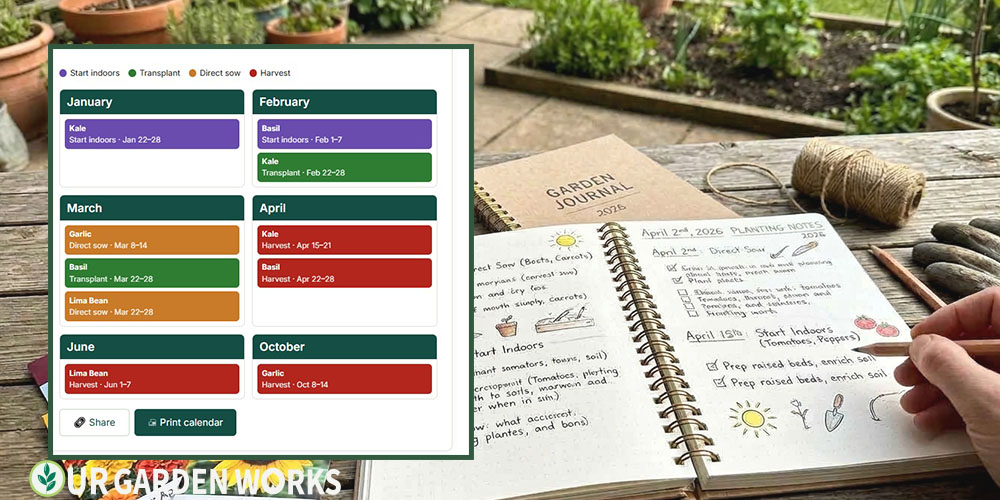
A planting calendar is the document that turns all of your garden intentions into actual, time-stamped actions.
You know you want to grow tomatoes, peppers, kale, beans, and basil. But when does the tomato go in? When does the kale go out? When do you direct sow the beans? Without a calendar, these decisions happen reactively — you walk into the garden center in May and buy whatever’s available rather than having what you planned.
The calendar above builds your personal month-by-month planting schedule based on your ZIP code and the crops you select. It accounts for your local frost dates, each crop’s specific timing requirements, and the full growing season from first indoor sowing through fall harvest.
Below, we explain how to read your results and how to build the seasonal gardening rhythm that experienced gardeners develop over years.
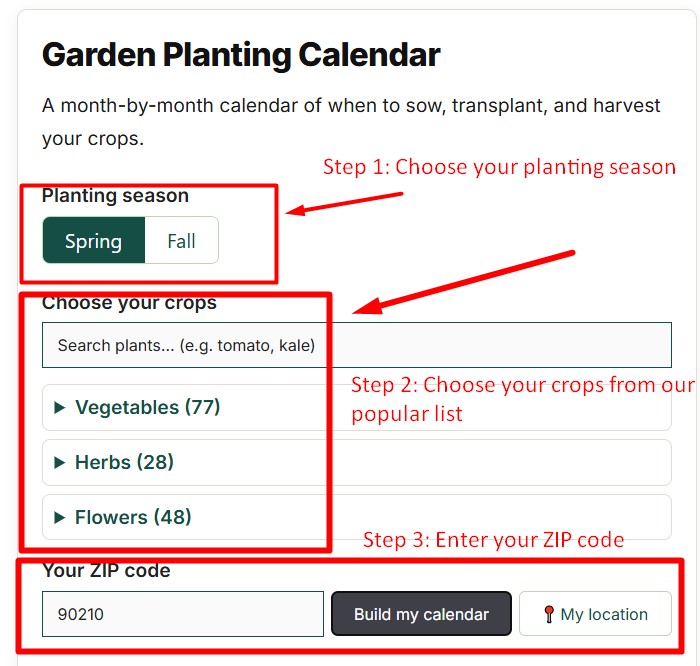
How to use OGW Vegetable Planting Calendar : (1) Select Planting season, (2) select from our list or add the crops you’re growing, (3) Enter your ZIP code and the calendar generates a month-by-month planting schedule customized to your location — covering indoor seed starting, outdoor transplanting, direct sowing, and fall planting dates for every crop you select.
How to Read Your Planting Calendar
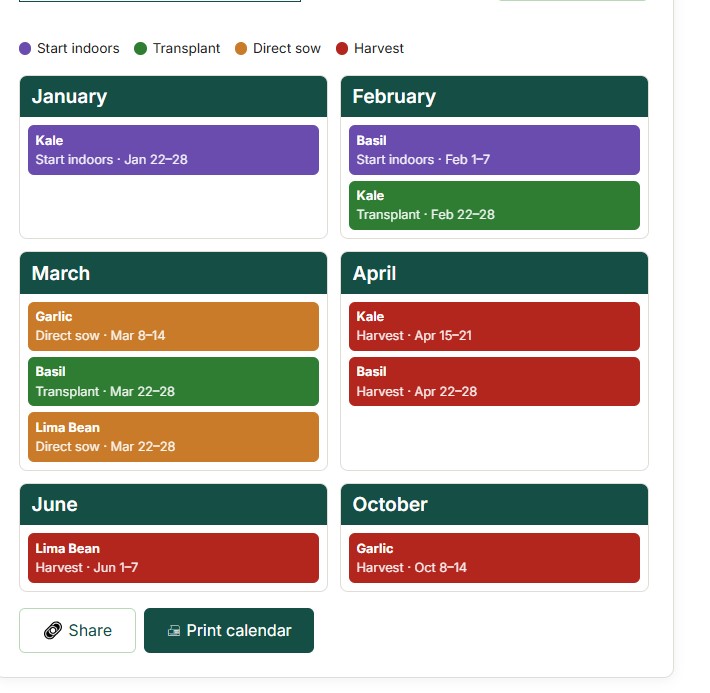
Your calendar organizes tasks by month. Each month shows you what action to take for which crop — and why that timing is right for your location. There are four types of tasks you’ll see:
| Task Type | What It Means | Example |
|---|---|---|
| Start indoors | Sow seeds in trays under grow lights in a warm indoor location | “Start tomatoes indoors” — Feb 15 for a Zone 6 gardener |
| Transplant outside | Move hardened-off seedlings from indoors to the garden or containers | “Transplant tomatoes outdoors” — May 1 for a Zone 6 gardener |
| Direct sow | Plant seeds directly in the garden soil — no indoor starting | “Direct sow beans” — May 15 after last frost |
| Start for fall | Start cool-season crops in late summer for fall and early winter harvest | “Start kale for fall” — July 15 for a Zone 6 gardener |
The Two Growing Seasons Your Calendar Plans For
Most gardeners think of one growing season — spring planting through summer harvest. But a productive vegetable garden actually has two growing seasons, and your planting calendar covers both:
Season 1 — Spring to Summer
Starting in late winter/early spring with indoor seed starting and running through the heat of summer. This is the warm-season garden: tomatoes, peppers, cucumbers, beans, zucchini, basil. The calendar starts this season with indoor sowing dates and carries through transplanting and direct sowing outdoors.
Season 2 — Late Summer to Fall (and Winter in Mild Climates)
The fall garden is planted in late summer when most gardeners have mentally checked out for the year. Cool-season crops — kale, spinach, broccoli, lettuce, arugula — planted in late July and August produce through fall and even into early winter in many climates. Some of the best vegetable growing of the year happens in this window, and it’s almost entirely unused by beginner gardeners.
Your calendar will show fall planting dates if you select cool-season crops.
💡 The most missed planting window in home gardens
Late July and August for fall crops. By the time most gardeners realize they could be starting broccoli or kale for fall, the window has passed. Set a reminder in your phone for July 15 that simply says “Start fall garden — kale, spinach, broccoli.” That one reminder produces vegetables most of your gardening neighbors don’t even know they could be growing.
What a Full-Season Calendar Looks Like — Zone 6 Example
Here’s what a productive Zone 6 garden calendar looks like across a full year, to help you understand the rhythm your calendar is building toward:
| Month | Key Tasks |
|---|---|
| January | Order seeds. Start onions and leeks indoors (early Jan). Review previous year’s notes. |
| February | Start peppers and eggplant (early Feb). Start tomatoes (late Feb). Set up grow lights. |
| March | Start broccoli, cabbage, kale, lettuce. Pot up pepper seedlings. Begin hardening off broccoli/kale by late March. |
| April | Transplant broccoli, kale, lettuce outdoors (frost-tolerant). Start cucumbers and squash indoors (late April). Direct sow peas, spinach. |
| May | Last frost ~April 15. Transplant tomatoes and peppers (early May, after hardening). Direct sow beans, carrots, beets. Transplant cucumbers. |
| June | Direct sow succession beans and lettuce. Plant out basil. First tomato harvest (cherry types). Harvest broccoli heads and side shoots. |
| July | Succession sow lettuce, radishes, beans. Start kale, broccoli, spinach indoors for fall crop (mid July). |
| August | Transplant fall kale and broccoli outdoors. Direct sow fall spinach, lettuce, arugula. Harvest garlic. Peak tomato and pepper season. |
| September | First fall frost ~Oct 15. Begin harvesting fall crops. Plant garlic and overwintering onions. Collect tomato seeds from best plants. |
| October | Harvest everything tender before first frost. Cover kale and spinach with row covers for extended harvest. Pull tomato stakes and cages. |
| November | Harvest kale and spinach under row cover. Plant garlic (if not done). Spread compost over empty beds. Clean and store tools. |
| December | Harvest kale (frost sweetens it). Review the year. Order next year’s seeds before the January rush depletes popular varieties. |
How to Use Succession Planting in Your Calendar
One of the most valuable things a planting calendar enables is succession planting — sowing the same crop at 2–3 week intervals so you have plants maturing continuously rather than all at once. Your calendar can be extended to show multiple sowing dates for fast-turnover crops.
The crops that benefit most from succession planting:
- Lettuce and salad greens: Every 2–3 weeks from early spring through May, then again from August through September
- Radishes: Every 2 weeks — they mature in 25 days and go bitter quickly
- Bush beans: Every 3 weeks from last frost through mid July
- Cilantro: Every 2–3 weeks — it bolts fast and succession is the only way to have it consistently
Turning Your Calendar into a Garden Journal
The most useful thing you can do with your planting calendar is add a notes column and keep it year after year. Record actual planting dates, actual last frost, weather notes, variety performance, and what you’d change. After 3 seasons, your personal calendar becomes more accurate than any app — because it reflects your specific garden, your specific microclimate, and your specific growing conditions.
Things worth recording alongside each calendar date:
- Actual date you planted vs. planned date — and why they differed
- Soil temperature on transplant day
- First harvest date for each crop
- Pest or disease problems and when they appeared
- Varieties you’ll grow again vs. ones to skip
Frequently Asked Questions
What's the difference between the planting calendar and the seed starting calculator?
The seed starting calculator focuses specifically on indoor seed starting — when to start each crop inside and when to transplant it outside. The planting calendar is a broader month-by-month view of your entire growing season — covering indoor starts, transplanting, direct sowing, fall planting, and harvest windows all in one place. Both tools use the same underlying frost date data for your location.
My planting calendar shows different dates from what I've used in past years — which should I trust?
Your personal records are valuable. If you’ve been gardening in the same location for 3+ years and your actual last frost consistently differs from the published date, trust your records for that adjustment. Use the calendar as the framework and your experience as the fine-tuning. The two together are more useful than either alone.
Can I print my planting calendar?
Yes — just press the “Print Calendar” button, your browser’s print function (Ctrl+P or Cmd+P) will pop up, and it will format for printing. A printed calendar posted in your potting shed or taped inside your seed storage box keeps planting dates visible when you’re actually working in the garden — which is more useful than a digital version you have to look up on your phone.
Should I adjust my calendar dates for raised beds?
Raised beds warm earlier in spring than in-ground beds — typically 2–4 weeks faster, depending on bed height and material. If your main growing area is raised beds, you may find you can transplant 1–2 weeks earlier than the calendar suggests and your soil temperature reaches the target faster in spring. A soil thermometer confirms when your specific raised beds are actually ready.
Final Thoughts
We hope your personalized planting calendar takes the guesswork out of the entire growing season and replaces it with a clear, time-specific plan that actually matches your garden’s reality. The gardeners we know who get the most from their growing space aren’t necessarily the most experienced — they’re the most organized.
And a good planting calendar is where that organization starts. For all our vegetable growing guides organized by crop like tomato, our vegetable gardening guide is the next place to go.
Share the calendar with a fellow gardener who’s always feeling a step behind their planting schedule — and let us know in the comments which season you find hardest to plan. Happy growing!
