
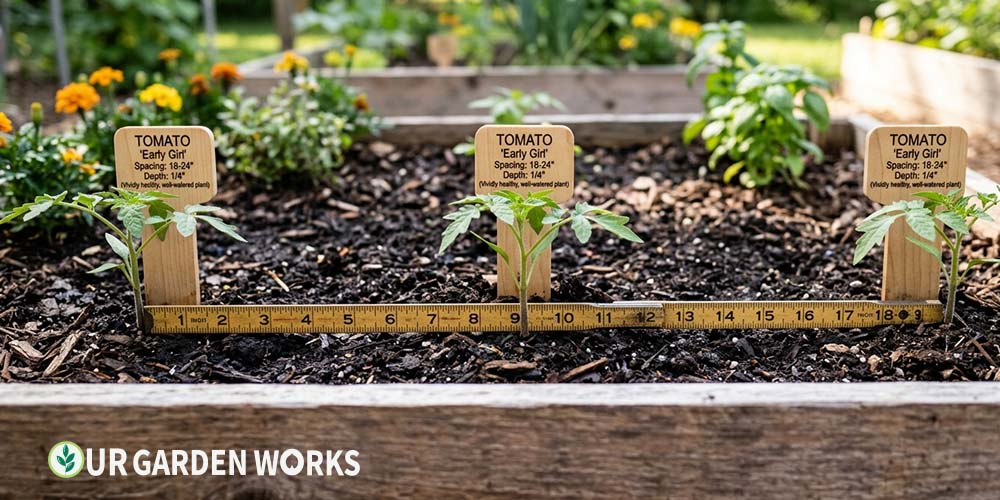
(Enter your bed length and width in feet, then select your crop. The calculator shows how many plants fit using square foot garden spacing versus traditional row spacing — and why the difference matters for your yield.)
Plant spacing determines yield more directly than almost any other single garden decision.
Too close and plants compete for light, water, and nutrients — you get half the harvest per plant with twice the disease pressure.
Too far apart and you waste productive space and give weeds exactly the light and air they need to establish. Getting spacing right is not guesswork; it’s a formula based on the mature diameter of each plant.
Editor’s Note: Square foot gardening spacing fills bed space 30–50% more efficiently than traditional row spacing, because row spacing was designed for tractor cultivation — not hand-tended raised beds. A 4×8 bed planted in rows can hold 32 lettuce plants; the same bed planted in the square foot pattern holds 128. Use the calculator to compare both methods for your specific crop.
Square Foot vs Row Spacing — The Numbers
Traditional row spacing places plants at the correct distance within the row but then leaves 18–36 inches between rows for foot traffic and equipment. In a raised bed where you access plants from the sides, those row aisles are completely wasted space. Square foot gardening eliminates those aisles and places plants at their correct in-row distance in every direction — turning a 2D line of plants into a 2D grid of plants.
| Crop | Sq Ft Spacing | Per 4×8 Bed (SFG) | Row Spacing | Per 4×8 Bed (Rows) |
|---|---|---|---|---|
| Lettuce | 4 per sq ft | 128 plants | 8″ apart, 12″ rows | 48 plants |
| Spinach | 9 per sq ft | 288 plants | 3″ apart, 12″ rows | 128 plants |
| Carrots | 16 per sq ft | 512 plants | 2″ apart, 12″ rows | 192 plants |
| Bush beans | 9 per sq ft | 288 plants | 4″ apart, 18″ rows | 128 plants |
| Peppers | 1 per sq ft | 32 plants | 12″ apart, 24″ rows | 16 plants |
| Tomatoes | 1 per 4 sq ft | 8 plants | 24″ apart, 36″ rows | 4 plants |
For planning a full bed layout with multiple crops using these spacing standards, our vegetable garden planner applies these numbers automatically and shows you an optimised layout.
Spacing Rules for Special Situations
Container growing: Use the wider end of the spacing range — containers heat up faster and have less moisture buffer than in-ground or raised beds. Competition in a container is more intense than in open soil. Choose compact or dwarf varieties where spacing choices are available.
Vertical growing: Crops trained vertically — cucumbers, pole beans, peas, small-fruited squash — can be spaced as close as 6 inches in the row because their canopy grows up rather than out. A trellis at the back of a 4-foot-wide bed with cucumbers planted at 6-inch spacing holds 8 plants while using less than one square foot of floor space each.
Succession planting: If you plan to succession sow — planting the same crop every 2–3 weeks for a continuous harvest — leave the same physical spacing but stagger the planting dates rather than the positions. Our seed starting calculator can help time each succession sowing from your frost dates.
After transplanting from seed: Seeds can be sown more densely than final spacing, then thinned after germination. Carrots, beets, and lettuce are sown thickly and thinned to final spacing — the thinnings are edible seedlings. Never leave plants at germination density through to harvest — the yield loss from crowding is significant.
Frequently Asked Questions
What happens if I plant too close together?
The effects of overcrowding compound over the season: initial competition for light reduces photosynthesis and slows growth. Poor air circulation between crowded plants dramatically increases fungal disease pressure — powdery mildew, blight, and botrytis spread fastest in dense plantings.
By harvest, overcrowded fruiting plants produce smaller fruit and lower total yield than properly spaced plants, even though there are more of them. More plants does not mean more harvest when spacing is wrong.
Do I need to follow spacing exactly, or is close enough acceptable?
The listed spacing is the minimum for healthy plants at maturity. You can plant somewhat closer than recommended in very fertile, deeply amended soil where nutrient and water competition are reduced.
You should never plant closer than 50% of the recommended spacing — that is the threshold where air circulation becomes inadequate for disease prevention regardless of soil quality. Erring toward slightly more space than recommended always outperforms erring toward less.
Free Tools & Guides:
Final Thoughts
We hope this calculator gives you a clear picture of exactly how productive your space can be when spacing is used efficiently.
The difference between traditional row spacing and square foot spacing in a raised bed is genuinely surprising the first time you see the numbers. For a full layout plan using these spacing values, our vegetable garden planner takes your bed dimensions and crop list and puts it all together.
Share this free tool with a fellow gardener who spends the spring cramming transplants in wherever they fit and then wonders why the bed is so chaotic by July — and tell us in the comments how it helped. Happy growing!
