
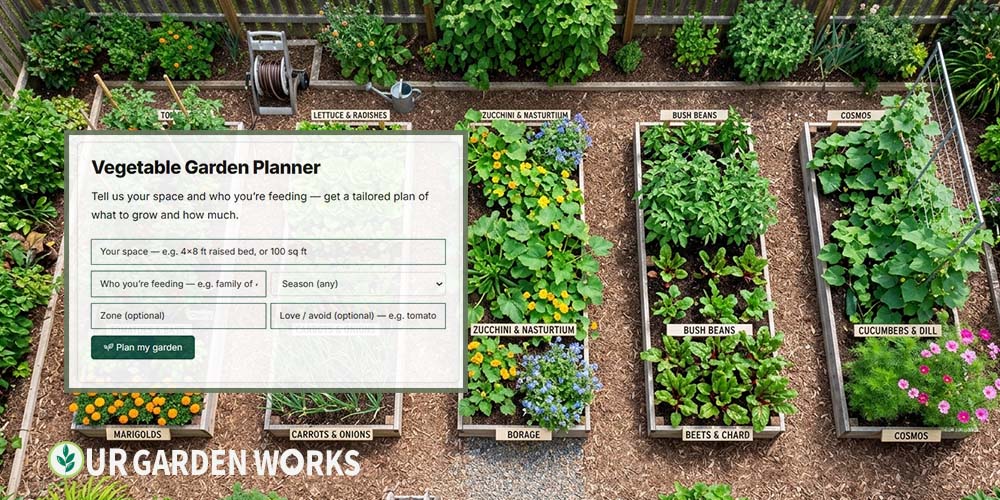
(Enter your bed dimensions and the crops you want to grow — the planner calculates exactly how many plants fit, the correct spacing for each crop, and companion plant suggestions for your layout.)
The most common vegetable garden mistake is not spacing plants too close together — it’s not knowing how close is too close in the first place. A tomato that needs 24 inches in every direction planted 12 inches from its neighbour will give you half the yield, twice the disease pressure, and a jungle that’s impossible to harvest from. Getting spacing right before you plant is the single highest-return planning decision in vegetable gardening.
Our free vegetable garden planner takes your bed dimensions and crop list and does the math for you — showing exactly how many plants fit using square foot spacing, where companion plants belong, and how to arrange crops by height so nothing shades out its neighbours.
Editor’s Note: Enter your bed length, width, and the crops you want to grow. The planner uses square foot gardening spacing standards — 1 plant per square foot for large plants like tomatoes and peppers, 4 per square foot for lettuce, 9 for spinach, 16 for carrots and radishes — to calculate exactly how many plants fit and suggest an efficient layout.
How Square Foot Spacing Works
Traditional row gardening was designed for tractors — not raised beds or home gardens. Square foot gardening, developed by Mel Bartholomew in the 1970s and refined ever since, uses each square foot of bed space as a planting unit. Instead of long rows with wide aisles, every inch of the bed grows food.
The spacing standards are based on the mature diameter of each plant. A tomato plant needs 24 inches in every direction at maturity — that’s a 4-square-foot footprint, so 1 tomato per 4 square feet. Lettuce matures at about 6 inches across, so 4 plants fit in 1 square foot. The planner applies these standards automatically for every crop in our database.
| Crop | Plants per Sq Ft | Spacing Between Plants | Notes |
|---|---|---|---|
| Tomatoes (indeterminate) | 0.25 (1 per 4 sq ft) | 24 inches | Need vertical support; most space-hungry crop |
| Tomatoes (determinate/bush) | 0.5 (1 per 2 sq ft) | 18 inches | Patio and container types |
| Peppers | 1 | 12 inches | Can be planted closer in mild climates |
| Eggplant | 1 | 12–18 inches | Needs good air circulation |
| Cucumbers (trellised) | 1 | 12 inches | Train vertically to save horizontal space |
| Zucchini | 0.25 (1 per 4 sq ft) | 24 inches | One plant produces more than most families need |
| Beans (bush) | 9 | 4 inches | Efficient space users; succession sow every 3 weeks |
| Lettuce | 4 | 6 inches | Harvest outer leaves; succession plant every 2 weeks |
| Spinach | 9 | 4 inches | Fast-growing; cut-and-come-again harvest |
| Carrots | 16 | 3 inches | Thin to final spacing after germination |
| Radishes | 16 | 3 inches | 25-day turnaround; excellent gap-filler |
| Kale | 1 | 12 inches | Harvest outer leaves for continuous production |
| Broccoli | 0.25 (1 per 4 sq ft) | 18–24 inches | Produces one main head then side shoots |
| Garlic | 4 | 6 inches | Plant in fall for summer harvest |
| Onions | 4–9 | 4–6 inches | Depends on desired bulb size |
Arranging Crops by Height — The Sun Rule
Tall crops shade shorter ones. In the northern hemisphere, the sun tracks across the southern sky — so tall plants on the north side of a bed cast shade toward the south, while tall plants on the south side shade everything behind them. The rule is simple: plant tallest crops on the north end of the bed, shortest on the south, with medium-height crops in between.
Tall (over 3 feet): indeterminate tomatoes, trellised cucumbers, pole beans, corn, sunflowers. Medium (1–3 feet): peppers, eggplant, kale, broccoli, chard. Short (under 12 inches): lettuce, spinach, radishes, carrots, herbs, strawberries.
💡 Trellis crops save horizontal space
Cucumbers, pole beans, peas, and small-fruited squash trained vertically on a trellis take a fraction of the horizontal space of sprawling crops. A 4-foot trellis at the north end of a 4×8 bed lets you grow 4–6 cucumber plants without stealing any bed space from the shorter crops in front.
Companion Planting Within Your Layout
Companion planting — placing plants that benefit each other as neighbours — works best when you plan it into your bed layout from the start, not as an afterthought. The most reliable in-bed companions are plants that do different things: a tall crop that provides afternoon shade for a heat-sensitive neighbour, a flowering herb that attracts beneficial insects, an allium that deters aphids from the crop next to it.
Three combinations that consistently pay off in a planned bed layout:
- Tomatoes + basil + marigolds: Classic combination — basil provides aromatic aphid deterrence, marigolds attract ladybugs and deter soil nematodes. All three have the same heat requirements and work in the same bed section.
- Beans + carrots: Beans fix nitrogen that carrots deplete. Carrots loosen the soil that benefits bean roots. They have similar space requirements and compatible harvest timing.
- Brassicas (broccoli/kale) + nasturtiums: Nasturtiums act as a trap crop for aphids — aphids colonise the nasturtiums rather than the brassicas, where they can be easily spotted and removed.
For the full companion planting reference, our companion planting chart covers every major vegetable combination. Our companion planting tool lets you enter your specific crop list and get personalised pairing recommendations.
Planning a Succession Planting Schedule in Your Layout
A well-planned bed layout isn’t static — it changes through the season as early crops are harvested and warm-season crops take their place. Building succession planting into your layout from the start means every square foot is always productive rather than sitting empty after a spring crop comes out.
The standard succession sequence for a 4×8 bed in most of the country: Cool-season crops (lettuce, spinach, radishes, peas) fill the bed from early spring until late May. When heat arrives and cool crops bolt, warm-season transplants (tomatoes, peppers, basil) go into the same beds. When the first fall frost approaches, cool crops go back in for a fall harvest.
For exact dates for each transition in your specific location, use our frost dates by ZIP code tool for your seasonal anchors and our Seed starting calculator for the indoor starting dates that get each planting ready at the right time.
Frequently Asked Questions
How many raised beds do I need to feed a family of four?
A productive kitchen garden for a family of four needs roughly 200 square feet of growing space — or five 4×8 raised beds planted intensively. This assumes you are growing a mix of high-yield crops (tomatoes, beans, lettuce, cucumbers) and practicing succession planting so the beds are productive from spring through fall. If you focus on high-value crops (those that are expensive to buy), you can do meaningful food production in 100 square feet or less.
Can I plant different crops in the same square foot?
Yes — this is called interplanting. Radishes, between slow-germinating carrots, use the space while carrots establish. Lettuce between tomato plants uses the shade cast by the tomatoes once summer arrives. Marigolds tucked into unused corners provide pest deterrence without taking productive space. The planner accounts for interplanting combinations and flags them where appropriate.
Does the spacing change for container gardens?
Container gardens follow the same spacing principles but need slightly more generous spacing than in-ground or raised bed gardens, because container soil heats up faster and dries out more quickly — crowded roots in a container compete more intensely for limited moisture. As a general rule, use the larger end of the spacing range for containers, and choose determinate or compact varieties that are specifically bred for container growing.
Free Tools & Guides:
Final Thoughts
We hope this planner takes the guesswork out of your layout and helps every square foot of your garden earn its keep this season.
A well-spaced, well-planned bed is genuinely one of the most rewarding things in gardening — everything is easier to water, harvest, and enjoy. For the complete vegetable gardening picture, our vegetable gardening guide links to every article we have published.
Share this free tool with a fellow gardener who spends every spring cramming too many plants into their beds and wonders why nothing produces the way they hoped — and leave a comment below telling us which crop you tried it on first. Happy growing!
