
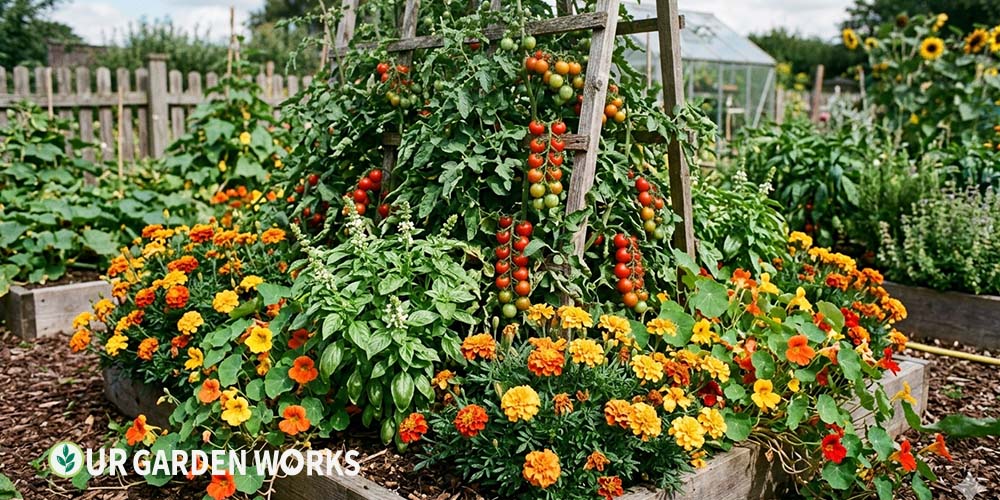
(Select a crop from the list — the tool shows you its best companion plants (and why they help), plants to avoid, and which pairings are most supported by evidence.)
Most companion planting advice lumps “good” and “bad” plant pairings together without explaining the mechanism behind them. That matters — because a pairing that works through aromatic pest deterrence needs to be close to be effective, while one that works through soil chemistry can work from several feet away. The more you understand why a pairing works, the better you can use it.
This tool gives you the what and the why for every pairing in our database — so you can make planting decisions with confidence rather than following a list blindly.
Editor’s Note: The most universally beneficial companion combinations: tomatoes + basil + marigolds, brassicas + nasturtiums (trap crop), beans + carrots (nitrogen + soil loosening), alliums (garlic, chives, onions) near roses and most brassicas. The key bad pairings to always avoid: fennel near almost everything, onions near beans and peas, potatoes near tomatoes (shared disease pressure).
How Companion Planting Actually Works — 4 Real Mechanisms
Not all companion planting claims are equal. Some are well-supported by observation and research; others are gardening folklore passed down without evidence. Here are the four mechanisms that consistently hold up:
1. Aromatic Confusion
Strongly scented plants interfere with the ability of pest insects to locate their host crops by smell. Basil near tomatoes, alliums near roses, and catmint near brassicas all work this way. For this mechanism to be effective, the aromatic plant must be physically close — within 12–18 inches — not just in the same bed.
2. Trap Cropping
Some plants are more attractive to specific pests than the crop you’re protecting. Nasturtiums attract aphids away from brassicas. Dill attracts tomato hornworm moths more than tomatoes do. The trap crop draws the pest in; you monitor it and intervene there rather than on your main crop.
3. Beneficial Insect Attraction
Flat-topped flowers — yarrow, dill when flowering, sweet alyssum, phacelia — are landing platforms for parasitic wasps, hoverflies, and ground beetles. These insects prey on aphids, caterpillars, and other soft-bodied pests. Planting these flowers near pest-prone crops creates a permanent beneficial insect habitat.
4. Soil Chemistry
Legumes (beans, peas, clover) fix atmospheric nitrogen into the soil through root-associated bacteria. Planting beans beside heavy nitrogen feeders like corn and brassicas provides a slow-release nitrogen supplement throughout the growing season. This works at a distance — the nitrogen is in the soil, not transferred above ground.
For a complete reference of which crops work best together and why, our companion planting chart maps every major vegetable, flower, and herb combination.
The Most Important Companion Pairs — and the Most Important Ones to Avoid
| Crop | Best Companions | Avoid Planting Near |
|---|---|---|
| Tomatoes | Basil, marigolds, garlic, parsley, borage | Fennel, brassicas, potatoes (shared blight) |
| Peppers | Basil, carrots, parsley, garlic | Fennel, kohlrabi |
| Cucumbers | Beans, dill (when young), nasturtiums, radishes | Potatoes, aromatic herbs (except dill) |
| Beans | Carrots, squash, cucumbers, marigolds | Onions, garlic, fennel (all alliums inhibit beans) |
| Peas | Carrots, radishes, turnips, lettuce | Onions, garlic, leeks |
| Brassicas | Nasturtiums (trap crop), dill, chamomile | Strawberries, tomatoes, fennel |
| Carrots | Tomatoes, rosemary, leeks, lettuce | Dill (when mature), fennel |
| Garlic | Roses, tomatoes, brassicas, carrots | Beans, peas (inhibits nitrogen fixation) |
| Lettuce | Carrots, radishes, chives, garlic | None serious — very compatible crop |
| Squash | Beans, corn, nasturtiums | Potatoes |
⚠️ Fennel — keep it isolated
Fennel is one of the most allelopathic plants in the vegetable garden — it secretes root compounds that inhibit the growth of most neighbouring plants, including tomatoes, peppers, beans, and brassicas. Keep fennel in its own container or a separate, isolated bed. It is never a good companion in a mixed planting.
Companion Planting in Practice — Layout Tips
Companion planting works best when it’s built into your bed layout from the start. These are the practical rules we apply when planning any mixed planting:
- Edge plantings for aromatic deterrence: Plant alliums, basil, and catmint at the edges of beds — they create a scent barrier that pests encounter before reaching the main crop.
- Interplanting for trap crops: Nasturtiums tucked between brassica plants attract aphids to themselves. Check them weekly and cut off heavily infested stems.
- Flowering companions at the back or corners: Yarrow, sweet alyssum, and dill (for beneficial insects) don’t need to be directly adjacent to the protected crop — place them at the back corners of the bed where they attract beneficial insects that then range across the whole bed.
- Check spacing compatibility: The companion planting combination only works if both plants thrive. Use our vegetable garden planner to make sure your companion pairs have compatible spacing and height requirements before committing to a layout.
Frequently Asked Questions
Does companion planting actually work, or is it mostly folklore?
Both. Some companion planting combinations have solid evidence behind them — alliums reducing aphid populations through aromatic interference, legumes fixing nitrogen, nasturtiums as trap crops for aphids. Others (basil improving tomato flavour, for example) have no scientific support and should be considered folklore. We flag which is which in our tool. The honest answer: companion planting reduces pest pressure and improves soil fertility — it doesn’t replace active pest management, but it meaningfully lowers your baseline pest load.
How close do companion plants need to be to work?
It depends entirely on the mechanism. Aromatic deterrence requires the companion plant to be within 12–18 inches of the protected crop. Beneficial insect attraction works at a much greater distance — a patch of flowering companions at one end of the garden draws in insects that range across the whole garden. Soil-level effects (nitrogen fixation, allelopathy) work through root zones, so the plants need to be in the same general soil space — within 2–3 feet is ideal.
Can I use companion planting instead of pesticides?
Companion planting should be thought of as a preventative system, not a treatment. It reduces pest pressure before it becomes a problem — it does not rescue a plant already under heavy infestation. Use it alongside, not instead of, targeted pest management when needed. Our how to get rid of aphids guide and pest control guide cover intervention when companion planting alone is not enough.
Free Tools & Guides:
Final Thoughts
We hope this tool makes companion planting feel less like memorising a list and more like understanding a system. Once you know the mechanism behind a pairing, you can adapt it intelligently to your own specific bed layout and crops. For the complete companion planting reference, our companion planting chart covers every major crop in one place.
Share this free tool with a fellow gardener who has been planting vegetables wherever they fit without thinking about what goes next to what — and leave a comment below with your results. Happy growing!
