

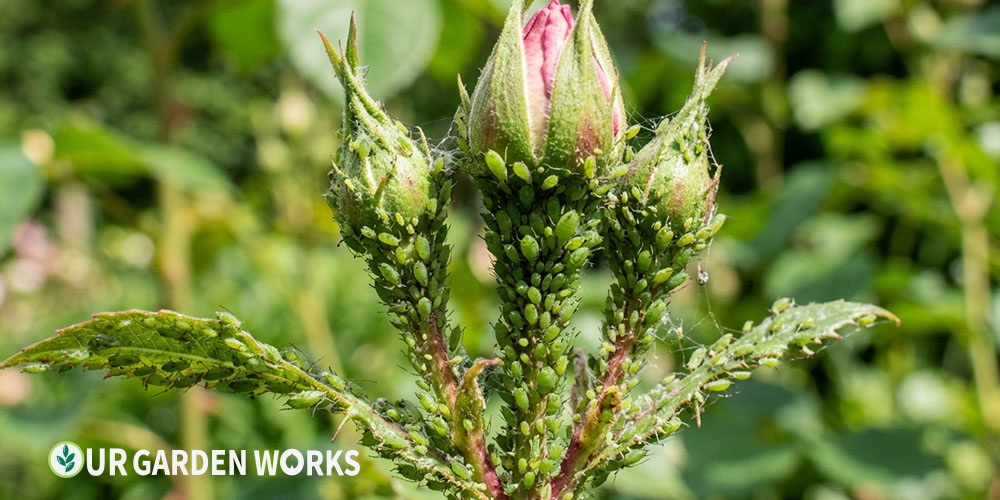
One aphid on a plant is not a problem. One hundred aphids is not yet a problem. But aphids reproduce asexually — a single aphid can produce 80 offspring in a week — and a colony left unchecked for 10 days can defoliate a plant, spread viral diseases between plants, and attract ants that actively protect the colony from predators.
The good news: aphids are one of the easiest garden pests to control when you act at the right moment with the right method.
Here are 9 methods ranked by effectiveness for different infestation levels. Start with Method 1 — it works for most aphid problems in under 5 minutes and costs nothing.
How to Get Rid of Aphids on Plants: For light to moderate aphid infestations, blast plants with a strong jet of water from a hose — dislodged aphids cannot climb back and die within 24 hours. For heavy infestations: neem oil spray (2 tsp per quart of water + half teaspoon dish soap) applied to all leaf surfaces including undersides, repeated every 7 days. Beneficial insects (ladybugs, lacewings) provide ongoing biological control once established.
First — Identify Aphids Correctly
Aphids are soft-bodied, pear-shaped insects 1–4mm long. They come in green, black, yellow, pink, white, or brown depending on species and plant host.
They cluster on new growth — tender stem tips, the undersides of young leaves, and around flower buds — causing the same kind of ragged damage you see described in our holes in tomato leaves guide.
Key identifiers: two small tubes (cornicles) projecting from their rear end, visible under a magnifying glass; sticky honeydew secretion on leaves below colonies; black sooty mould growing on the honeydew.
Aphids are most active in spring when new plant growth is tender and soft. Populations crash naturally in summer heat above 90°F — but the damage from spring colonies is done by then.
Why Aphid Searches Spike Every May
If you’ve noticed aphids seem to appear overnight in spring, that’s not your imagination — it’s biology lining up against you.
Aphid eggs that overwintered on bark, in leaf litter, or in plant debris hatch as soon as soil and air temperatures climb into the 50s and 60s, which in most of the US lands squarely in April and early May.
The first generation that hatches is entirely female and reproduces asexually, which means there’s no courtship delay, no waiting on a mate — every single aphid that survives to adulthood can start producing offspring within days.
That reproductive math compounds fast. A founding colony of a few dozen aphids in late April can become several thousand by late May, all while feeding on the same tender new growth that spring brings out on roses, vegetable transplants, and flowering shrubs.
This is exactly why the search spike happens in May rather than earlier — by the time a colony is large enough to be visibly alarming, the exponential growth phase is already well underway, and gardeners are searching for solutions in a genuine hurry rather than as a precaution.
💡 Get ahead of the May spike in April
If aphids have been a recurring problem in your garden in past springs, don’t wait for the visible colony. Start a weekly inspection routine on new growth in early-to-mid April, before populations have had a chance to multiply.
A water blast or insecticidal soap application on a handful of aphids in April takes five minutes; the same problem in late May, after several reproductive cycles, can mean treating an infestation that’s already caused visible damage.
Method 1 — Strong Water Blast (Best First Response)
A strong jet of water from a garden hose nozzle dislodges aphids physically. They cannot climb back to the plant and die within 24 hours.
This works best for light to moderate infestations on sturdy plants (roses, vegetables, shrubs). Avoid on very young seedlings or delicate flowers where water pressure may cause damage.
How to do it: Set your hose nozzle to a strong jet — not mist. Direct the stream at the undersides of leaves where aphid colonies concentrate. Work systematically through every stem tip and leaf. Repeat every 2–3 days for 2 weeks.
Effectiveness: 🟢🟢🟢🟢 Very good for accessible plants · 🔴 Limited for dense shrubs where you can’t reach all surfaces
Method 2 — Insecticidal Soap Spray
Insecticidal soap kills aphids on contact — for a full comparison, see our insecticidal soap vs neem oil guide.
Insecticidal soap kills aphids on contact by disrupting their cell membranes — it has no residual effect, meaning it only kills aphids it directly touches. That is actually a feature, not a bug: it does not harm beneficial insects that weren’t present during spraying.
DIY formula: 1–2 teaspoons of pure castile soap (Dr. Bronner’s, not dish soap with degreasers) per quart of water. Spray directly onto aphid colonies, covering undersides of leaves thoroughly. Apply early morning or evening — never in direct sun which causes leaf burn.
Commercial option: Ready-to-use insecticidal soap sprays from Safer Brand or Garden Safe. More consistent than DIY formulas.
Effectiveness: 🟢🟢🟢🟢 Excellent on contact · Repeat every 5–7 days because it has no residual protection
Method 3 — Neem Oil Spray
Neem oil contains azadirachtin, which disrupts aphid feeding and reproduction over several days.
Unlike soap spray, neem has some systemic and residual properties — it continues working after the spray dries. It also kills aphid eggs on the plant surface.
Mixing: 2 teaspoons cold-pressed neem oil + half teaspoon dish soap (emulsifier) per quart of warm water. Shake before each spray as neem and water separate quickly. Apply every 7 days for 3 weeks during active infestation.
When to use over soap: Heavy infestations, roses (which recover slowly from repeated handling), plants where you cannot water-blast effectively, or when you want residual protection between applications.
💡 Spray at dusk — never in full sun
Neem oil applied in direct sunlight causes leaf burn, especially on tender new growth. Apply at dusk, after direct sun has left the plant. The neem works overnight and is dry by morning. If you need to spray during the day, do it in the shade or on an overcast day.
Effectiveness: 🟢🟢🟢🟢🟢 Excellent · Best for moderate to heavy infestations · OMRI-listed organic option available
Method 4 — Rubbing Alcohol Wipe
For small, concentrated colonies — aphids on a single stem tip or a single branch — a cotton ball soaked in 70% rubbing alcohol and wiped directly over the colony kills them instantly on contact.
Works well for potted plants, houseplants brought outside, and spot-treating individual stems without spraying the whole plant.
Effectiveness: 🟢🟢🟢 Good for spot treatment · 🔴 Not practical for large infestations
Method 5 — Beneficial Insects
Ladybug adults and larvae eat 50–100 aphids per day. Lacewing larvae eat up to 200 per day. Parasitic wasps lay eggs inside aphids, killing them from the inside.
These biological controls are the most sustainable long-term aphid management — once established, they continuously suppress aphid populations without any intervention.
Attracting beneficials naturally: Plant dill, fennel, yarrow, sweet alyssum, and marigolds near aphid-prone plants. These provide nectar and shelter for beneficial insects. Avoid broad-spectrum pesticides that kill beneficials.
Purchased releases: Mail-order ladybugs work temporarily but most disperse within days of release. Lacewing eggs are more effective — they hatch where released and establish in the garden.
Effectiveness: 🟢🟢🟢🟢 Excellent long-term · 🔴 Slow to establish — not for active heavy infestations
Method 6 — Diatomaceous Earth
Food-grade diatomaceous earth (DE) dusted on stems and leaves damages the waxy cuticle of soft-bodied insects like aphids, causing dehydration.
It works best in dry conditions — rain or heavy dew washes it off and requires reapplication. Apply in still air (not wind) to avoid inhaling the fine particles.
Effectiveness: 🟡🟡 Moderate · Works well in dry climates, less effective in humid or wet conditions
Method 7 — Row Cover on Seedlings
Lightweight row cover (floating fabric) physically prevents aphids from landing on young seedlings during the highest-risk spring window.
Particularly useful for brassicas (broccoli, cabbage, kale) which are among the most heavily aphid-targeted seedlings. Keep cover on until plants are established enough to tolerate some aphid pressure without serious damage.
Method 8 — Remove and Dispose of Heavily Infested Growth
For a stem tip that is fully coated in aphids — hundreds to thousands packed on 2–3 inches of growth — the fastest solution is pruning that section off entirely and disposing of it in a sealed bag.
This removes thousands of aphids in seconds and eliminates a colony before it spreads to other parts of the plant. Follow up with a neem or soap spray on the rest of the plant.
Method 9 — Systemic Insecticide (Last Resort)
Imidacloprid-based systemic insecticides (Bayer Tree and Shrub, etc.) are absorbed by the plant and make all plant tissue toxic to feeding insects for weeks to months. They are effective against aphids but also kill bees and other pollinators that visit treated plants.
Do not use on flowering plants, vegetables, or anything visited by pollinators. Appropriate for ornamental trees and shrubs with recurring severe aphid infestations where other methods have failed.
The Ant Connection — Control Ants to Control Aphids
Ants and aphids have a farming relationship: ants protect aphid colonies from predators in exchange for the honeydew aphids produce.
If you have ants marching up stems to aphid colonies, the ants are actively preventing natural aphid control. Address the ants — a sticky barrier around the trunk or stem (Tanglefoot or similar) — and natural predators will have a chance to work.
Building a Spring Monitoring Habit
Most serious aphid problems are really late-detection problems. Because the population grows exponentially once it starts, the gap between “a few aphids I didn’t notice” and “a colony bad enough to cause visible leaf curl and stunted growth” can be as short as two weeks during warm spring weather.
The most effective long-term aphid strategy isn’t any single product — it’s a five-minute weekly walk through your garden in April and May, checking the undersides of new leaves and the tips of fast-growing stems on the plants aphids favor most: roses, the tender new growth on fruit trees, and any newly transplanted vegetable seedlings.
Catching a colony at a few dozen individuals instead of a few thousand changes which methods are realistic.
A water blast or a quick wipe with rubbing alcohol handles a small colony in under a minute. The same infestation given three more weeks to multiply may require repeated neem oil applications over several weeks to fully knock back.
Treat the first sighting as the cheapest moment to act, not as something to watch and wait on.
Frequently Asked Questions
When do aphid populations peak in the garden?
Aphid populations peak in mid-spring through early summer when new plant growth is most tender. They crash in summer heat above 85–90°F and in heavy rain. Fall brings a secondary, smaller peak as temperatures drop.
Early May is typically when gardeners first notice significant colonies — which is why the aphid search volume spikes sharply every May.
Are aphids harmful to established plants or just seedlings?
Established plants can tolerate moderate aphid pressure — a few colonies won’t kill a mature rose or tomato plant.
The real risks are: disease transmission (many plant viruses spread by aphids moving between plants), heavy infestations on seedlings or very young plants that may be overwhelmed, and the sooty mould that grows on honeydew and blocks photosynthesis on persistent infestations. Act on colonies you can see, but don’t panic about a handful of aphids on a mature plant.
What plants do aphids attack most?
Roses (rose aphid), brassicas (cabbage aphid — grey, waxy coating), tomatoes and peppers (green peach aphid), beans (black bean aphid), and ornamental trees like birch and linden (woolly aphid).
Every garden plant is susceptible, but these are the most common targets in home gardens.
Will ladybugs I buy online actually solve my aphid problem?
Mail-order adult ladybugs provide a quick but usually short-lived boost — most disperse and fly off within a few days of release rather than staying to work through your aphid colony.
They’re most useful as a supplement to other methods rather than a standalone fix. Lacewing eggs, which hatch in place rather than flying away, tend to establish and provide more reliable ongoing control. For a colony you need handled now, pair either option with a water blast or neem application rather than relying on beneficial insects alone.
Related Guides & Tools:
- Garden Pest Identifier — What’s Eating My Plants?
- Unleash Your Garden’s Potential: 10 Best Neem Oil Picks for 2026
- Insecticidal Soap vs. Neem Oil: Which Is Better?
- How to Get Rid of Slugs in the Garden – 11 Methods Ranked
- Companion Planting Chart — Attract Beneficial Insects
- Garden Pest Control Guide: Organic Methods That Actually Work
- Vegetable Gardening Guide: Grow More Food with Less Frustration
Final Thoughts
We hope this gives you the confidence to tackle aphids quickly — because catching them at the first signs of a colony is genuinely all it takes for most infestations. The water blast method has saved more of our rose buds than anything else.
For related pest problems, our garden pest control guide links to every pest article we have published.
Share this with a fellow gardener who has been losing their rose buds to aphids every spring and doesn’t know why nothing seems to work — and let us know in the comments what method has worked best in your garden. Happy growing!
