

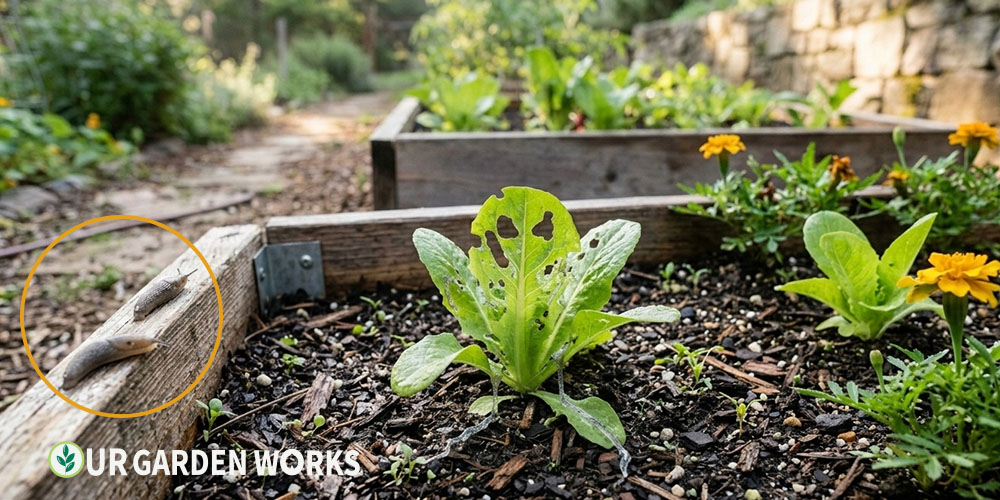
If your seedlings look perfect at sunset and demolished by morning — leaves with ragged irregular holes, a silvery slime trail on the soil — slugs found your garden.
They feed exclusively at night and in early morning, hide in moist dark places during the day, and can strip a 4-inch seedling to a stub in a single overnight visit.
The frustrating part: by the time you see the damage, the slugs are long gone. You’re reacting to evidence, not a visible pest.
Here are 11 methods ranked from most to least effective, including the combination that works for persistent infestations.
How to Get Rid of Slugs in the Garden: Iron phosphate bait (Sluggo, Escar-Go) is the most reliable slug control for vegetable and flower gardens — safe for pets, children, and wildlife, breaks down into soil nutrients, and works even if not consumed directly. Combine with a copper tape barrier around raised beds for near-complete protection. Beer traps provide high immediate kill rates but require daily maintenance.
First — Confirm It Is Slugs
Before treating, confirm that slugs are your pest.
The definitive signs: irregular holes with smooth edges (not the angular holes caterpillars make), silvery slime trails on soil and plant surfaces, damage primarily at ground level and on lowest leaves.
For comparison, our aphid guide covers the other spring pest that works alongside slugs. Go out with a flashlight 2 hours after dark — if slugs are active, you will see them directly on the plants.
Why Slugs Are So Hard to Get Ahead Of
Part of what makes slugs uniquely frustrating compared to most garden pests is that a single slug isn’t really your problem — it’s the population working underground and under cover that you never see.
A mature slug can lay several hundred eggs over a season, depositing them in clusters just below the soil surface in moist, undisturbed spots.
Those eggs can survive winter conditions that kill off many other pest larvae, which is exactly why a wet, mild winter so reliably produces a heavy slug spring regardless of anything you did differently in your own garden.
This life cycle is also why single-method control so often disappoints people. Spraying or trapping adult slugs you can see does nothing about the eggs and juveniles still developing in the soil, which is why the most effective long-term programs combine an active method (bait or traps) with a soil-level method (nematodes or habitat reduction) rather than relying on just one approach.
Think of it as managing two separate slug populations — the visible one above ground and the invisible one still developing below it.
1. Iron Phosphate Bait — Best Overall
Iron phosphate slug bait (brand names: Sluggo, Garden Safe, Natria) is the most effective slug control available for home gardens.
Our Top Picks:
Slugs eat the bait, stop feeding within 24 hours, and die within 3–6 days. Unlike metaldehyde baits (older blue pellets), iron phosphate is OMRI-listed organic, safe for pets, children, birds, and wildlife, and breaks down into iron and phosphate — soil nutrients — if not consumed.
Scatter 1 teaspoon per square yard around plant bases, particularly near slug sheltering spots (dense mulch, board edges, pots).
Reapply every 1–2 weeks and after heavy rain. Effective even if slugs don’t contact it directly — the bait acts as a feeding deterrent in the treated zone.
Effectiveness: 🟢🟢🟢🟢🟢 Excellent · Safe · OMRI organic · Our top recommendation
2. Beer Traps — Highest Immediate Kill Rate
Slugs are attracted to the yeast in beer. Bury a shallow container (tuna can, disposable cup) with the rim at soil level and fill with cheap beer. Slugs crawl in and drown. Empty and refill every 1–2 days.
Beer traps are highly effective at capturing large numbers quickly — but they require consistent maintenance. Neglected traps become breeding grounds.
A simple beer alternative: 1 teaspoon sugar + 1 teaspoon yeast dissolved in 1 cup of warm water. Works as well as beer at a fraction of the cost.
Effectiveness: 🟢🟢🟢🟢 Very good · High maintenance required
3. Copper Tape Barriers
Copper reacts with slug slime to produce a mild electrical sensation, deterring them from crossing. Copper tape applied around raised bed perimeters, individual pots, and container bases creates an effective barrier when properly installed.
Key: the copper must be wide enough (at least 2 inches) and continuous — a single break in the tape eliminates the barrier effect. Check monthly for gaps.
Effectiveness: 🟢🟢🟢🟢 Very good as barrier · Only protects contained areas · One-time installation
4. Reduce Shelter and Moisture
Slugs shelter during the day in any moist, dark location: under boards, in dense mulch, under pots, in leaf litter, in soil crevices. Removing shelter reduces the local slug population over weeks.
- Water in the morning — not evening. Dry soil at night is less hospitable to slug activity
- Pull mulch 4–6 inches back from plant stems
- Remove boards, stones, and debris near beds
- Rake out leaf litter in fall when slug eggs overwinter
Effectiveness: 🟢🟢🟢 Good long-term · Cultural, no products needed
5. Handpicking at Night
The most direct method. Go out 1–2 hours after dark with a flashlight and drop slugs into a container of soapy water.
Surprisingly effective for small gardens and raised beds — a 15-minute nightly sweep for a week significantly reduces a population. Works best combined with iron phosphate bait for a dual-front approach.
Effectiveness: 🟢🟢🟢 Good for small areas · Time-consuming for larger gardens
6. Diatomaceous Earth
Food-grade diatomaceous earth scattered around plants damages slug bodies and causes dehydration.
Effective in dry conditions — completely ineffective when wet. In humid climates or after rain, it requires constant reapplication. Best used as a dry-season supplement in combination with iron phosphate bait.
Effectiveness: 🟡🟡 Moderate in dry conditions · 🔴 Poor in wet climates
7. Rough-Textured Barriers (Crushed Eggshells, Gravel, Sharp Sand)
Slugs move on a mucus layer and avoid rough, sharp surfaces. A 3-inch wide band of crushed eggshells, coarse grit, or sharp horticultural sand around plant bases deters crossing.
Requires regular replacement as shells break down and grit sinks into soil. Less reliable than copper but useful as a supplementary deterrent.
Effectiveness: 🟡🟡 Moderate · Good supplement to primary methods
8. Salt (Only for Emergency Spot Kills)
Salt kills slugs on direct contact by osmosis. It is effective but has a significant drawback: salt accumulates in soil and damages plant roots at the concentrations needed.
Do not scatter salt around plants or in beds. Use only for direct application to slugs you’ve handpicked and placed on a non-soil surface. Never as a general bed treatment.
Effectiveness: 🟢🟢🟢 Excellent for individual slugs · 🔴 Damaging to soil if broadcast · Not recommended as primary method
9. Encourage Natural Predators
Ground beetles, hedgehogs, frogs, toads, slow worms (where native), and birds all eat slugs regularly.
A garden that supports these animals will have significantly lower slug pressure than one that doesn’t.
Concrete and paving around beds reduces habitat for slug predators — add a toad shelter, leave some long grass at the garden edge, and avoid broad-spectrum pesticide applications that reduce beetle populations.
Effectiveness: 🟢🟢🟢 Excellent long-term · Slow to establish
10. Nematodes (Biological Soil Treatment)
Phasmarhabditis hermaphrodita is a parasitic nematode that infects and kills slugs in the soil.
For broader organic pest treatments, our neem oil guide covers the most versatile organic option. Available by mail order, applied as a soil drench in spring and fall when soil is 40–68°F and moist.
Works on slug eggs and juveniles in the soil — doesn’t address adults above ground. Best for persistent slug problems where populations are re-establishing from soil-resident eggs.
Effectiveness: 🟢🟢🟢🟢 Excellent at soil level · Requires correct conditions · Premium price
11. Plant Collars for Vulnerable Transplants
A simple physical barrier around individual transplants buys critical protection during the highest-risk window.
Cut the bottom out of a plastic cup or yogurt container and press it into the soil around a new transplant, leaving an inch or two above ground.
Slugs have to climb over the rim to reach the plant, and the smooth plastic surface combined with the height is often enough to deter all but the most determined slugs.
This is inexpensive, reusable season to season, and especially worth doing for prized transplants like dahlias or the first round of lettuce starts where losing even one or two plants feels disproportionately frustrating.
Effectiveness: 🟢🟢🟢 Good for individual high-value plants · Not practical at scale
Frequently Asked Questions
Why do I have so many slugs this year?
Slug populations spike after mild, wet winters — which allows eggs and juveniles to survive at higher rates than normal. A wet spring amplifies this further.
If you are noticing more slugs than usual, it’s almost certainly a weather pattern response rather than anything specific to your garden. Applying iron phosphate bait in early spring before you see damage prevents the problem from developing.
Are slug pellets (metaldehyde) safe?
Metaldehyde slug pellets (the traditional blue pellets) are toxic to pets, birds, and wildlife and have been banned or restricted in several countries including the UK.
Iron phosphate bait achieves equivalent or better slug control and is safe for all non-target animals including dogs, cats, birds, and hedgehogs. We recommend iron phosphate universally over metaldehyde.
What time of year are slugs worst?
Two peaks: early spring (March–May) when overwintered eggs hatch and newly germinated seedlings are most vulnerable, and autumn (September–October) when conditions become wet again and new egg-laying occurs.
Summer heat suppresses slug activity. The spring peak coincides exactly with the most critical seedling period — which is why spring slug control is so important.
Which plants do slugs damage the most?
Tender, soft-leaved seedlings and transplants are by far the most vulnerable — lettuce, beans, hostas, dahlias, and brassica transplants top the list. Established plants with tougher, more fibrous leaves (most herbs, mature tomatoes, peppers) are far less attractive once they’re past the seedling stage.
This is exactly why the first few weeks after transplanting are the highest-risk window, and why concentrating your slug defenses around new transplants rather than the whole garden is usually the most efficient approach.
Free Tools & Guides:
Final Thoughts
We hope this saves you from the mystery of finding seedlings gone in the morning. The beer trap plus copper barrier combination handles most garden slug problems reliably.
Iron phosphate bait is our top recommendation for beds where you cannot get to every night. For the complete garden pest picture, our pest control guide links to every pest article on the site.
Share this with a fellow gardener who keeps finding their seedlings eaten overnight and suspects slugs but is not sure — and let us know in the comments how it went for you. Happy growing!
