
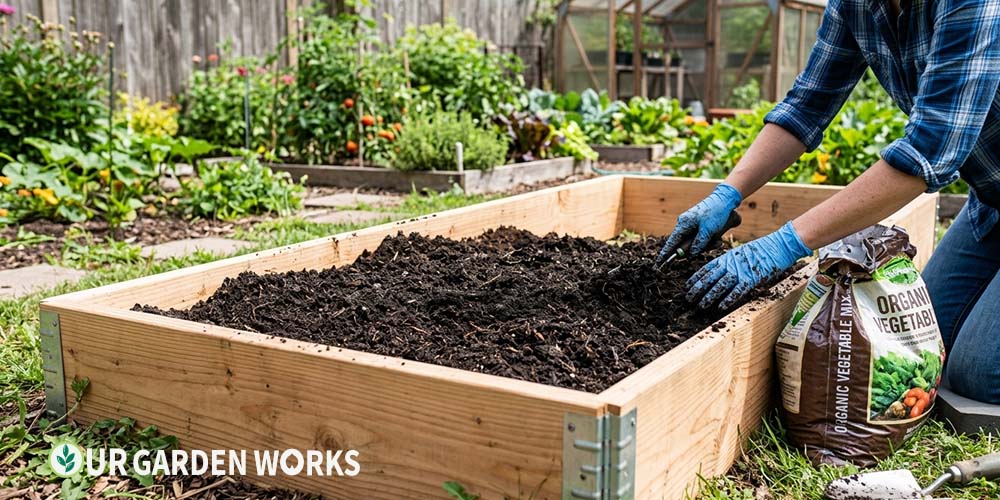
(Enter your raised bed length, width, and height in feet. The calculator shows cubic feet needed, cubic yards for bulk ordering, and the number of bags needed for common bag sizes (1 cu ft and 1.5 cu ft bags).)
Buying soil for a new raised bed without calculating the volume first is one of the most reliably expensive gardening mistakes.
A standard 4×8 raised bed filled to 12 inches deep needs 32 cubic feet of soil — which is 18–32 bags depending on bag size. Most gardeners buy far too little, make a second trip, and end up with a mix of soils from different batches that don’t integrate well. Calculate first, buy once.
Editor’s Note: Volume formula: length (ft) × width (ft) × depth (ft) = cubic feet needed. Divide cubic feet by 27 to get cubic yards for bulk ordering. A 4×8 bed filled 12 inches deep = 32 cubic feet = 1.19 cubic yards. At 1.5 cu ft per bag, you need 22 bags. At 1 cu ft per bag, you need 32 bags. Bulk delivery is significantly cheaper than bags for beds over 4×8 at 12-inch depth.
What to Fill Your Raised Bed With
The fill material is as important as the volume calculation. A raised bed filled with native soil performs no better than the surrounding ground and defeats the purpose of raised bed gardening. The goal is a light, nutrient-rich, perfectly draining mix that plant roots can move through easily.
Mel’s Mix (the gold standard for raised beds): 1/3 compost + 1/3 vermiculite + 1/3 peat moss or coco coir by volume. Developed by Mel Bartholomew for the Square Foot Gardening method — no soil, no weeds from the soil, perfect drainage. More expensive upfront but produces the best results and requires minimal amendment over subsequent seasons.
Standard raised bed mix: 60% topsoil + 30% compost + 10% perlite by volume. More affordable than Mel’s Mix, heavier, and will need annual compost top-dressing to maintain structure. Buy quality topsoil from a local landscape supplier — avoid generic bagged topsoil which is often sandy and nutritionally empty.
What to avoid: Native clay soil (compacts and drains poorly in a raised bed context), cheap bagged topsoil without compost amendment, pure compost (too nutrient-rich for seeds, can burn roots), or any mix that does not include drainage-improving amendments.
Bulk vs Bagged — When Each Makes Sense
| Bed Size | Fill Depth | Cu Ft Needed | Bags (1.5 cu ft) | Bulk Cost Advantage? |
|---|---|---|---|---|
| 2×4 bed | 8 inches | 5.3 cu ft | 4 bags | No — buy bags |
| 4×4 bed | 12 inches | 16 cu ft | 11 bags | Borderline |
| 4×8 bed | 12 inches | 32 cu ft | 22 bags | Yes — bulk saves $30–60 |
| 4×8 bed | 18 inches | 48 cu ft | 32 bags | Yes — bulk saves $60–100 |
| Two 4×8 beds | 12 inches | 64 cu ft | 43 bags | Strongly yes |
For beds requiring more than 30 cubic feet, call a local landscape supply company for bulk compost and topsoil delivery. A cubic yard (27 cu ft) typically costs $35–60 delivered — versus $80–120 for the same volume in bags from a garden centre. Once you have the calculation, use our soil pH calculator to test and correct the pH of your new fill before planting.
Frequently Asked Questions
How deep should a raised bed be?
8 inches is the functional minimum for annual vegetables — enough for most root development with good watering. 12 inches is the standard recommendation and handles almost all vegetables. 18–24 inches is necessary for deep-rooted crops (parsnips, carrots in clay soils, asparagus) and is the best depth for anyone who wants to sit on the bed edge while gardening.
If your native soil is good below the raised bed, roots will naturally extend down through the bed bottom — the bed depth adds fertility and drainage, not a hard root limit.
Do I need to remove grass before filling a new raised bed?
No — you can place cardboard directly over the grass or sod, then fill the raised bed on top. The cardboard smothers the grass (it degrades within one season) and the soil weight holds it in place.
This sheet mulching method is faster than removing sod and actually adds organic matter as the cardboard and grass decompose.
The only exception: aggressive perennial weeds like bermuda grass, ground ivy, or quackgrass — these can push through a single layer of cardboard and should be removed or buried under 3+ layers.
How much does the soil settle after filling?
Expect 15–25% settling in the first season as soil particles consolidate and organic matter decompresses. For a 12-inch deep bed, fill to 14 inches initially — after one season of watering and settling it will be at approximately 12 inches.
Top-dress with 1–2 inches of compost at the start of each subsequent season to replace what decomposed and settle what compacted. This annual compost addition is what maintains the light, rich texture of a well-managed raised bed over years.
Free Tools & Guides:
Final Thoughts
We hope this calculator saves you the second trip to the garden center and gives you a clear budget before you start digging.
Getting the volume right before you buy means you can invest in quality fill rather than making up the difference with cheap bags. For everything that goes into a raised bed system — soil, spacing, planting, and care — our vegetable gardening guide has every guide in one place.
Share this free tool with a fellow gardener who built their first raised bed without calculating the soil volume and ended up short by half — and tell us in the comments how it helped. Happy growing!
