

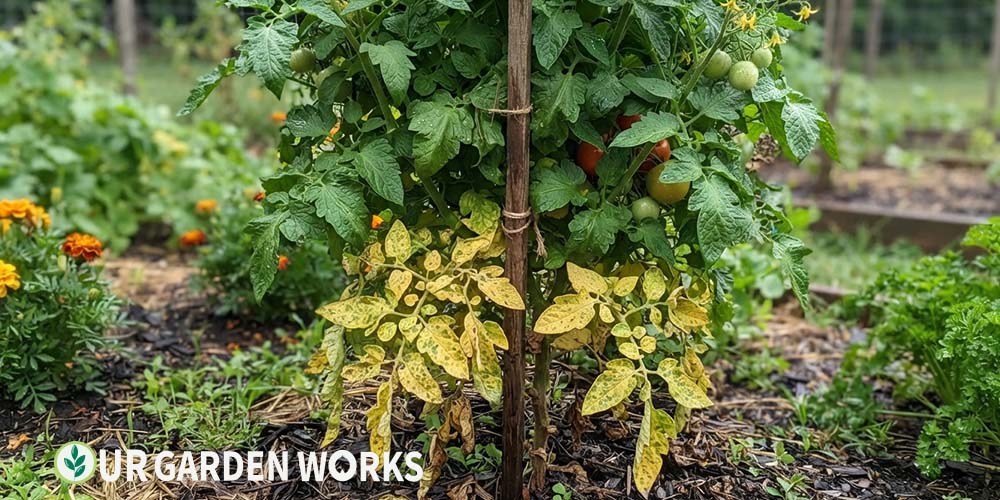
The specific pattern of yellowing starting at the bottom of a tomato plant and staying confined there, at least initially, points to a narrower and somewhat different set of causes than yellowing that’s scattered randomly or affects new growth.
This pattern is common enough, and distinctive enough, that it deserves its own focused look separate from tomato yellowing in general.
We’ll walk through what specifically explains this bottom-up pattern, since the location says almost as much as the color itself.
Quick Answer: Yellowing confined to lower tomato leaves most often means natural lower leaf senescence (normal, especially once fruit load increases), nitrogen deficiency (the plant moving limited nitrogen to new growth), early blight or septoria starting low, or simply reduced light reaching lower leaves in a dense, bushy plant. Check whether spots are present, whether the plant is otherwise vigorous, and how dense the canopy has become.
Cause 1 — Natural Lower Leaf Senescence (Most Common)
As a tomato plant matures and especially once it begins setting significant fruit, it’s entirely normal for the plant to redirect resources away from its oldest, lowest leaves and toward fruit development and new growth higher up.
Those lower leaves naturally yellow and eventually die back as part of this normal resource reallocation, even in a completely healthy, well-cared-for plant.
How to confirm it’s natural senescence:
- Yellowing is confined to the lowest few leaves, without spots or other lesions
- Rest of the plant looks vigorous with healthy new growth and developing fruit
- Coincides with the plant entering or being well into its fruiting phase
- Progresses gradually rather than appearing suddenly across many leaves at once
Fix: None needed. Removing these naturally yellowing leaves is a reasonable, common practice that also improves airflow around the base of the plant, but it’s a choice rather than a necessity.
💡 Removing lower leaves is a common, beneficial practice
Many experienced tomato growers routinely remove the lowest leaves once plants reach a certain height, regardless of whether those leaves have started yellowing yet, since this improves airflow at the base, reduces soil-splash disease transmission, and directs the plant’s energy more efficiently toward fruit production.
Cause 2 — Nitrogen Deficiency
Nitrogen is a mobile nutrient within the plant, meaning the plant can and will relocate it from older leaves to support new growth when supply is limited. This is exactly why nitrogen deficiency characteristically shows up first and most severely on the lowest, oldest leaves rather than scattered randomly across the plant.
How to confirm it’s nitrogen deficiency:
- Yellowing is uniform across affected leaves, not patchy or spotted
- Coincides with reduced overall plant vigor or slower growth than expected
- No recent fertilizing, or fertilizing was light relative to the plant’s needs
- Progresses upward over time if left unaddressed, eventually affecting higher leaves too
Fix: Apply a balanced or nitrogen-forward fertilizer at this stage, then transition to a lower-nitrogen, higher-potassium formula once the plant is actively flowering and fruiting, to avoid pushing excessive leafy growth at fruit’s expense.
Cause 3 — Early Blight or Septoria Starting Low
Both early blight and septoria leaf spot characteristically begin on lower leaves before working upward through the canopy over the course of a season, which means yellowing confined to the bottom of the plant in mid-to-late season is also consistent with an early-stage fungal infection, not just senescence or nutrient issues. The distinguishing factor is the presence of actual spots, not just uniform yellowing.
How to confirm it’s disease-related:
- Distinct spots are visible on the yellowing leaves — concentric rings (early blight) or small dark-bordered spots (septoria)
- Yellowing surrounds or follows the spotting pattern rather than appearing uniformly first
- Conditions have been warm and humid, or there’s been frequent overhead watering
Fix: See our brown spots on tomato leaves guide for the complete identification and treatment steps for both diseases, since the spotting pattern is what confirms this cause specifically rather than the yellowing alone.
Cause 4 — Reduced Light From Dense Canopy
A vigorously growing, bushy tomato plant can develop a canopy dense enough that lower leaves receive significantly less light than the upper growth, and leaves that aren’t receiving adequate light for photosynthesis will yellow and eventually die back as the plant essentially abandons that unproductive tissue. This is most common on indeterminate varieties allowed to grow without much pruning or training.
How to confirm it’s light-related:
- Plant has dense, untrained growth with significant upper canopy shading the lower portion
- Yellowing leaves are specifically the ones most shaded by growth above them
- No spots, and overall plant nutrition and watering seem adequate
Fix: Selectively prune some of the densest upper growth to improve light penetration to lower portions of the plant, or accept that some lower leaf loss is a natural tradeoff of a vigorously growing, unpruned indeterminate variety.
Telling the Four Causes Apart at a Glance
| Cause | Spots Present? | Plant Vigor | Progression |
|---|---|---|---|
| Natural senescence | No | Otherwise vigorous | Gradual, stays low |
| Nitrogen deficiency | No | Reduced overall | Moves upward over time |
| Early blight/septoria | Yes | Variable | Moves upward over season |
| Dense canopy/low light | No | Vigorous, dense growth | Stays in shaded areas |
Why This Pattern Deserves Its Own Diagnostic Approach
General tomato leaf yellowing covers a wide range of possible causes, but the specific bottom-up pattern narrows things down meaningfully because it reflects how the plant actually allocates and prioritizes resources internally.
Nitrogen mobility, fruit load prioritization, and light competition within the canopy are all mechanisms specifically tied to a plant’s lower, older growth rather than affecting the whole plant uniformly.
This is why checking the specific location of yellowing — not just whether yellowing is present — genuinely changes which causes deserve your first attention.
A gardener who jumps straight to fertilizing in response to any yellow leaf might miss that the real explanation is simply normal aging in a plant that’s already fruiting heavily and doesn’t need any nutritional intervention at all.
Pruning Practices That Reduce Unnecessary Lower Leaf Loss
While some lower leaf yellowing is unavoidable and even beneficial to remove deliberately, a few growing habits can reduce how much premature, unnecessary yellowing happens specifically from the dense-canopy and light-competition cause covered above.
Staking or caging indeterminate tomato varieties early and consistently, rather than letting vines sprawl unsupported, naturally improves light penetration throughout the plant by keeping growth more vertical and organized.
Selective pruning of suckers — the small shoots that emerge at the junction between the main stem and existing branches — on indeterminate varieties also reduces overall plant density without sacrificing the productive growth you actually want to keep.
This is a different practice from removing already-yellowing lower leaves; sucker pruning happens proactively throughout the season to manage the plant’s overall shape and density before light competition becomes severe enough to cause leaf loss in the first place.
Determinate varieties, which grow to a fixed, more compact size and don’t benefit from the same ongoing sucker removal, are generally less prone to this specific dense-canopy cause simply due to their more contained growth habit.
If light-competition-driven lower leaf yellowing has been a recurring frustration with indeterminate varieties in a tight growing space, switching to a determinate variety for that particular spot can sidestep the issue more completely than ongoing pruning management.
When Lower Leaf Yellowing Signals a Bigger Problem
While the four causes above account for the great majority of bottom-up yellowing cases, it’s worth watching for signs that the pattern is progressing beyond what any of them would predict.
If yellowing continues climbing steadily upward through the plant despite no spots being present, ruling out nitrogen deficiency through fertilizing, and the canopy isn’t particularly dense, it’s worth revisiting the possibility of a vascular wilt disease, covered in detail in our wilting tomato plants guide, especially if wilting accompanies the yellowing.
The key distinguishing factor is that the four causes in this guide all have a logical endpoint or stable pattern — natural senescence stays at the bottom, nitrogen deficiency resolves with fertilizing, disease-related yellowing follows visible spotting, and light competition stays confined to shaded areas.
Yellowing that keeps progressing relentlessly upward despite addressing these possibilities is the signal to consider a more serious explanation rather than continuing to wait it out.
Frequently Asked Questions
Should I be worried if my tomato plant loses its lowest leaves entirely by mid-season?
Not necessarily — many healthy, productive tomato plants naturally lose their lowest leaves by mid-to-late season as fruiting ramps up, and this doesn’t indicate a problem as long as the rest of the plant remains vigorous with healthy new growth and developing fruit.
It’s worth monitoring whether the yellowing progresses upward into otherwise healthy foliage, which would suggest something beyond simple natural aging.
Does removing yellowing lower leaves help the plant in any way?
Yes, modestly — removing leaves that are no longer contributing meaningfully to photosynthesis improves airflow around the base of the plant, which can reduce disease pressure, and it eliminates tissue that might otherwise serve as an entry point for pests or pathogens.
It’s a beneficial maintenance practice rather than a strictly necessary one for naturally senescing leaves.
Can container-grown tomatoes show this lower-leaf yellowing pattern differently than in-ground plants?
The same basic causes apply, but nitrogen deficiency tends to show up faster and more prominently in containers, since the limited soil volume holds fewer nutrient reserves and regular watering flushes nutrients out through drainage more quickly than in garden soil.
Container tomato growers often need to fertilize on a more frequent schedule specifically to avoid this pattern developing prematurely compared to the same variety grown in well-amended ground.
Related Articles in Our Tomato Leaf Problems Guide
Final Thoughts
We hope this guide has shown you why the location of yellowing on a tomato plant matters just as much as the color itself — and in many cases, reassured you that bottom-up yellowing on an otherwise thriving plant is nothing to worry about.
For all our tomato and vegetable guides, our vegetable gardening guide links to everything.
Share this post with a fellow gardener who’s troubleshooting their tomato plants — and let us know in the comments which cause matched what you found. Happy growing!
