

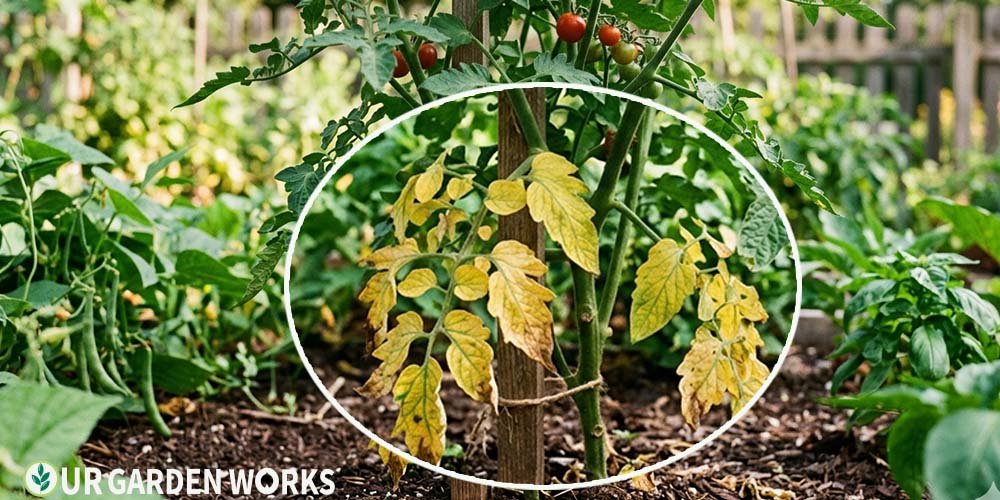
Yellow leaves on your tomato plants aren’t just an eyesore — they’re a message. The plant is telling you something is off, and the good news is that each cause produces a recognisably different yellowing pattern.
If you know what to look for, you can diagnose the problem accurately and fix it without guessing.
The most important tool you have is observation: where on the plant is the yellowing? What does it look like? How fast is it spreading? These 3 questions point you directly to the cause.
Quick Answer: Yellow tomato leaves are caused by: natural aging of lower leaves, overwatering, nitrogen deficiency, early blight, Fusarium or Verticillium wilt, magnesium deficiency, or tobacco mosaic virus. Start at the bottom of the plant and work upward — most problems start from the lowest leaves.
Diagnostic Map — Use the Pattern First
| Pattern | Cause | Urgent? |
|---|---|---|
| Lower leaves only, slow progression upward | Natural aging or nitrogen deficiency | No / Low |
| Uniform pale yellowing, all leaves affected | Overwatering / poor drainage | Medium |
| Yellow between veins, veins stay green | Magnesium deficiency | Low |
| Brown spots with yellow halo, lower leaves | Early blight (fungal) | Medium — act quickly |
| One side of plant wilting and yellowing | Fusarium wilt — no cure | High |
| Whole plant wilting and yellowing rapidly | Verticillium wilt | High |
| Mosaic yellow-green patterning, leaf distortion | Tobacco mosaic virus — no cure | High |
Cause #1 — Natural Lower Leaf Aging
The lowest leaves on a tomato plant naturally yellow and die as the season progresses — the plant redirects energy upward. Normal. Remove yellowing lower leaves to improve airflow. No treatment needed.
Cause #2 — Overwatering or Poor Drainage
Waterlogged roots can’t transport nutrients. Uniform yellowing that appears after a wet period or following heavy irrigation is almost always overwatering.
Allow soil to partially dry before watering again. In containers, confirm drainage holes are clear. In beds, check for compaction. See our compacted soil guide.
Cause #3 — Nitrogen Deficiency
Uniform pale yellowing starting at lower leaves and progressing upward evenly. Unlike fungal disease, nitrogen deficiency yellowing is even and doesn’t have spots or brown patches. Apply balanced fertilizer and the plant responds within 7–10 days.
Cause #4 — Early Blight (Alternaria solani)
Early blight creates dark brown spots with a yellow halo and distinctive concentric ring pattern (like a target). Starts on lower leaves and moves upward. Remove affected leaves immediately. Apply copper-based fungicide preventively to remaining foliage.
See our best fungicides for tomatoes guide. Mulch under plants to prevent soil splash — the primary spread mechanism.
Cause #5 — Fusarium Wilt
Fusarium wilt typically affects one side of the plant or one branch first — you’ll see yellowing and wilting on one side while the other looks healthy.
Cut through an affected stem and look for brown or orange discoloration inside the vascular tissue. There is no treatment.
Remove the plant and don’t plant tomatoes (or other solanaceous crops) in that soil for 3+ years. Choose Fusarium-resistant varieties (look for “F” in the variety name) next season.
Cause #6 — Magnesium Deficiency
Yellow between leaf veins with the veins themselves remaining green — interveinal chlorosis. Appears on middle-aged leaves first.
Fix with Epsom salt solution (1 tbsp per gallon of water, applied as soil drench or foliar spray). More common in acidic soils below pH 6.0.
Cause #7 — Tobacco Mosaic Virus
Irregular mosaic pattern of light and dark green with yellow — leaves often distorted or puckered. No cure. Remove infected plants. Wash hands thoroughly after handling — this virus is transmissible by touch.
Do not smoke near tomato plants (tobacco products are a TMV vector). Choose TMV-resistant varieties (look for “T” on the label) next season.
Frequently Asked Questions
Should I remove all yellow leaves from tomato plants?
Yes — remove yellowing and brown leaves promptly, regardless of cause. They’re not photosynthesizing effectively, they reduce airflow, and they can harbor disease spores. Use clean, sharp scissors and sterilize between plants if you suspect fungal disease.
Can yellow tomato leaves recover to green?
Leaves that have fully turned yellow will not recover to green — the chlorophyll is gone. However, treating the underlying cause prevents new yellowing and the plant produces healthy new growth going forward. Remove the yellow leaves once you’ve identified and addressed the cause.
Is it normal for lower tomato leaves to turn yellow?
Completely normal. The lowest 6–8 leaves on a tomato plant naturally turn yellow and die as the season progresses. This only becomes a concern if the yellowing is spreading rapidly upward, includes spots or lesions, or if the upper growth is also affected.
🥬 Related Articles in Our Vegetable Gardening Guide
- How to Grow Tomatoes from Seed to Harvest
- 10 Best Fungicides for Tomatoes — Organic & Chemical Options (2026)
- How to Fix Blossom End Rot on Tomatoes
- Why Do Tomatoes Crack and Split? 5 Causes + Fixes
- Black Worms in Tomatoes: What They Are & How to Get Rid of Them (2026)
- White Spots on Tomatoes: 4 Causes, Fixes & Safety Guide (2026)
Final Thoughts
We hope this guide helped you identify the specific cause of your tomato leaves turning yellow — because that identification is 90% of the solution. If you want to grow tomatoes from seed, our How to Grow Tomatoes from Seed to Harvest post walk you on step-by-step.
Share this post with a fellow gardener who’s ready to get growing — and let us know in the comments which cause matched your plant’s symptoms. Happy growing!
