

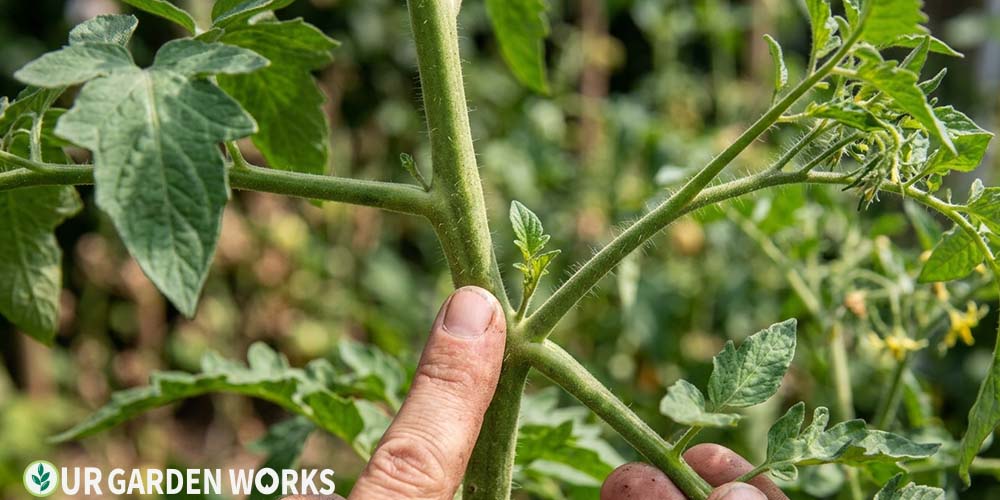
Tomato pruning is the technique that divides gardeners most sharply. Some swear by aggressive pruning to a single stem. Others let their tomatoes grow completely unpruned.
The truth is that both approaches can work — but understanding why and when to prune gives you intentional control over your harvest, not just a set of rules to follow.
The core principle is simple: every part of a tomato plant is competing for the same pool of energy. Suckers, extra stems, and excess foliage all draw from that pool.
When you prune, you redirect energy from vegetative growth into the fruit already developing. You’re not punishing the plant — you’re focusing it.
Editor’s Note: Remove suckers (shoots growing in the V-junction between stem and branch) on indeterminate varieties to improve airflow and direct energy to fruit. Never prune suckers from determinate varieties — it cuts your harvest. Remove leaves touching the soil and any yellow or diseased leaves. Top the main stem 4–6 weeks before first frost to push energy into remaining fruit.
First: Identify Your Tomato Type (This Changes Everything)
| Type | Sucker Removal | Leaf Removal | Topping |
|---|---|---|---|
| Indeterminate (vining) | Yes — remove to improve yield and airflow | Yes — lower leaves touching soil; diseased leaves | Yes — 4–6 weeks before frost |
| Determinate (bush) | No — suckers become fruiting branches | Only leaves touching soil | No |
⚠️ Never prune suckers from determinate tomatoes
Determinate tomatoes are genetically programmed to produce fruit on their side shoots — the same shoots that grow from sucker positions. Removing them reduces your harvest by 30–50%. Check your seed packet or plant label: “determinate” or “bush” = don’t prune suckers. “Indeterminate” = pruning improves results
What Is a Sucker? How to Find and Remove It
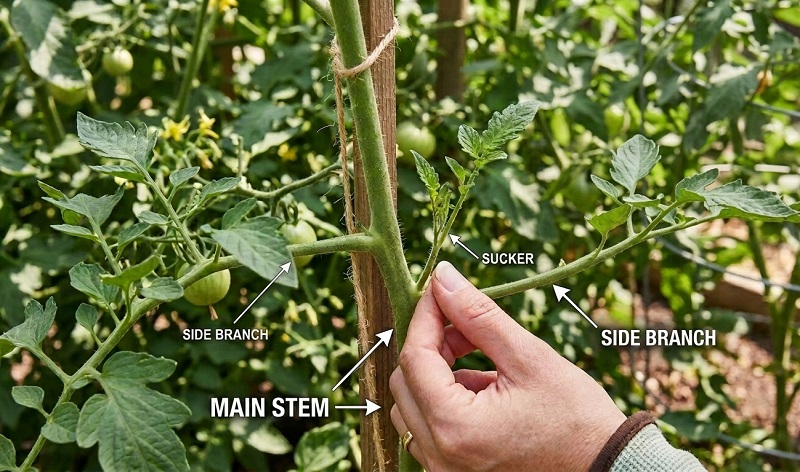
A sucker is the new shoot that grows in the axil — the V-shaped junction between the main stem and a side branch.
Every single branch junction on an indeterminate tomato will produce a sucker if left unpruned. Left to grow, each sucker becomes a complete new branch with its own branches and its own suckers.
The exponential growth that results creates an overcrowded, airflow-restricted plant where disease thrives and fruit development slows.
How to Remove Suckers
- Inspect your plant by looking at every junction between the main stem and a branch.
- When the sucker is small (under 2 inches, pencil-thin), pinch it off between your thumb and forefinger. This leaves a clean break with no stub.
- When the sucker is larger (over 2 inches), use clean, sharp pruning shears. Sterilize between plants using a diluted bleach solution (1 part bleach to 9 parts water) to prevent spreading bacterial or fungal diseases between plants.
- Remove suckers in dry weather — wet conditions allow pathogens to enter open pruning cuts.
- The Missouri pruning technique: instead of removing the sucker completely, pinch off all but the first 1–2 leaves of the sucker. This leaves a small stub that won’t develop further but shields the wound from sun and disease. Used by many experienced growers for suckers below the first flower cluster.
The 1, 2, or 3-Stem System — Choosing Your Approach
You don’t have to choose between fully pruned (1 stem) and fully unpruned. Many experienced gardeners grow on a 2-stem or 3-stem system:
- 1-stem: Remove all suckers. Maximum airflow, fastest fruit ripening, best for short seasons and high-disease environments. Requires tall, sturdy stake support.
- 2-stem: Allow one sucker (typically the first sucker below the first flower cluster) to become a second main stem. Remove all other suckers. Good balance of yield and manageability.
- 3-stem: Allow two suckers to develop. Significant productivity increase with more maintenance. Requires very sturdy support. Best for long-season climates where maximum yield is the goal.
Leaf Removal — What to Take and What to Leave
Leaf removal is separate from sucker removal and follows different logic. Leaves are the plant’s solar panels — remove healthy mid-plant leaves and you reduce the energy available for fruit development. Remove the right leaves, in the right locations, and you improve airflow without hurting the plant.
Leaves to Always Remove
- Any leaf touching or near the soil: Soil splash carries early blight spores. Remove the lowest 12 inches of leaves from the stem to create a clear zone.
- Yellow or brown leaves: These are no longer photosynthesizing — they’re just providing shelter for disease organisms. Remove cleanly.
- Leaves showing disease spots: Remove and dispose (not compost) immediately when spotted.
Leaves to Leave Alone
- Any healthy green leaf in the mid or upper canopy — they’re providing energy for fruit development
- Leaves shading ripening fruit — they prevent sunscald
Topping — The End-of-Season Technique
Topping (also called “terminal pruning”) is cutting the growing tip of the main stem 4–6 weeks before your first expected fall frost. The plant stops putting energy into new growth and directs all resources into ripening the fruit already on the vine. In a short-season climate, this can add 1–2 weeks of effective ripening time to fruit that would otherwise still be green when frost hits.
How to top: cut the main stem just above the second leaf above the highest fruit cluster you want to ripen. This leaves a small stub that prevents dieback from damaging fruit below the cut.
Frequently Asked Questions
How often should I prune tomatoes?
Check for new suckers every 7–10 days throughout the growing season. New suckers grow quickly — a sucker that’s pencil-thin this week becomes a 6-inch branch next week that’s harder to remove cleanly. Weekly inspection keeps it manageable.
Can I root tomato suckers to grow new plants?
For indeterminate varieties in short-season climates or humid disease-prone conditions: yes, meaningfully. In long-season, low-disease environments: the difference is less dramatic. The airflow benefit (disease reduction) is often more valuable than the fruit-focusing benefit, particularly in humid summer climates.
Does pruning tomatoes really improve yield?
For indeterminate varieties in short-season climates or humid disease-prone conditions: yes, meaningfully. In long-season, low-disease environments: the difference is less dramatic. The airflow benefit (disease reduction) is often more valuable than the fruit-focusing benefit, particularly in humid summer climates.
🥬 Related Articles in Our Tomatoes Growing Guides:
- How to Grow Tomatoes from Seed to Harvest
- How to Start Seeds Indoors: Complete Step-by-Step Guide (2026)
- How to Stake Tomatoes — 5 Methods Compared (With Setup Instructions)
- When to Plant Tomatoes — Regional Guide
- Tomato Varieties Guide — Best Types for Every Garden
- Why Do Tomatoes Crack and Split? 5 Causes + Fixes
- Vegetable Gardening Guide
Final Thoughts
We hope this guide has made tomato pruning feel deliberate rather than mysterious. The key takeaway: indeterminate = prune suckers for better results; determinate = don’t touch them. Everything else is nuance.
Share this post with a fellow gardener who’s ready to grow their own — and let us know in the comments whether you’re going single-stem, two-stem, or unpruned this season — and your reasoning. Happy growing!
