

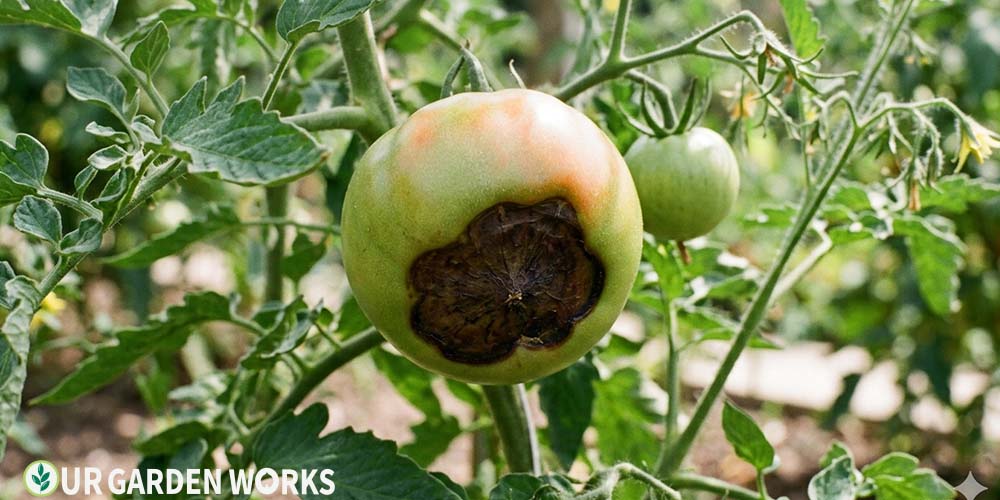
You planted the seeds. You staked the plants. You watered faithfully. And now the tomatoes that should be your triumph have a dark, sunken, leathery patch on the bottom that makes them look like they’ve given up halfway through developing.
Blossom end rot is one of the most demoralizing tomato problems — and one of the most misunderstood.
Most gardeners rush to add calcium, because that’s what every label says is the cause. But calcium deficiency in the soil is almost never the actual problem.
The real cause is inconsistent watering. Understanding this distinction is the key to actually fixing it.
Quick Answer: Blossom end rot is caused by calcium deficiency in the developing fruit — but almost always because inconsistent watering is preventing calcium uptake from the soil, not because calcium is actually missing. Fix your watering consistency and the problem resolves in the next fruit set.
What Causes Blossom End Rot — The Real Explanation
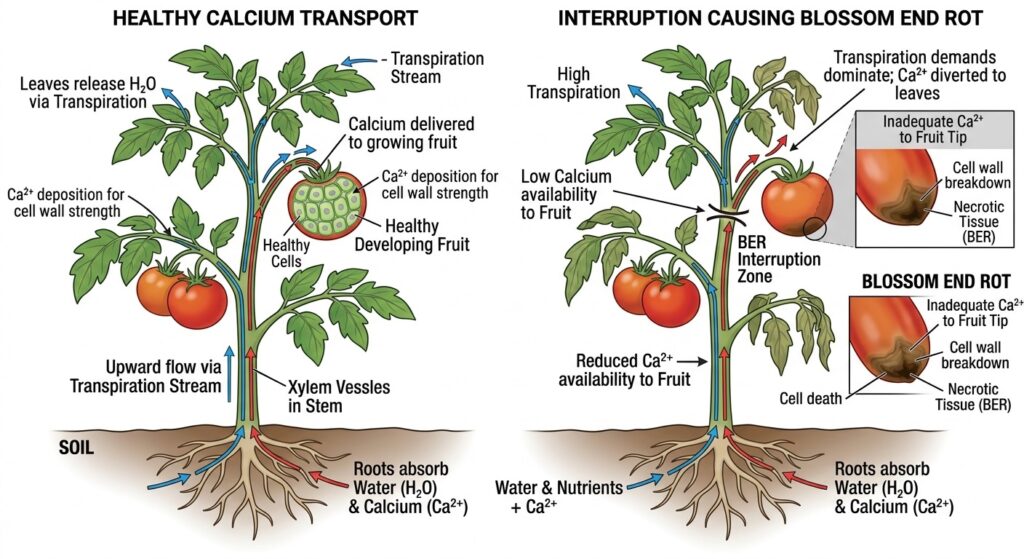
Calcium is a nutrient that moves through a tomato plant via the transpiration stream — the flow of water from roots through stems and into leaves.
Unlike nitrogen and potassium, calcium cannot be moved from older parts of the plant to newer ones once it’s been deposited. The developing fruit has to get its calcium from the current water supply, every day.
When watering is inconsistent — wet periods followed by dry spells — the calcium transport to developing fruit is interrupted.
The fruit cells at the blossom end (the bottom) that form first are the ones that suffer. They collapse, die, and become the brown leathery patch you’re looking at.
The soil almost always has adequate calcium. The problem is delivery, not supply.
What Blossom End Rot Is NOT
- It is not a disease — it’s a physiological disorder. It doesn’t spread between plants.
- It is not caused by a pest — no insect is responsible.
- It is not (usually) caused by low calcium in the soil — adding calcium sprays or supplements rarely fixes it if watering is still inconsistent.
- It is not fatal — the plant keeps producing. Affected fruits won’t recover, but future fruits will be fine once watering is corrected.
Step-by-Step Fix
Immediate Actions
- Remove affected fruits. They won’t recover, and leaving them on the vine wastes the plant’s resources.
- Establish a consistent watering schedule. This is the fix. Water deeply (1–2 inches) and consistently — same days, same time, same amount. Stop the boom-bust cycle of soil moisture.
- Mulch immediately. Apply 2–3 inches of straw or wood chips around your plants. Mulch is the most effective tool for buffering soil moisture swings — it prevents rapid drying between waterings.
- Switch to drip irrigation if possible. Drip delivers water slowly and consistently directly to the root zone — the ideal setup for calcium delivery. It eliminates the moisture swings that cause BER better than any other single change.
- Check your soil pH. If pH drops below 6.0, calcium becomes chemically unavailable to roots even when it’s physically present. If pH is off, add dolomitic lime and retest in 4 weeks. See our soil guide.
When Calcium Supplementation Actually Helps
In two specific situations, adding calcium to the soil or as a foliar spray can genuinely help:
- Container growing: Containers require frequent watering, which leaches calcium over time. A monthly calcium supplement (calcium nitrate or crushed eggshells) is beneficial for container tomatoes specifically.
- Confirmed low calcium soil: If a soil test shows calcium below 1,000 ppm, supplementation is warranted. A soil test from your local extension service costs $15–25 and removes all guesswork. Without this test, adding calcium is treating a symptom that probably doesn’t exist in your soil.
💡 A moisture meter pays for itself
A basic soil moisture meter inserted 4 inches deep removes all guesswork from watering. “Water when it reads dry” is the most consistent schedule you can follow. One meter + consistent watering = blossom end rot eliminated in almost every garden situation.
What to Do When the Problem Is Too Much Rain, Not Too Little
Everything above assumes you’re in control of the watering — but a multi-day rainy stretch takes that control away.
You can’t “water consistently” when the sky is doing the watering for you, and the instinct to just wait it out isn’t entirely wrong, but there are a few things that meaningfully reduce the damage while you ride it out.
1. Improve drainage before the rain arrives. Raised beds drain faster than flat, in-ground rows almost by definition.
If you’re growing in-ground, even mounding soil into a slight ridge around each plant helps excess water move away from the root zone instead of pooling around it. On heavy clay, working compost or coarse sand into the bed between seasons pays off the next time a wet pattern rolls through.
2. Keep mulch down year-round, not just in dry spells. Mulch’s real job here is buffering — it slows how fast a downpour saturates the soil, and then slows how fast that soil dries out again once the sun returns.
Beds with no mulch swing harder between soaked and bone-dry, which is exactly the inconsistency that triggers BER in the first place.
3. A simple rain cover for the worst stretches. This doesn’t have to mean standing in the garden with an umbrella.
A length of clear plastic sheeting over a hoop frame or cattle panel, left open on the sides for airflow, keeps the heaviest rain off the soil around your tomatoes without trapping heat or humidity against the plants.
Roll the sides up between downpours so it doesn’t turn into a greenhouse, and take the cover off entirely once the rain pattern breaks.
4. Calcium supplementation is actually more useful here. We’ve stressed throughout this guide that calcium sprays rarely fix blossom end rot caused by drought — but waterlogged soil is a different mechanism.
Saturated soil is low in oxygen, and oxygen-starved roots struggle to take up calcium even when plenty is present.
A calcium supplement (crushed eggshells worked into the soil, or a foliar spray as a short-term bridge) can help carry the plant through a genuinely wet week in a way it wouldn’t help during a dry one.
5. Accept some fruit loss and let the plant reset. In a true multi-day soaker, you’re managing the situation, not eliminating it.
The fruit already developing during the wettest days may still show some BER — that’s expected, not a sign you did something wrong.
Once the soil dries back to a normal, manageable moisture level, the plant typically resumes producing healthy fruit within the next flowering cycle.
⚠️ The pattern matters more than any single rainy day
One heavy rain after a dry week is a normal part of summer and rarely causes BER on its own. The damage comes from the swing — saturated, then bone-dry, then saturated again. If your region gets a genuinely wet pattern for a week or more, focus your energy on drainage and mulch rather than trying to “undo” the rain itself.
Which Tomatoes Are Most Susceptible?
- Paste and Roma tomatoes — the most BER-prone type due to their elongated shape and dense flesh
- Large beefsteak varieties — the long fruit development period means more exposure time to watering fluctuations
- Container-grown tomatoes — highly susceptible due to rapid soil moisture swings in pots
- Cherry tomatoes — the least susceptible due to their small size and fast development
Frequently Asked Questions
Can I eat a tomato with blossom end rot?
Yes — cut away the affected area generously (at least 1 inch beyond the dark patch) and eat or cook the rest. The unaffected portion is fine. BER is a physiological condition, not a disease or contamination.
Will calcium spray fix blossom end rot?
Foliar calcium spray has limited effectiveness — calcium is poorly absorbed through leaves. It can help as a short-term supplement for container tomatoes but won’t fix the underlying cause (watering inconsistency) in ground-grown plants. Fix the watering first.
Why do I only get BER on the first fruits of the season?
Very common. The first fruits develop during the plant’s early establishment phase when roots are still shallow and watering is often less consistent. As the season progresses, roots deepen, the plant gets more efficient at calcium uptake, and BER often resolves on its own — even without any intervention.
Does high nitrogen cause blossom end rot?
Indirectly, yes. Very high nitrogen causes rapid leafy growth that competes with fruit for calcium. The fast-growing leaves take calcium away from developing fruit. This is another reason to switch to low-nitrogen fertilizer once tomatoes start flowering.
🥬 Related Articles in Our Vegetable Gardening Guide
- Tomato Stem Rot: Causes, Treatment & Prevention Guide (2026)
- How to Grow Tomatoes From Seed to Harvest (Complete 2026 Guide)
- Why Do Tomatoes Crack and Split? 5 Causes + Fixes (2026)
- White Spots on Tomatoes: 4 Causes, Fixes & Safety Guide (2026)
- 7 Best Potting Soils for Tomatoes — Tested & Reviewed (2026)
- Vegetable Gardening Guide
Final Thoughts
We hope this guide has cleared up the real cause of blossom end rot — and given you the specific fix that actually works.
Consistent watering and mulching resolve this in the next fruit set almost every time. For all our tomato and vegetable growing guides, our vegetable gardening guide links to everything.
Share this post with a fellow gardener who’s ready to get growing — and let us know in the comments whether consistent watering solved your BER problem and how quickly you saw results. Happy growing!

Thank you. The article was informative but goes not cover what one can do if there is excessive rain for periods of time. Obviously, “dont water”, but is there anything other than “go stand out there with an umbrella over your plants!”?
Hi Marlit, thank you for asking this — you’re right that we focused on the dry side of “inconsistent” and left out what to do when the problem is too much rain rather than too little. Here are a few things that actually help:
1. Improve drainage before the rain comes. Raised beds or even just mounding soil into a slightly raised ridge around each plant keeps roots from sitting in saturated soil. If you’re on heavy clay, working in compost or coarse sand over time makes a real difference for next season.
2. Mulch heavy, not just for dry spells. A thick layer of straw or wood chips also slows how fast rain saturates the soil around the root zone and helps it drain and even back out a bit between downpours, rather than swinging from soaked to bone-dry the moment the sun comes back out.
3. A simple rain cover for the worst stretches. You don’t need to stand there with an umbrella — a basic clear plastic sheet or a cattle-panel hoop with greenhouse film over your tomato row, open on the sides for airflow, keeps the worst of a multi-day deluge off the soil without trapping heat or humidity against the plants. Roll the sides up between rains so they don’t cook.
4. Calcium becomes more useful here. This is actually one of the cases where a calcium supplement (crushed eggshells worked into the soil, or a foliar calcium spray as a stopgap) genuinely helps — because the issue during a wet stretch often isn’t lack of calcium, it’s that the roots are too oxygen-starved in waterlogged soil to take it up efficiently, so giving the plant a more available form for a few weeks can bridge the gap.
5. Accept some fruit loss and move on. Realistically, in a true multi-day soaker, you’re managing the situation rather than eliminating it. The plant will recover and put out healthy fruit once the soil dries back out — the affected ones just won’t be it.
We’ll add a section on this to the article since it’s a fair gap. Thanks again for flagging it!
Reread the article