

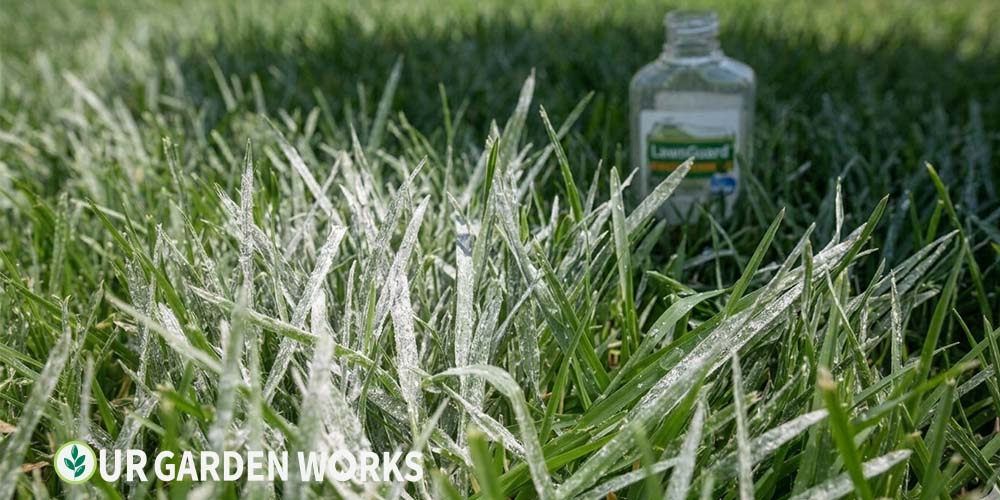
White powder on grass blades, especially in shaded areas, points fairly reliably to powdery mildew — one of the more visually distinctive lawn diseases once you know to check for it.
A couple of less common alternatives are worth ruling out, but this single cause explains the large majority of cases.
We’ll cover confirming the diagnosis, treating an active outbreak, and why shade plays such an outsized role in this particular lawn problem.
Quick Answer: White powder on grass blades is almost always powdery mildew, a fungal disease that thrives in shaded, humid conditions with poor airflow. It produces a fine, dusty white coating that smudges when touched. Improve light and airflow to the affected area, reduce nitrogen fertilizer, and apply a fungicide for active outbreaks.
Cause 1 — Powdery Mildew (By Far the Most Common)
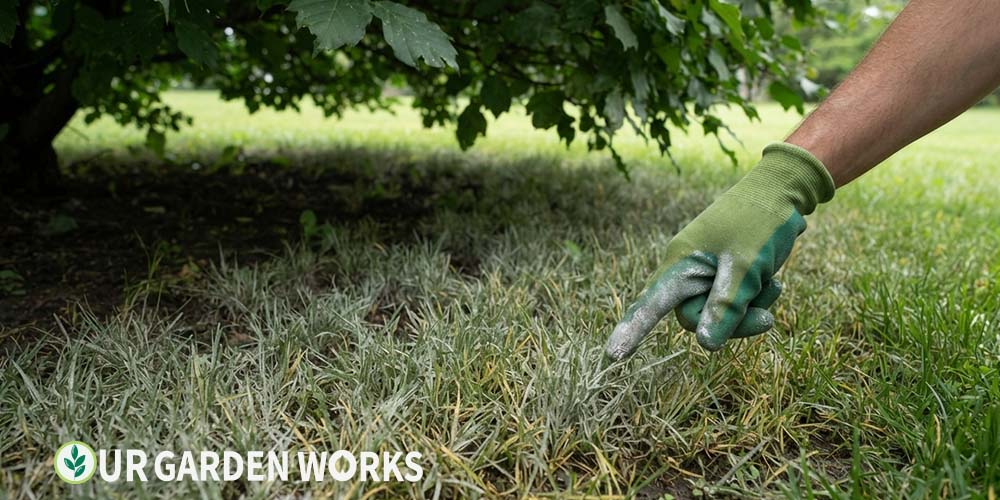
Powdery mildew on lawns behaves similarly to the powdery mildew covered in our vegetable garden guides, producing a fine, dusty white to grayish coating across grass blades.
Unlike many lawn fungal diseases that favor full sun and heat, powdery mildew specifically favors shaded areas with limited airflow and humidity — making it one of the few lawn diseases you’re more likely to see under a tree canopy than out in open sun.
How to confirm it’s powdery mildew:
- Coating is fine, dusty, and smudges or transfers when you rub a finger across affected blades
- Concentrated specifically in shaded areas — under trees, near fences, or close to buildings that block sun
- Grass blades may appear slightly stunted or weakened where coating is heaviest
- Worse during humid, overcast stretches
Fix: Improving light penetration by pruning overhanging tree branches or thinning dense shrubs nearby addresses the underlying shade conditions the fungus depends on. A fungicide labeled for powdery mildew helps manage active outbreaks, and reducing nitrogen fertilizer in affected areas (excess nitrogen promotes the lush, tender growth this fungus prefers) supports longer-term resistance.
💡 Consider a shade-tolerant grass blend for chronically affected areas
If a specific shaded section of lawn experiences powdery mildew repeatedly despite reasonable management, overseeding with a grass variety specifically bred for shade tolerance often handles the underlying light limitation better than continuing to fight the disease in a spot that simply isn’t well suited to standard turf grass.
Cause 2 — Downy Mildew (Less Common, Different Mechanism)
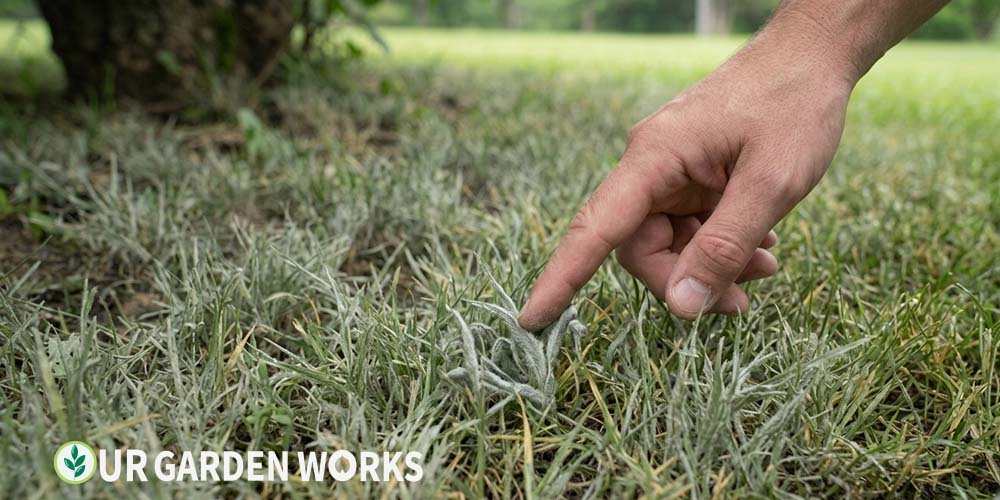
Downy mildew, despite the similar name, is caused by a different organism and produces a somewhat different appearance — often a grayish, fuzzy growth rather than the drier, more uniformly powdery coating of true powdery mildew, sometimes accompanied by stunted, distorted blade growth.
This is considerably less common on home lawns than powdery mildew but worth distinguishing if the texture doesn’t quite match.
How to confirm it’s downy mildew:
- Coating has a grayish, somewhat fuzzy rather than purely powdery texture
- Grass blades may show distortion or stunting alongside the coating
- Less strictly tied to shade than powdery mildew, though still favors humid conditions
Fix: Similar management approach to powdery mildew — improve airflow, reduce excess moisture and nitrogen, and apply an appropriate fungicide for active, significant outbreaks.
Cause 3 — Residue From a Recent Fungicide or Pesticide Application
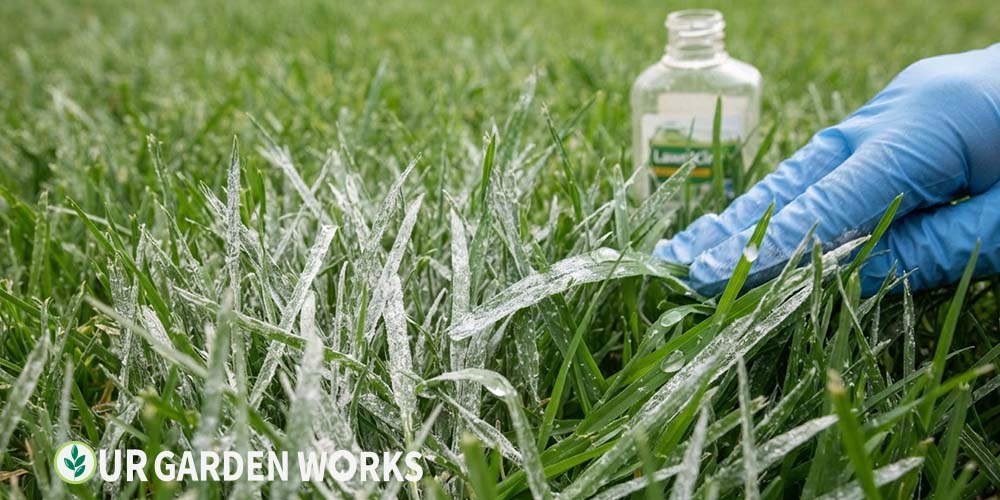
Sometimes the simplest explanation applies: a recent fungicide, pesticide, or even certain fertilizer products can leave a visible white residue on grass blades that’s easily mistaken for disease. This is purely cosmetic and not a sign of any actual problem with the lawn itself.
How to confirm it’s product residue:
- Coating wipes or rinses off easily with water
- Timing correlates with a recent product application
- Not specifically concentrated in shaded areas the way powdery mildew typically is
Fix: None needed — simply rinse with a hose if the residue is cosmetically bothersome. No treatment required.
Telling the Three Causes Apart at a Glance
| Cause | Texture | Location Pattern | Wipes Off? |
|---|---|---|---|
| Powdery mildew | Fine, dusty, smudges | Concentrated in shade | Partially, smudges |
| Downy mildew | Grayish, fuzzy | Less shade-specific | Partially |
| Product residue | Flat, surface-level | No specific pattern | Yes, easily |
Does Grass Type Affect Susceptibility to Powdery Mildew?
Grass type genuinely matters for powdery mildew risk, with Kentucky bluegrass standing out as particularly susceptible compared to many other common cool-season and warm-season varieties.
This is part of why powdery mildew shows up so reliably in shaded patches of bluegrass lawns specifically, even when adjacent areas with a different grass type under similar shade conditions remain unaffected.
Fine fescues, often marketed specifically for their shade tolerance, generally show better resistance to powdery mildew than bluegrass, making them a logical substitute for chronically shaded, mildew-prone areas rather than continuing to fight the same battle with a more susceptible variety planted in conditions it isn’t well suited to.
If you’re dealing with recurring powdery mildew in a specific shaded zone and don’t know what grass type is currently growing there, this is worth investigating, since the answer may point toward a straightforward variety-switch solution rather than an ongoing disease management routine.
Warm-season grasses like St. Augustine and zoysia can develop powdery mildew as well under sufficiently shaded, humid conditions, though this is somewhat less commonly reported than in cool-season bluegrass lawns, possibly reflecting both genuine resistance differences and the fact that warm-season lawns are more often found in climates and landscape designs with less dense shade overall.
Seasonal Patterns in Lawn Powdery Mildew
Powdery mildew on lawns tends to follow a fairly predictable seasonal pattern, generally appearing and intensifying during the cooler, more humid stretches of spring and fall rather than the height of summer heat.
This timing differs somewhat from many other lawn fungal diseases that peak during summer’s warmest, most humid weeks, and it’s a useful piece of supporting evidence when confirming this specific diagnosis.
If you’re noticing the characteristic white, dusty coating specifically during a cool, overcast spring stretch or as fall temperatures begin dropping, this timing aligns well with powdery mildew’s typical seasonal behavior and adds confidence to the diagnosis beyond the shade-location and texture clues alone.
Conversely, a similar-looking coating appearing during the height of summer heat is worth double-checking against the alternative causes covered above, since powdery mildew’s preference for cooler, humid conditions makes it a somewhat less likely fit for peak summer symptoms specifically.
Why Shade Is the Dominant Risk Factor for This Specific Disease
Powdery mildew’s strong association with shaded lawn areas sets it apart from most other lawn diseases, which more typically favor full sun combined with heat and humidity.
The mechanism is fairly straightforward: shaded grass grows more slowly and with thinner, more tender blade tissue than sun-grown grass, while also staying damp longer after dew or rain since reduced sun exposure means slower drying. Both factors create ideal conditions for this specific fungus.
This is exactly why addressing the shade itself — rather than only treating the visible disease symptom — produces more lasting results.
A fungicide application without any corresponding improvement to light and airflow conditions often sees the same patch develop new symptoms again once treatment effects wear off, since the underlying environmental conditions favoring the disease never actually changed.
Frequently Asked Questions
Will powdery mildew on my lawn spread to my garden plants?
Lawn powdery mildew and the powdery mildew affecting vegetables or ornamentals are typically caused by different, host-specific fungal species, so lawn powdery mildew generally won’t spread to your garden beds even if both are present in the same yard.
Each affected area is worth managing according to its own specific conditions rather than assuming cross-contamination between lawn and garden.
Is powdery mildew on grass harmful to pets or children playing on the lawn?
Powdery mildew on lawns isn’t considered a significant health risk for typical incidental contact during normal outdoor play, though it’s reasonable to avoid prolonged direct contact with heavily affected areas until the condition is addressed.
If you have specific health concerns, particularly for anyone with mold sensitivities, consulting a doctor about precautions is a reasonable extra step.
Can I prevent powdery mildew without removing trees that create the shade?
Yes, often — selectively pruning lower or overly dense branches to improve light penetration and airflow without removing the tree entirely frequently provides enough improvement to meaningfully reduce disease pressure.
Switching to a shade-tolerant grass variety in the affected area, as mentioned earlier, also reduces reliance on light conditions you can’t fully change without removing mature trees.
Does mowing height affect powdery mildew risk on lawns?
Yes, to a meaningful degree — mowing shaded grass at a slightly taller height than you might use in full sun helps the grass maintain more leaf surface for photosynthesis under already-limited light, supporting overall plant vigor that resists disease better than weak, overly short turf struggling in low light.
This is a small adjustment worth making specifically in chronically shaded, mildew-prone sections rather than applying uniformly across an entire lawn with mixed sun exposure.
Related Articles in Our Lawn Care Guide
Final Thoughts
We hope this guide has helped you confirm and address the white powder on your grass blades — improving light and airflow really does solve this one more reliably than fungicide treatment alone.
For more lawn care guidance, our full collection of lawn articles on the soil and fertility page covers everything from seasonal maintenance to disease management.
Share this post with a fellow homeowner who’s troubleshooting their lawn — and let us know in the comments which cause matched what you found. Happy growing!
