

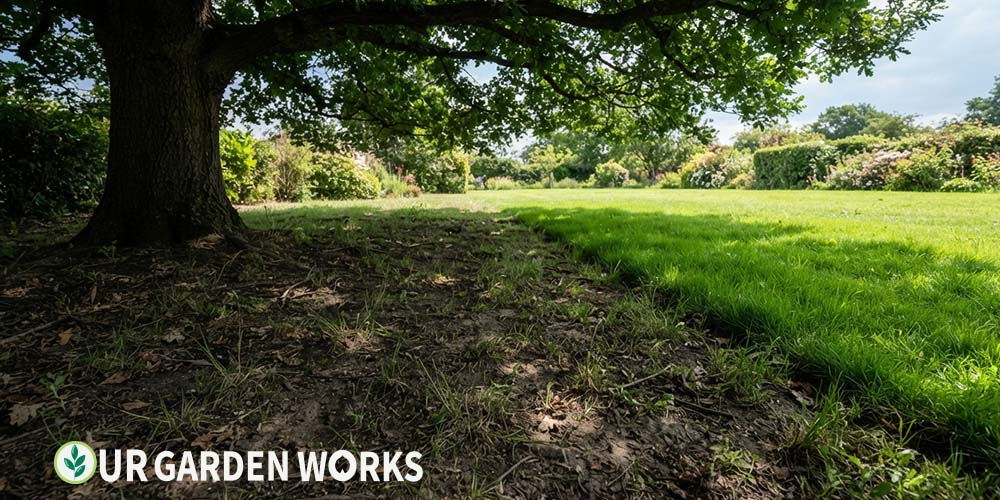
Shaded lawn areas are genuinely one of the more persistent lawn challenges, mostly because the standard advice — water more, fertilize more, reseed again — addresses none of the actual underlying issue.
Grass needs light for photosynthesis, and no amount of additional water or fertilizer substitutes for light that simply isn’t there.
We’ll walk through what actually moves the needle in shaded areas, since this requires a different approach than most general lawn troubleshooting.
Quick Answer: Thin, patchy grass in shade is primarily a light limitation problem, not a watering or fertilizing problem. Real fixes include switching to a shade-tolerant grass variety, improving available light through selective tree pruning, raising mowing height in shaded zones, reducing foot traffic on already-stressed shaded turf, and in deep shade, accepting that groundcover or mulch may outperform any grass variety.
Why Standard Lawn Advice Fails in Shade
Most general lawn care advice assumes adequate sunlight is available, and the recommendations that follow — frequent fertilizing, standard mowing height, regular reseeding with whatever grass type matches the rest of the yard — all depend on that assumption holding true.
In shade, it doesn’t, and applying sun-lawn solutions to a shade problem explains why so many homeowners feel like they’ve “tried everything” without success.
Grass photosynthesizes less efficiently in reduced light, producing thinner blades, weaker root systems, and slower recovery from any stress, regardless of how much water or fertilizer is applied.
Until the light limitation itself is addressed or worked around, additional inputs largely go to waste rather than producing the thick, healthy turf you’d see in a sunnier spot with the same care.
Real Fix 1 — Switch to a Genuinely Shade-Tolerant Grass Variety
This is the single highest-impact change available, and it’s also the one most often skipped in favor of reseeding with the same grass type that’s already failing.
Fine fescues are widely regarded as among the most shade-tolerant common turf grass options, tolerating meaningfully less direct light than Kentucky bluegrass or most Bermuda grass varieties while still producing a reasonably dense, attractive lawn.
How to implement this fix: Identify your current grass type if unknown, then overseed the shaded area specifically with a fescue blend or another seed mix explicitly labeled for shade tolerance, rather than using the same general-purpose seed used elsewhere in the yard.
This single change often produces more visible improvement than any other single intervention in this guide.
💡 “Shade tolerant” still means some light is required
Even the most shade-tolerant grass varieties still need a meaningful amount of indirect or filtered light to survive — typically at least 3-4 hours of direct sun or equivalent filtered light daily.
In truly deep shade with little to no direct light at any point in the day, even the best grass seed blend may struggle, which is where the groundcover alternative covered later becomes worth genuinely considering.
Real Fix 2 — Improve Available Light Through Selective Pruning
Rather than only adapting the grass to existing shade, improving the actual light conditions through strategic pruning addresses the root cause directly.
Removing lower branches on mature trees, thinning overly dense canopy growth, and trimming back overgrown shrubs that block light all increase how much sun reaches the ground beneath, often more significantly than expected from what feels like a modest pruning effort.
How to implement this fix: Consult a tree professional for guidance on safe, healthy pruning amounts for mature trees, since removing too much canopy at once can stress the tree itself.
Even a modest, well-planned pruning session focused on lower branches and the densest interior growth can shift a shaded lawn area from struggling to genuinely viable.
Real Fix 3 — Raise Mowing Height in Shaded Zones
Grass in shade benefits from more leaf surface area to maximize whatever limited photosynthesis is possible, which means mowing shaded areas slightly taller than you would in full sun — often an extra half-inch to a full inch — genuinely helps the grass cope better with reduced light. This is a free, immediate adjustment requiring no purchases or major projects.
How to implement this fix: If your mower has adjustable deck height, raise it specifically when mowing the shaded section, or accept a slightly taller overall lawn height if separating mowing heights between zones isn’t practical for your equipment or routine.
Real Fix 4 — Reduce Foot Traffic on Shaded Turf
Shaded grass, already weakened by light limitation, recovers from foot traffic compaction and wear far more slowly than vigorous, sun-grown turf.
A shaded area that also happens to be a regular walking path compounds two stress factors simultaneously, making recovery even harder than either factor alone would cause.
How to implement this fix: Where practical, redirect regular foot traffic away from shaded lawn areas using a path, stepping stones, or simply encouraging an alternate route, giving the already-stressed grass one less compounding challenge to contend with.
Real Fix 5 — Accept Groundcover or Mulch in Deep Shade
In genuinely deep shade — areas receiving little to no direct or strong filtered light at any point during the day — even the most shade-tolerant grass variety may simply never thrive, regardless of how well you implement every other fix in this guide.
At some point, continuing to fight for turf grass in conditions it fundamentally can’t support becomes a losing, frustrating, and expensive ongoing battle.
How to implement this fix: Shade-tolerant groundcovers, ornamental mulched beds, or hardscaping (a small patio, gravel area, or path) all provide attractive, low-maintenance alternatives to continuing to reseed grass in a spot it’s simply not suited to. This isn’t giving up — it’s matching the solution to the actual growing conditions rather than fighting them indefinitely.
Adjusting Watering Specifically for Shaded Areas
While watering alone doesn’t fix the underlying light limitation, shaded soil does behave differently than sunny soil in ways worth understanding to avoid compounding the problem with poor watering habits.
Shaded areas typically retain moisture longer than sunny spots since less direct heat and evaporation occurs, meaning the same watering schedule that’s appropriate for the rest of your sunny lawn can actually overwater shaded grass, creating waterlogged, weak roots on top of the existing light stress.
Reducing watering frequency specifically in shaded zones, or watering the whole lawn on a schedule calibrated to the sunnier areas while accepting that shaded spots will naturally stay somewhat moister longer, prevents this compounding issue.
Checking soil moisture directly in the shaded area before watering, rather than assuming it needs the same schedule as sun-exposed turf, helps you calibrate this more accurately for your specific yard’s conditions.
Managing Fallen Leaves and Debris in Shaded Areas
Shaded lawn areas, especially those beneath deciduous trees, often accumulate more fallen leaves and organic debris than sunnier open areas, and this debris can further smother already light-stressed grass if allowed to sit for extended periods.
A layer of fallen leaves blocks what limited light is already reaching the grass beneath, compounding the existing shade stress in a way that’s easy to overlook since leaf litter feels like a separate, unrelated seasonal task rather than part of the same underlying shade-management challenge.
Regular raking or mulching of fallen leaves in shaded lawn zones, rather than allowing them to accumulate over an extended period, removes this additional light-blocking factor and gives already-struggling shaded grass one less obstacle to contend with.
This is a particularly important habit during fall in regions with significant deciduous tree cover, when leaf accumulation happens fastest and the consequences of neglecting it compound most quickly.
Which Fix Should You Try First?
| Situation | Recommended First Fix |
|---|---|
| Currently growing wrong grass type for shade | Switch to shade-tolerant seed blend |
| Dense tree canopy blocking most light | Selective pruning to improve light first |
| Shaded area also a walking path | Redirect traffic, then reseed |
| Deep shade, little to no direct light ever | Consider groundcover or mulch instead of grass |
Frequently Asked Questions
How much sun does grass actually need at minimum to survive?
Most standard turf grass needs at least 4-6 hours of direct sunlight daily to thrive, while the most shade-tolerant varieties like fine fescue can sometimes manage with as little as 3-4 hours of direct sun or a longer period of bright, filtered light.
Below this threshold, even the best shade-tolerant grass seed typically struggles to maintain a dense, healthy stand over time.
Will fertilizing more heavily compensate for inadequate light in a shaded lawn area?
No — fertilizer provides nutrients, but photosynthesis (which requires light, not fertilizer) is what actually produces the energy grass needs to grow and thrive.
Over-fertilizing a shaded area in an attempt to compensate for light limitation often does more harm than good, sometimes promoting weak, disease-prone growth without addressing the actual underlying constraint.
Is it worth removing a tree entirely to fix a shaded lawn problem?
This is a significant, often irreversible decision that should weigh the tree’s other benefits (shade for the house, wildlife habitat, property value, aesthetics) against the relatively modest goal of improving a patch of lawn.
Selective pruning to improve light without full removal addresses many shade-related lawn issues effectively enough that full tree removal is rarely the first or most proportionate response.
Related Articles in Our Lawn Care Guide
Final Thoughts
We hope this guide has given you fixes that actually address why shaded grass struggles, rather than more of the same advice that doesn’t account for the light limitation at the heart of the problem.
For more lawn care guidance, our full collection of lawn articles on the soil and fertility page covers everything from seasonal maintenance to soil health.
Share this post with a fellow homeowner who’s battling a shaded lawn area — and let us know in the comments which fix made the biggest difference for you. Happy growing!
