

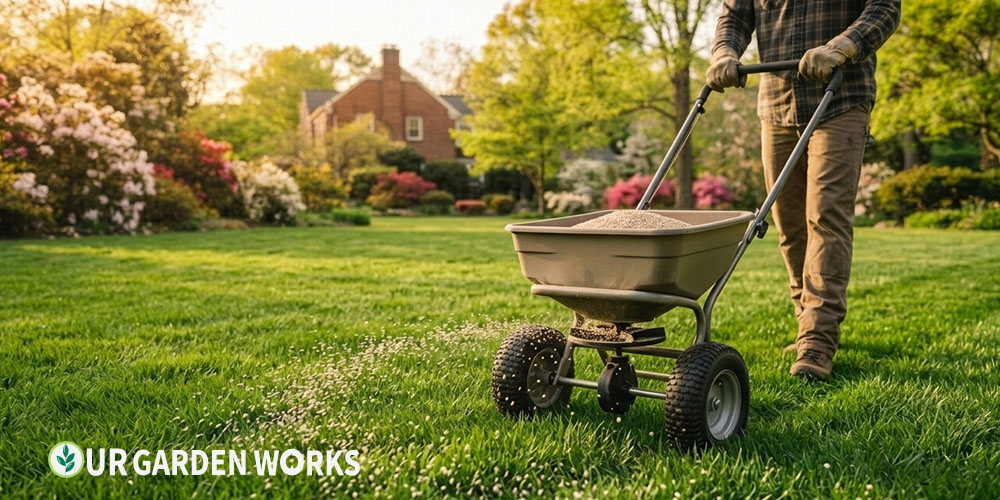
Spring lawn care has a specific sequence that most homeowners get wrong — not because the individual tasks are hard, but because doing them in the wrong order wastes money and effort.
Applying pre-emergent after aerating. Fertilizing before the grass is actively growing. Overseeding at the same time as pre-emergent. These common timing errors are the reason so many spring lawn care efforts produce disappointing results.
This schedule lays out the correct sequence for both cool-season and warm-season grasses — with specific timing anchors based on soil temperature, not calendar date, because soil temperature is what actually governs grass growth and product effectiveness.
Editor’s Note: Cool-season grass (fescue, bluegrass, ryegrass) spring sequence: 1) Clean up debris when soil is workable, 2) aerate if compacted, 3) apply pre-emergent at soil temp 50–55°F, 4) first fertilizer application 4–6 weeks later, 5) overseed thin spots in fall. Warm-season grass (Bermuda, zoysia, St. Augustine): wait for full green-up before doing anything — all tasks shift to late spring.
The Soil Temperature Anchor — More Important Than Calendar Date
Every spring lawn task has a soil temperature trigger — not a calendar date. The same calendar date means very different soil temperatures in Georgia versus Minnesota. A soil thermometer pushed 2–3 inches into the lawn gives you the number that actually governs what to do next.
| Soil Temp | What It Means | Task to Trigger |
|---|---|---|
| Below 40°F | Soil dormant, grass dormant | Nothing lawn-specific — prep equipment |
| 40–50°F | Cool-season grass root activity begins | Cleanup, aeration, dethatching |
| 50–55°F | Crabgrass seeds begin germinating | Apply pre-emergent NOW for cool-season lawns |
| 55–65°F | Cool-season grass actively growing | First fertilizer application |
| 65–70°F | Warm-season grass begins green-up | Start warm-season grass schedule |
| 70°F+ | Warm-season grass fully active | Aerate, fertilize, treat warm-season lawns |
Cool-Season Grass Schedule (Fescue, Bluegrass, Ryegrass)
Cool-season grasses grow actively in spring and fall, go semi-dormant in summer heat. All spring tasks need to be completed in the spring window before soil temperatures exceed 80°F.
Step 1 — Cleanup and Assessment (Soil Temp 40–50°F)
- Rake out dead grass, leaves, and debris
- Do the screwdriver compaction test and thatch assessment
- Identify thin spots, bare patches, and problem areas to address
- Sharpen mower blades before the first mow of the season
Step 2 — Aerate If Compacted (Soil Temp 40–55°F)
Aerate before applying any products. See our complete spring lawn aeration guide for method and timing. Skip this step if the screwdriver test shows no compaction.
Step 3 — Apply Pre-Emergent (Soil Temp 50–55°F)
This is the most time-sensitive spring lawn task. Crabgrass and other summer annual weeds begin germinating when soil reaches 55°F. Pre-emergent must be in the soil before this threshold — it prevents germination; it cannot kill seeds that have already sprouted.
Timing rule: apply when forsythia is in full bloom in your area — this is a reliable biological indicator that soil temperatures are approaching the pre-emergent window.
⚠️ Do not overseed and apply pre-emergent at the same time
Pre-emergent herbicide prevents ALL seeds from germinating — including your grass seed. If you need to overseed thin areas, either skip pre-emergent in those zones and spot-treat weeds instead, or wait until fall to overseed. You cannot do both simultaneously.
Step 4 — First Fertilizer Application (Soil Temp 55–65°F)
Wait until the grass is actively growing before applying nitrogen fertilizer. Applying nitrogen to dormant or barely-active grass causes the nitrogen to leach away or run off before roots can absorb it. When the lawn needs its first mow of the season, it’s ready for fertilizer.
Spring fertilizer rate: for cool-season grasses, 0.5–1 lb of actual nitrogen per 1,000 square feet in spring. If you notice yellow spots developing in the lawn despite adequate nitrogen, switch to a soil test before applying more. Use a slow-release formula to extend the benefit through the season without pushing excessive top growth.
Step 5 — Mowing Protocol
First mow at one-third lower than your target height to remove brown winter tips. Then return to the correct mowing height and maintain it:
- Kentucky bluegrass: 2–3 inches
- Tall fescue: 3–4 inches (higher in summer)
- Fine fescue: 2.5–3 inches
- Perennial ryegrass: 2–3 inches
Never remove more than one-third of the blade height in a single mowing. Scalping the lawn stresses the grass and opens the canopy to weed seeds.
Warm-Season Grass Schedule (Bermuda, Zoysia, St. Augustine, Centipede)
Warm-season grasses go dormant brown in winter and don’t begin active growth until soil temperatures reach 65–70°F.
The cardinal rule: do nothing significant until your warm-season lawn is at least 50% green. Aerating, fertilizing, or treating dormant warm-season grass wastes product and invites weed competition into a lawn without the density to fight back.
Step 1 — Wait for Green-Up (Soil Temp 65–70°F)
- Clean up debris once soil is workable
- Mow at a scalping height (1–1.5 inches) once the lawn is 50% green to remove dead top growth and allow sunlight to warm the soil faster
- Do NOT fertilize, aerate, or apply anything until fully green
Step 2 — Pre-Emergent (Soil Temp 55°F, Before Full Green-Up)
For warm-season grasses, apply pre-emergent slightly earlier than it feels right — when soil temps are approaching 55°F, even before the lawn is fully green. Crabgrass doesn’t wait for your lawn to wake up.
Step 3 — Aerate (Soil Temp 70°F+, Grass Actively Growing)
Aerate warm-season grasses in late spring through early summer — never in early spring or fall. Warm-season grass recovery from aeration requires active growth; aerating during dormancy or spring transition creates open wounds the lawn cannot heal quickly.
Step 4 — Fertilize (Lawn Fully Green, Actively Growing)
First fertilizer application once the lawn is fully green and growing:
- Bermuda grass: 1 lb nitrogen per 1,000 sq ft; repeat every 4–6 weeks through summer
- Zoysia: 0.5–1 lb nitrogen per 1,000 sq ft; feed less aggressively than Bermuda
- St. Augustine: Slow-release formula, 1 lb nitrogen per 1,000 sq ft
- Centipede: Light fertilizer only — 0.5 lb nitrogen or less. Over-fertilizing centipede causes decline.
Spring Lawn Care Calendar — Quick Reference
| Task | Cool-Season Timing | Warm-Season Timing |
|---|---|---|
| Debris cleanup | Early spring, soil workable | Early spring, soil workable |
| Aeration | Early spring (secondary window) | Late spring after full green-up |
| Pre-emergent | Soil temp 50–55°F | Soil temp approaching 55°F |
| First fertilizer | Soil temp 55–65°F, lawn actively growing | Lawn fully green, soil 70°F+ |
| First mow | When grass needs it (4–5 inches) | After scalp mow at green-up |
| Overseeding | Fall only — conflicts with spring pre-emergent | Not applicable for most |
| Weed control (post-emergent) | After 3–4 mowings, lawn established | After full green-up |
Common Spring Lawn Care Timing Mistakes
The single most expensive mistake is applying pre-emergent too late. Crabgrass seeds germinate when soil reaches 50–55°F, which often happens weeks before gardeners think it does — especially in a warm spring.
By the time you see crabgrass seedlings, the window for pre-emergent has fully closed and you’re left managing a weed rather than preventing one.
The second most common mistake is fertilizing too early. A lawn that’s just coming out of dormancy doesn’t have the root activity to efficiently take up nitrogen yet, and early-applied fertilizer is especially vulnerable to being washed away by spring rains before it can be absorbed. Wait until the lawn is actually actively growing, not just beginning to green up at the tips.
Overwatering in spring is another underrated problem. Lawns emerging from winter need less water than you think — soil is often still holding moisture from snowmelt or spring rains.
Saturating already-moist soil encourages shallow roots and creates ideal conditions for fungal diseases like snow mold and pink patch that thrive in cool, damp conditions.
Tools You Need for Spring Lawn Care
The two most important pieces of equipment for spring lawn care are a soil thermometer and a calibrated spreader — and most homeowners have neither.
A soil thermometer costs under $15 and gives you the number that governs every decision in this schedule. Without it, you’re timing everything by calendar date, which is consistently less accurate.
A broadcast or drop spreader ensures fertilizer and pre-emergent are applied at the label-specified rate rather than guessed.
Over-applying either one is worse than under-applying — too much pre-emergent prevents overseeded grass from germinating, and too much fertilizer causes nitrogen burn.
💡 Calibrate your spreader every season
Spreader settings vary by product — never assume last year’s setting for fertilizer A applies to fertilizer B.
Do a quick calibration pass over a tarp before spreading on the lawn: weigh what comes out in a measured pass and confirm it matches the label rate before you commit to the full lawn.
Frequently Asked Questions
Can I apply fertiliser and pre-emergent at the same time?
Combination weed-and-feed products apply both simultaneously, which is convenient but not ideal timing. For best results, apply pre-emergent at soil temperature 50–55°F, then apply a separate fertilizer application 4–6 weeks later when the lawn is actively growing. Combo products are a reasonable compromise for homeowners who want to simplify the schedule.
My lawn has both cool-season and warm-season grasses — what do I do?
Mixed-grass lawns (common in the transition zone — Virginia through Kansas) require a compromise schedule. Apply pre-emergent on the cool-season timeline (soil temp 50–55°F).
Delay fertilizer until the warm-season component is beginning to green up. Avoid aerating until the warm-season grass is actively growing — late April through May for most transition zone areas.
How do I know if my lawn actually needs aerating this spring?
Push a screwdriver or pencil 6 inches into the lawn with moderate pressure. If it goes in easily, compaction isn’t severe enough to need aeration this season — focus on fertilizing and overseeding instead.
If it meets significant resistance before 3 inches, compaction is restricting root growth and aeration should be your first active task of the spring schedule.
Is it too late to apply pre-emergent if I missed the 50–55°F window?
Once soil has been above 55°F for more than a few days, pre-emergent has limited effectiveness against crabgrass that’s already germinated.
At that point, your options shift to post-emergent crabgrass control products applied directly to young crabgrass plants (most effective when plants are under 3 inches tall) and planning a pre-emergent application in late summer to target winter annuals instead.
Related Articles in Our Soil & Fertility Guide
Free Tools for Lawn Care Planning
We hope this schedule takes the guesswork out of spring lawn care and gives you a clear task list in the right order. The sequence matters as much as the individual tasks — pre-emergent before fertilizer, aeration before overseeding, mowing before you apply anything.
For your specific frost dates and soil temperature thresholds, our frost dates tool gives you the exact timing anchors for your ZIP code.
For the rest of a complete seasonal lawn routine, our soil and fertility guides cover aeration, overseeding, and scarifying in depth.
Share this with a fellow gardener who is staring at their patchy lawn this spring and wondering what to do first — and let us know in the comments how your lawn is looking this spring. Happy growing!
