

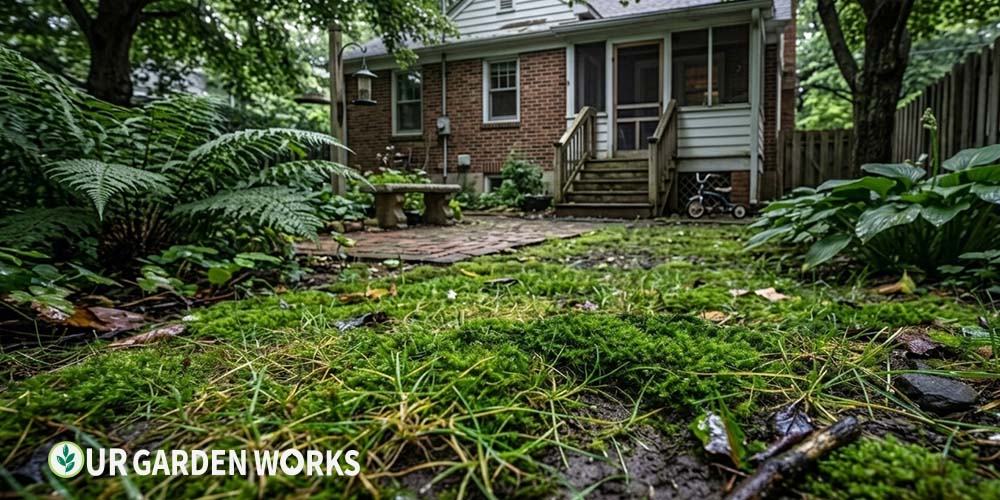
Moss showing up in your lawn isn’t really the problem. It’s a symptom of conditions your grass doesn’t like — usually some combination of shade, compaction, poor drainage, or acidic soil.
You can kill the moss you see today with a moss killer spray, and it will come right back next year if you don’t fix what let it move in. This guide covers both: the quick fix and the actual cause.
How to get rid of moss in your lawn – Quick Guide: Apply an iron-based moss killer (ferrous sulfate) to kill existing moss within a few days, then rake out the dead moss. But the moss returns unless you address the underlying cause — usually shade, compacted soil, poor drainage, or acidic pH below 6.0. Fix the cause and the moss problem ends permanently.
Why Moss Shows Up Where Grass Struggles
Moss and grass aren’t really competing for the same space in the way two grass varieties would. They’re suited to almost opposite conditions.
Grass needs full sun, well-drained soil, decent fertility, and a near-neutral pH to grow thick and outcompete everything else. Moss needs none of that.
It thrives in shade, compacted wet soil, low fertility, and acidic conditions — exactly the spots where grass is already struggling to survive. Moss doesn’t invade healthy grass. It fills in where grass has already given up.
💡 This is why killing moss alone never works long-term
Spraying moss killer removes the moss but does nothing to the conditions that let it take hold in the first place.
Within one season, if shade and drainage haven’t changed, new moss spores (which are everywhere, all the time) recolonize the same bare, struggling patch.
Step 1 — Identify Which Cause Applies to Your Lawn
Most lawns have moss for one or two of these four reasons. Walk your moss patches and check each one.
| Cause | How to Tell | Fix |
|---|---|---|
| Too much shade | Moss under trees, near fences, north side of house | Prune trees, choose shade-tolerant grass, or accept moss as groundcover |
| Compacted soil | Hard to push a screwdriver in; heavy foot traffic area | Core aerate in fall and spring |
| Poor drainage | Soil stays soggy 24+ hours after rain | Improve drainage, add organic matter, consider a French drain |
| Acidic soil (low pH) | Confirmed by a soil test below 6.0 | Apply lime per soil test recommendation |
It’s common to have more than one cause stacked together. A shaded, compacted spot near a downspout is often dealing with all three at once, which is exactly why moss in that one corner of the yard always seems to come back no matter what you try.
Step 2 — Kill the Existing Moss
Directions
- Apply an iron-based moss killer (ferrous sulfate) following the label rate. This is the standard, lawn-safe option.
- Wait 3–7 days. The moss will turn black or dark brown as it dies — this is expected and means it’s working.
- Rake out the dead moss vigorously with a hard-tined rake. This is genuinely the hardest part physically — dead moss is dense and clingy.
- Don’t skip the raking. Leaving dead moss in place blocks light and air from reaching the soil, which just sets up the next moss colony.
⚠️ Iron-based products can stain
Ferrous sulfate moss killers can stain concrete, pavers, and clothing. Sweep granular product off hard surfaces immediately after application, and rinse any spills before they dry.
Step 3 — Fix the Underlying Cause
If the Cause Is Shade
Thin out overhanging tree branches to let more light through. Even a moderate increase in light can shift the balance back toward grass.
If the shade is permanent (a fence, a building), consider switching that area to a shade-tolerant fine fescue blend, or simply accept moss as an intentional groundcover. Moss lawns are a real, low-maintenance landscaping choice in deep shade.
If the Cause Is Compaction
Core aerate the area in spring and fall. This physically removes small plugs of soil, relieving compaction and letting air, water, and roots move more freely.
Follow aeration with overseeding — the freshly opened soil is ideal for seed-to-soil contact. See our overseeding guide for the full process.
If the Cause Is Drainage
Check where water is coming from. Often it’s a downspout, a low spot, or runoff from a neighboring slope.
Redirecting that water source, regrading a low spot, or adding organic matter to improve soil structure all help. For genuinely waterlogged spots, a French drain may be the real fix.
If the Cause Is Acidic Soil
Get a soil test to confirm pH before applying lime — guessing wastes money and can overcorrect. Our soil pH calculator helps you read the results and figure out exactly how much lime to apply.
Lime works slowly, often taking a full season or more to meaningfully shift pH. Don’t expect overnight results, and don’t reapply heavily out of impatience.
Why You Can’t Just Out-Fertilize Moss
A common instinct is to throw down extra fertilizer on a mossy patch, hoping to push grass growth hard enough to crowd the moss out. This rarely works on its own.
Fertilizer feeds grass roots, but if the underlying conditions (shade, compaction, poor drainage, wrong pH) are still in place, the grass still can’t compete effectively no matter how much nitrogen is available. Worse, excess unused fertilizer can wash into nearby waterways or simply feed weeds instead.
Fertilizer is a genuinely useful supporting tool once the actual cause is addressed — it’s just not a substitute for fixing that cause first.
Why pH Affects Moss So Directly
It’s worth understanding the actual mechanism, since “acidic soil causes moss” can sound like a vague correlation rather than a real cause. Grass roots have a fairly narrow pH range — roughly 6.0 to 7.0 — where they can efficiently take up nitrogen, phosphorus, and other key nutrients from the soil.
Outside that range, those nutrients become chemically less available even if they’re present in the soil, which weakens grass growth regardless of how much fertilizer you apply. Moss, by contrast, doesn’t rely on the same root-based nutrient uptake system at all.
It absorbs moisture and nutrients directly through its surface tissue, which works just fine in acidic conditions that leave grass starved. This is why correcting pH alone, with no other changes, often shifts the competitive balance back toward grass without needing any other intervention.
Keeping Moss From Coming Back
Once you’ve cleared moss and addressed its cause, a few ongoing habits keep it from returning. Mow at the correct height for your grass type — cutting too short stresses grass and opens up bare soil moss can colonize.
Keep an eye on the same trouble spots each fall, since shade and drainage issues tend to be seasonal. A spot that’s sunny and dry in summer can become shaded and damp again once deciduous trees drop their leaves and rainfall increases.
Annual aeration and a fall soil test, even in years without visible moss, catch compaction or pH drift before they get bad enough to invite moss back in.
Frequently Asked Questions
Will moss kill my grass if I leave it alone?
Moss doesn’t actively kill grass through competition the way a vine might choke a plant. It simply fills space where grass has already declined due to shade, compaction, or poor drainage. Left alone, moss will spread to fill any space grass isn’t actively occupying, but it isn’t attacking healthy grass directly.
Can I just remove the moss by hand instead of using a chemical killer?
Yes — hand-raking or power-raking moss out works without chemicals, though it’s more physically demanding and won’t kill spores already present in the soil the way an iron treatment does. Combined with fixing the underlying cause, manual removal is a perfectly valid chemical-free option.
Is moss actually bad for my lawn, or just unattractive?
Moss itself doesn’t damage soil or grass roots. The concern is mostly aesthetic, plus the fact that moss patches are often slippery when wet, which matters on walkways or play areas. In purely ornamental beds or deep shade where grass won’t grow anyway, many gardeners simply let moss be the groundcover.
How long does it take to permanently get rid of lawn moss?
Killing visible moss takes about a week. Fixing the underlying cause and seeing grass fully reclaim the space typically takes a full growing season, sometimes two if the cause is pH (which corrects slowly) or heavy shade (which may need a tree pruned and a season to respond).
Does raking moss out spread it to other parts of my lawn?
It’s a reasonable concern, but moss spores are already present essentially everywhere in your yard’s soil and air, waiting for the right conditions. Raking out one patch doesn’t meaningfully “introduce” moss elsewhere — the spores were already there. Bag and dispose of the raked debris rather than leaving piles, mostly for tidiness rather than spread prevention.
Can dog urine or pet activity cause moss to grow in a lawn?
Not directly — pet urine more commonly causes brown, dead patches from nitrogen burn rather than moss specifically. However, heavily trafficked pet areas often become compacted from repeated foot and paw traffic, and that compaction is a genuine moss-friendly condition. If your dog has a favorite path or spot, treat it the same as any other compacted area.
🌱 Related Articles in Our Soil & Fertility Guide
🛠️ Free Tools
Final Thoughts
We hope this gives you a complete picture of why moss showed up and what it’ll actually take to keep it gone for good. Treating the cause instead of just the symptom is the difference between a one-time fix and a yearly battle.
For more on building a thicker, healthier lawn overall, our soil and fertility guides cover the rest.
Share this post with a fellow gardener dealing with a mossy lawn — and let us know in the comments which cause turned out to be behind yours. Happy growing!
