

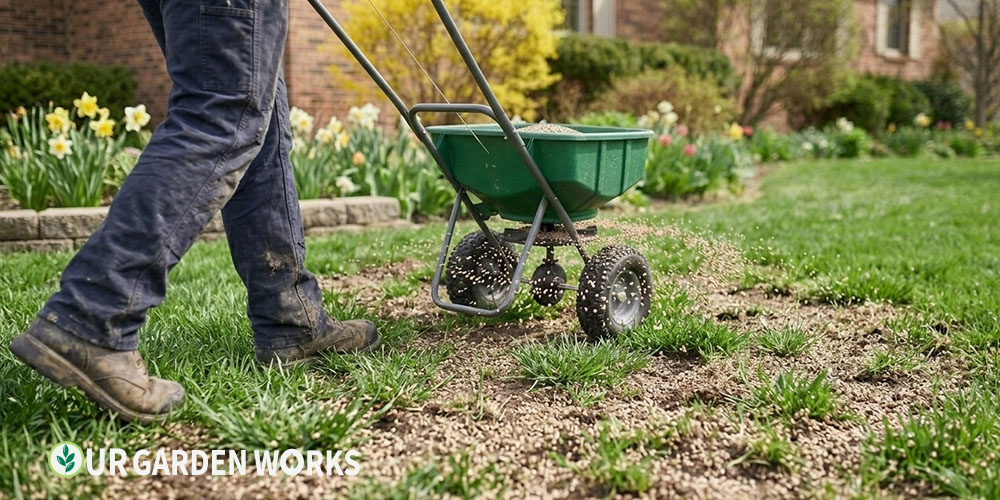
Overseeding is the practice of spreading new grass seed directly over an existing lawn to thicken thin areas and fill bare patches, without tearing out and replacing what’s already growing.
It’s one of the highest-leverage lawn care techniques available, because a thicker lawn naturally crowds out weeds, holds moisture better, and recovers from foot traffic and stress far more easily than a sparse one.
How to Overseed a Lawn – Quick Guide: Overseed in early fall for cool-season grasses or late spring for warm-season grasses, after mowing short and dethatching or aerating to expose soil. Spread seed at the rate recommended on the label, lightly rake it in for soil contact, and keep the area consistently moist for the first 2–3 weeks until germination is complete.
Try our free tool: Lawn Overseeding Calculator – How Much Grass Seed and Fertilizer You Need
Why Seed-to-Soil Contact Is the Step Most People Skip
Grass seed scattered over an existing lawn without any soil contact has a dramatically lower germination rate than seed worked into loosened soil, and the reason comes down to basic seed biology.
A seed needs consistent moisture against its outer coat to trigger germination, and seed sitting on top of thatch or dense grass blades — rather than in contact with actual soil — dries out far faster between waterings, repeatedly interrupting the process before it can complete.
This is exactly why dethatching or light aeration before overseeding matters so much. Removing the dead thatch layer and breaking up compacted soil exposes bare earth the new seed can actually settle into, rather than seed that’s effectively stranded on top of existing growth with no way to reach moist soil underneath.
Why Germination Is So Sensitive to Moisture Interruption
It’s worth understanding exactly what happens inside a grass seed during germination, since it explains why even a single missed watering can effectively reset the whole process.
Once a seed coat absorbs enough moisture to begin germination, internal enzymes activate and start breaking down stored starches into the sugars the emerging seedling needs for initial growth.
If that seed then dries out partway through this process, those enzymatic reactions halt, and in many cases the seed’s remaining energy reserves have already been partially consumed without producing a viable seedling — meaning a seed that dries out mid-germination often doesn’t simply pause and resume later, it frequently fails outright.
This is the underlying reason overseeding guides are so insistent about frequent, consistent watering during the germination window rather than treating it as a flexible suggestion.
This same biology explains why grass seed has such a wide germination time range depending on conditions — anywhere from 5 days to 3 weeks for common cool-season types.
Soil temperature, moisture consistency, and seed-to-soil contact quality all directly affect how efficiently those internal enzymatic processes can run, which is why two lawns overseeded with the same product on the same day can show meaningfully different germination timelines based purely on how well each was prepared and watered.
Step-by-Step: How to Overseed
Directions
- Mow the existing lawn shorter than usual — about 1.5–2 inches — to reduce competition for light and expose more soil surface to incoming seed.
- Dethatch or core aerate if thatch is heavier than ½ inch, or if soil feels compacted. This step alone meaningfully improves seed-to-soil contact.
- Choose a grass seed blend matched to your existing lawn type and the amount of sun the area receives.
- Spread seed using a broadcast or drop spreader at the rate listed on the seed label — overseeding rates are typically lower than rates for starting a lawn from bare soil.
- Lightly rake the seeded area to work seed into the top ¼ inch of soil, improving contact without burying seed too deep to germinate.
- Water lightly but frequently — 2–3 short sessions daily — to keep the top inch of soil consistently moist through germination, typically 7–21 days depending on grass type.
- Once seedlings reach mowing height, reduce watering frequency gradually and resume a normal mowing schedule, raising the blade slightly higher for the first few cuts.
The shift from frequent light watering during germination to a normal, deeper, less-frequent watering schedule afterward deserves its own explanation, since switching too early or too late both cause problems.
Frequent light watering keeps the soil surface consistently moist exactly where seeds and emerging roots need it, but doesn’t encourage roots to grow deep, since there’s no need to search for water beyond the surface layer.
Once seedlings are established enough to handle it, transitioning to less frequent, deeper watering actually encourages roots to grow downward in search of moisture, building the deeper, more drought-resilient root system a mature lawn needs.
Making this transition too early, before roots are established, risks letting young seedlings dry out; making it too late can leave the lawn with a shallow root system more vulnerable to future drought stress.
Choosing the Right Seed Blend
Matching seed to your existing lawn type matters more than many overseeding guides emphasize.
Overseeding a fescue lawn with a Kentucky bluegrass-only blend, for example, introduces a grass type with different growth habits, mowing needs, and seasonal coloring than what’s already established, which can create a visually patchy, inconsistent lawn even after successful germination.
For most cool-season lawns, a blend matching the dominant existing grass type, possibly with a modest percentage of a complementary type for added disease resistance or shade tolerance, produces the most visually uniform result.
Read the seed bag’s blend composition rather than just the marketing name, since “premium lawn mix” products vary considerably in their actual grass type percentages between brands, and a name alone tells you very little about what’s actually inside.
💡 Timing matters more than almost any other factor
Cool-season grasses (fescue, bluegrass, ryegrass) overseed best in early fall, when warm soil and cooling air give seedlings ideal germination conditions without summer heat stress. Warm-season grasses (Bermuda, zoysia) overseed best in late spring as soil warms. Overseeding at the wrong time for your grass type significantly lowers success regardless of how well you prep the soil.
Frequently Asked Questions
Can I overseed and apply pre-emergent weed control at the same time?
No — most pre-emergent herbicides prevent all seeds from germinating, including the grass seed you just put down. Wait at least 6–8 weeks after overseeding before applying pre-emergent, or use a product specifically labeled safe for use alongside new seeding.
How soon can I mow after overseeding?
Wait until new grass reaches about 3 inches tall, then mow to around 2.5 inches for the first cut — taking off no more than a third of the blade height at once. Mowing too early or too aggressively can uproot shallow new seedlings before they’re established.
Do I need to fertilize right after overseeding?
A starter fertilizer formulated for new grass, applied at or shortly after seeding, helps establish strong root development. Avoid high-nitrogen lawn fertilizers at this stage, since they push leaf growth at the expense of the root system new seedlings need to establish first.
Will birds eat the grass seed before it has a chance to germinate?
Some loss to birds is normal and generally accounted for in standard seeding rates, but heavy bird activity can meaningfully reduce germination in exposed areas. Lightly raking seed into the soil, as recommended in the steps above, helps significantly by making seed less visible and accessible than seed left sitting on the surface.
For particularly bird-prone areas, a thin layer of straw mulch over the seeded area provides additional cover while still allowing light and water through.
What should I do if it rains heavily right after overseeding?
Light to moderate rain is generally beneficial, providing the consistent moisture germination needs without any effort on your part.
Heavy, pounding rain can be more of a concern, since it has the potential to wash newly spread seed into low spots or off the area entirely, particularly on sloped ground. If heavy rain is forecast shortly after seeding, consider waiting a day or two if your schedule allows, or apply a light straw mulch beforehand to help hold seed in place.
How Long Until a Newly Overseeded Lawn Looks Fully Established?
Germination itself is only the first stage of a longer process, and it’s worth setting realistic expectations for the full timeline rather than judging success purely by whether seeds sprouted.
Cool-season grasses typically germinate within 7–14 days and reach a mowable height within 3–4 weeks, but a newly overseeded area often takes a full growing season — sometimes longer for thin, sparse spots — to blend in seamlessly with the surrounding established lawn in terms of density, color matching, and root depth.
Warm-season grasses, given their more aggressive spreading growth habit during their active season, often fill in visually faster, sometimes within just a few additional weeks beyond initial germination.
Patience during this establishment period matters as much as the initial seeding technique.
Resisting the urge to walk heavily on newly seeded areas, mowing conservatively at first, and maintaining consistent watering through the full establishment period — not just the first couple of weeks — all meaningfully affect how quickly and completely the new grass integrates with the rest of the lawn.
Related Articles in Our Soil & Fertility Guide
Final Thoughts
We hope this gives you a clear, complete picture of what overseeding actually requires to work — the prep work genuinely matters as much as the seed itself.
For the next steps in building out a complete lawn care routine, our soil and fertility guides cover aeration, fertilizing schedules, and more.
Overseeding done right is one of the most cost-effective lawn improvements available, transforming a thin, patchy lawn into a genuinely dense one without the time and expense of a full renovation.
The prep work — mowing short, addressing thatch, choosing the right timing — is what separates a successful overseeding from a bag of seed that mostly never germinated.
Get that part right, and the seed itself does most of the remaining work on its own, rewarding the effort with a noticeably thicker, more resilient lawn by the time the next growing season fully arrives and puts the new growth to its first real test against foot traffic and summer heat, the two key stresses a freshly overseeded lawn most needs to be fully ready for.
Share this post with a fellow gardener who’s ready to get growing — and let us know in the comments what grass type you’re overseeding and how thin the lawn was beforehand. Happy growing!
