

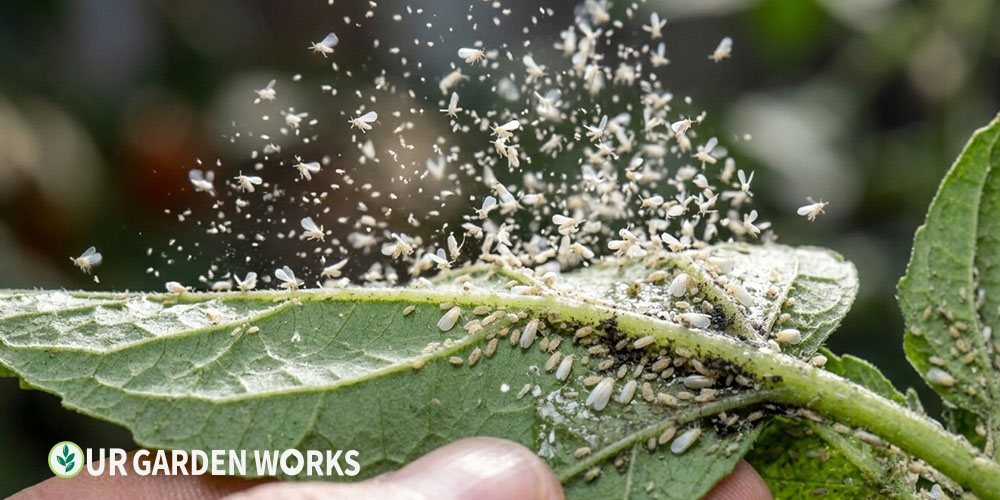
If you’ve ever brushed against a plant and watched a small cloud of tiny white insects scatter into the air, you’ve met whiteflies.
They’re frustratingly fast breeders, and their habit of clustering on leaf undersides means a quick, surface-level spray often misses most of the actual population — which is exactly why whitefly treatments need to be thorough and repeated to actually work.
How to Get Rid of Whiteflies – Quick Guide: Spray insecticidal soap or neem oil directly onto leaf undersides, where whiteflies feed and lay eggs, every 5–7 days for 3–4 applications to catch successive generations as they hatch. Yellow sticky traps help monitor and reduce adult populations between treatments. A single spray rarely resolves an infestation — the repeat schedule is what actually works.
Why a Single Treatment Almost Never Works
Whitefly eggs hatch into a nymph stage that’s largely immobile and protected on the leaf underside, making it naturally resistant to contact-based treatments like soap sprays that only kill on direct contact.
A single spray kills the adults and exposed nymphs present at that exact moment, but eggs already laid — and nymphs tucked against the leaf surface — frequently survive and continue the cycle.
This is why the standard recommendation is 3–4 treatments spaced 5–7 days apart, timed to intercept each new wave as eggs hatch and nymphs become vulnerable to contact treatment before they mature into egg-laying adults themselves.
Stopping after just one or two applications, even if the visible adult population seems to drop, usually means an undetected next generation is already developing.
The Full Whitefly Life Cycle and Why Timing the Spray Schedule Matters
It’s worth walking through the complete cycle to understand exactly why the 5–7 day interval between treatments is the number it is, rather than an arbitrary recommendation.
A whitefly egg hatches into a nymph within roughly 2–4 days under typical warm conditions, and that nymph then passes through several growth stages over about 2–4 weeks before emerging as a winged adult capable of flying to new leaves and laying its own eggs.
The 5–7 day spray interval is timed specifically to catch nymphs after they’ve hatched (and become exposed and vulnerable to contact sprays) but before they’ve matured into adults capable of producing the next generation.
Spacing treatments too far apart risks letting an entire generation mature to egg-laying adulthood between sprays, effectively resetting the population each time. Spacing them too close together wastes effort without giving newly hatched nymphs from the previous treatment cycle time to actually emerge and become targetable.
Temperature also plays a meaningful role in how quickly this cycle moves, which is worth keeping in mind when deciding exactly how strictly to follow the 5–7 day window.
Warmer conditions — a hot greenhouse, an indoor space kept consistently warm, or outdoor summer heat — accelerate the whitefly life cycle, sometimes shortening the egg-to-adult timeline enough that leaning toward the 5-day end of the interval, rather than the full 7 days, produces better results.
Cooler conditions slow the cycle down correspondingly, giving slightly more flexibility in spacing.
Step-by-Step Treatment
Directions
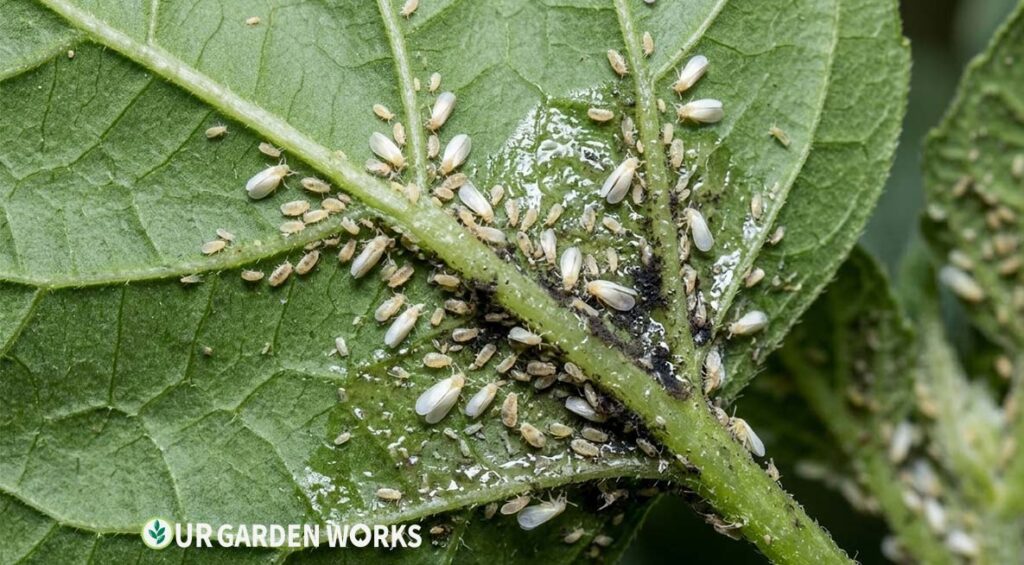
- Inspect leaf undersides closely — whiteflies and their pale, oval-shaped nymphs cluster there, often alongside sticky honeydew residue and sometimes sooty mold growing on it.
- Spray insecticidal soap or neem oil thoroughly, focusing specifically on leaf undersides rather than the more visible leaf tops. See our insecticidal soap vs neem oil guide to choose the right product for your situation.
- Repeat every 5–7 days for at least 3–4 total applications, even if the visible population appears to drop after the first spray.
- Place yellow sticky traps near affected plants to catch adults and help you track whether the population is genuinely declining between sprays.
- Remove and dispose of heavily infested leaves, which reduces the breeding population directly and speeds overall recovery.
- Improve airflow around plants where possible — whiteflies, like many soft-bodied pests, often build up faster in still, crowded conditions.
The instruction to focus on leaf undersides specifically, rather than spraying generally, deserves emphasis since it’s the single detail most likely to determine whether a treatment actually works.
Whiteflies position themselves and their eggs on the underside specifically because it offers protection from rain, direct sun, and many predators — which means it also offers protection from a spray applied carelessly from above.
Turning leaves over, or angling the spray nozzle upward from beneath the canopy, takes more effort but is the difference between a treatment that works and one that doesn’t.
💡 Check new plants before bringing them home
Whiteflies frequently arrive on infested nursery stock, particularly on the undersides of leaves where casual inspection misses them.
A quick check of leaf undersides before purchasing prevents introducing a population into an otherwise clean garden or houseplant collection.
Why Whiteflies Cluster So Heavily on Certain Plants
If whiteflies seem to gravitate toward specific plants in your garden while leaving others largely alone, this pattern reflects genuine host preferences rather than random distribution.
Whiteflies are drawn to plants with soft, tender leaf tissue and high sap sugar content — tomatoes, peppers, hibiscus, and many flowering ornamentals are common targets for exactly this reason, while tougher-leaved or more fibrous plants tend to see less pressure.
If your tomato leaves are yellowing alongside a whitefly infestation, our tomato leaf yellowing guide can help you confirm whether whiteflies are the actual cause or something else entirely.
This preference is worth factoring into garden planning if whiteflies have been a recurring problem in a particular bed.
Interspersing known whitefly-attractive plants with less preferred neighbors, rather than growing a dense monoculture of a favorite host plant, can reduce how quickly a population builds simply by making it harder for adults to find their preferred host repeatedly in close proximity.
This same principle is part of why diverse, mixed plantings tend to experience less severe pest pressure overall compared to large blocks of a single susceptible species.
Frequently Asked Questions
Are whiteflies actually harmful to my plants, or just unsightly?
Whiteflies feed by piercing plant tissue and extracting sap, which can stunt growth, cause yellowing, and weaken plants in significant numbers.
They also excrete sticky honeydew that promotes sooty mold growth, and in some cases can transmit plant viruses — a genuine infestation is worth treating promptly rather than dismissing as cosmetic.
Do yellow sticky traps actually reduce the population, or just help monitor it?
Both, to a meaningful degree. Whiteflies are strongly attracted to yellow, so traps placed near infested plants do catch and remove a real number of adults, reducing how many survive to lay further eggs — though traps alone rarely resolve a significant infestation without the spray treatment alongside them.
Why do whiteflies keep coming back after I think I've cleared them?
The most common cause is stopping treatment after only one or two applications rather than completing the full 3–4 treatment cycle. A second common cause is a nearby infested plant — indoors or outdoors — that’s continuously reseeding the population onto plants you’ve already treated.
Do natural predators help control whiteflies without any spraying at all?
Yes, meaningfully in outdoor gardens — ladybugs, lacewings, and several species of parasitic wasps all prey on whitefly nymphs and can keep populations in check without any intervention in a garden with a healthy population of these beneficial insects.
Indoor infestations don’t benefit from this natural control to the same degree, since most homes don’t host these predator populations, which is part of why indoor whitefly problems often require more active spray-based management than the same pest would in an outdoor setting.
Is it worth using yellow sticky traps as the only treatment, without spraying?
Sticky traps alone are rarely sufficient to fully resolve an established infestation, since they only catch adults that happen to fly into them rather than addressing eggs and nymphs still developing on the plant.
They’re most useful as a monitoring tool and as a supplement to the spray schedule described above, helping you confirm the population is declining between treatments rather than serving as the primary control method.
When to Consider a Stronger Treatment Approach
For most home garden and houseplant infestations, the insecticidal soap or neem oil spray schedule described above resolves the problem within the standard 3–4 treatment cycle.
Occasionally, particularly in greenhouse conditions or with especially heavy, well-established infestations, this approach alone isn’t enough.
In these more stubborn cases, products containing pyrethrin or insecticidal soap formulated at a higher concentration specifically for whiteflies can provide stronger knockdown, though they should still be applied following the same repeat-treatment logic described above rather than expecting a single stronger application to substitute for the full cycle.
Systemic insecticides, which the plant absorbs and which then affect insects feeding on any part of the plant, are another option for severe cases, though they come with their own considerations around safety for edible crops and impact on pollinators that are worth researching specifically for your situation before choosing this route.
For most home gardeners, though, persistence with the basic soap or neem oil approach — genuinely committing to all 3–4 applications on schedule rather than stopping early — resolves the overwhelming majority of whitefly problems without needing to escalate to anything stronger.
🐛 Related Articles in Our Pest Control Guide
Final Thoughts
We hope this gives you a treatment plan that actually breaks the cycle rather than just knocking back the visible population temporarily. Whiteflies respond well to consistency — the repeat schedule really is the key detail most quick-fix advice leaves out.
For more on natural pest treatment options, our pest control guides cover the rest.
The hardest part of treating whiteflies usually isn’t the spraying itself, but sticking with the full schedule even after the visible population appears to have dropped following the first or second application.
That apparent improvement is real, but it’s also exactly the point where most people stop too early — pushing through the full 3–4 treatments is what actually closes out the cycle for good.
Mark each application on a calendar so the schedule doesn’t quietly slip once the plant starts looking better, since that’s exactly the moment the temptation to stop early is strongest, and exactly the moment a few remaining nymphs are quietly maturing into the next generation, ready to start the whole cycle over again right under your nose, undoing several full, hard-won weeks of otherwise careful, diligent treatment in the process.
Share this post with a fellow gardener who’s ready to get growing — and let us know in the comments how many treatment rounds it took to clear your whiteflies. Happy growing!
