

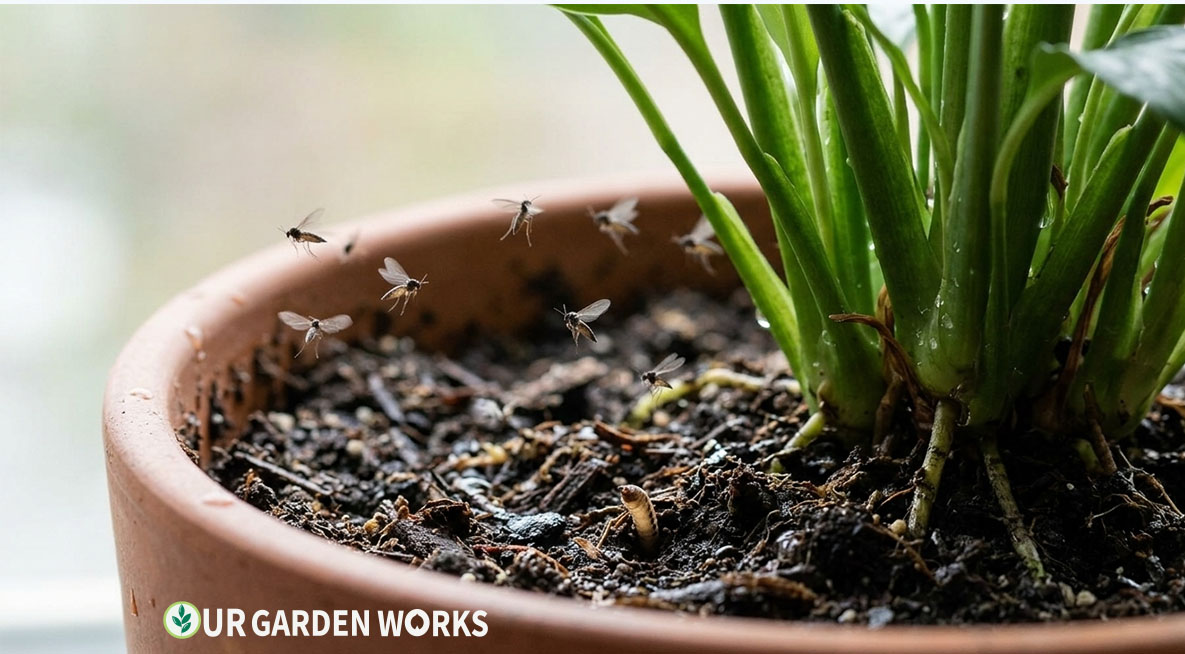
Fungus gnats are more annoying than dangerous to most established plants, but a swarm of tiny flying insects every time you water can make any plant collection feel like a problem.
The good news is that fungus gnats have a genuinely predictable life cycle, and breaking it doesn’t require harsh chemicals — just consistency.
How to Get Rid of Fungus Gnats – Quick Guide: Fungus gnats breed in consistently moist soil, so the most effective fix is letting the top 1–2 inches of soil dry out between waterings, which kills larvae before they mature. Combine this with yellow sticky traps for adults and a thin layer of sand or diatomaceous earth on the soil surface to prevent new egg-laying.
Why Drying the Soil Surface Solves the Problem at Its Root
Fungus gnat larvae live in the top layer of soil and feed primarily on fungi and decaying organic matter, which thrive specifically in consistently moist conditions.
The adult gnats you see flying around are simply looking for that same moist soil to lay their next batch of eggs — the visible swarm is really just evidence of an ongoing breeding cycle happening just below the surface.
Letting the top inch or two of soil dry out between waterings interrupts this cycle directly: existing larvae in that drying layer die from lack of moisture, and adult gnats have nowhere suitable to lay new eggs.
This single change, consistently applied, resolves most fungus gnat problems within 2–3 weeks without any additional product needed — though combining it with the methods below speeds up visible results.
The Complete Fungus Gnat Life Cycle, and Where to Interrupt It
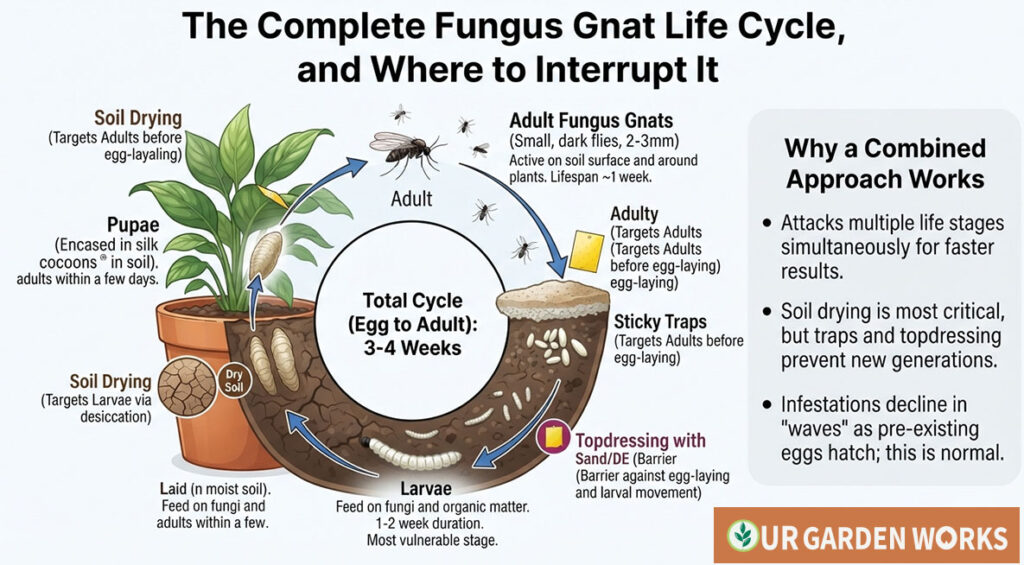
It’s worth understanding the full life cycle, since different stages respond to different interventions, and knowing which stage you’re targeting helps explain why a combined approach works better than any single method alone.
Adult fungus gnats lay eggs directly into moist soil, and those eggs hatch into larvae within roughly 3–6 days under typical indoor conditions.
The larval stage, which does the actual feeding on fungi and organic matter in soil, lasts about 1–2 weeks before pupating, and the pupal stage lasts another few days before a new adult emerges to begin the cycle again.
This entire cycle, egg to adult, typically takes around 3–4 weeks, though warmer, consistently moist conditions can shorten it.
Soil drying primarily targets the larval stage, since larvae are the most vulnerable to desiccation. Sticky traps target adults before they can lay new eggs. Topdressing with sand or diatomaceous earth creates a barrier that interferes with both adult egg-laying and larval movement near the surface.
Using all three together attacks the cycle at multiple points simultaneously, which is why the combined approach typically resolves an infestation faster than soil drying alone, even though soil drying is the single most important piece.
This staged understanding also explains why infestations seem to come in waves rather than declining smoothly once treatment begins.
A treatment applied on day one kills existing larvae and traps existing adults, but eggs already laid before treatment started will still hatch on their own schedule over the following week, producing what looks like a brief resurgence before the population genuinely declines.
This is normal and expected, not a sign the treatment isn’t working — it simply reflects the staggered ages of the population present when treatment began.
The Full Treatment Approach
Directions
- Let soil dry between waterings. Check with a finger 1–2 inches deep before watering again — water only once that layer feels dry, not on a fixed schedule.
- Apply yellow sticky traps at soil level to catch adult gnats, which are strongly attracted to the color. This won’t stop breeding on its own, but it reduces the adult population laying new eggs while the soil-drying approach takes effect.
- Top-dress soil with a thin layer of sand, gravel, or diatomaceous earth. This creates a dry, inhospitable surface that adult gnats avoid for egg-laying, even if the soil underneath is slightly moist.
- For severe infestations, consider beneficial nematodes or a BTI (Bacillus thuringiensis israelensis) soil drench, which specifically targets fungus gnat larvae without harming the plant or beneficial insects.
- Check for overwatered or rotting plant matter nearby, including saucers that collect standing water — these create additional breeding sites beyond the main pot.
Saucers deserve more attention than they usually get in fungus gnat advice. A pot that’s correctly allowed to dry on the surface can still be sitting in a saucer holding standing water from the last watering session, and that standing water is every bit as attractive a breeding site to adult gnats as moist soil itself.
Emptying saucers promptly after each watering, rather than letting water sit and slowly evaporate or get reabsorbed, closes off this commonly overlooked breeding location.
💡 Outdoor garden beds respond to the same principle
Fungus gnats in raised beds and garden soil follow the identical moisture-driven cycle as houseplants.
Avoiding overwatering, improving drainage, and removing decaying plant debris from the soil surface addresses outdoor infestations the same way it does indoors.
Why Some Plants Seem More Prone to Fungus Gnats Than Others
If you’ve noticed that fungus gnats consistently show up around certain plants in your collection while leaving others alone, this isn’t random.
Plants that prefer consistently moist soil — many ferns, certain tropical houseplants, and seedlings in general — naturally create the breeding conditions fungus gnats need far more reliably than plants like succulents or other drought-tolerant species that are watered infrequently and allowed to dry out thoroughly between sessions.
This pattern is worth using diagnostically. If gnats keep returning to one specific plant despite your best efforts elsewhere in a mixed collection, that plant’s own watering needs may genuinely require more consistent moisture than the gnat-free approach described above allows, and you may need to lean more heavily on sticky traps and topdressing for that specific plant rather than soil drying alone.
Frequently Asked Questions
Can fungus gnats actually damage my plants, or are they just annoying?
In small numbers, fungus gnats are mostly a nuisance rather than a genuine threat to established, healthy plants. In large numbers, larvae can feed on fine root hairs, particularly in seedlings or weakened plants, which can stunt growth or contribute to wilting in more vulnerable plants.
How long does it take to fully get rid of an infestation?
Most infestations resolve within 2–4 weeks of consistently letting the soil dry between waterings, since this breaks the breeding cycle at its source. Sticky traps and topdressing speed up visible improvement, but the underlying moisture habit is what actually ends the problem long-term.
Will repotting into fresh soil get rid of fungus gnats immediately?
It helps, since fresh, dry potting mix removes existing eggs and larvae along with the old soil. However, if the same overwatering habits continue, gnats can return within weeks even in fresh soil — the moisture habit, not just the soil itself, is the real long-term fix.
Are fungus gnats more common at certain times of year?
Yes — many gardeners notice an uptick during winter months, when indoor heating dries the air but watering habits don’t always adjust accordingly, sometimes leading to overwatering as a way of compensating for what feels like overly dry conditions.
Warmer indoor temperatures during this period also shorten the fungus gnat life cycle slightly, allowing populations to build somewhat faster than they would in cooler conditions.
Can fungus gnats spread from one plant to another in my collection?
Yes, easily — adult gnats fly freely between pots, and a population established in one consistently moist plant can readily colonize neighboring plants, especially if those plants are also kept on the moist side.
This is part of why an infestation that starts in one pot often seems to spread through an entire plant collection within a few weeks if left untreated.
Preventing Fungus Gnats Before They Start
Once you understand the moisture-driven life cycle, prevention becomes mostly a matter of consistent habits rather than any special product or technique.
Establishing a genuine check-before-watering routine, rather than watering on a fixed calendar schedule, is the single most effective preventive measure — it ensures soil actually reaches the dry state gnats can’t tolerate before you add more moisture, regardless of how long that takes for any specific plant and season.
Using well-draining potting mix, ensuring pots have adequate drainage holes, and avoiding the common mistake of watering on a fixed schedule regardless of how the soil actually feels are the foundational habits that keep most plant collections gnat-free without ever needing the more active treatment methods described above.
New plants brought into an existing collection are also worth a closer look before placing them near established plants, since they sometimes arrive already carrying eggs or larvae in their nursery soil.
A short quarantine period for new plants — keeping them physically separated from the rest of your collection for the first couple of weeks — is a simple, low-effort habit that catches this exact scenario before it has a chance to spread, and it’s worth adopting even if a new plant looks perfectly healthy at the time of purchase.
🐛 Related Articles in Our Pest Control Guide
- Insecticidal Soap vs. Neem Oil: Which Is Better?
- Plants That Don’t Need Drainage Holes
- Money Tree Yellow Leaves — Causes and Fixes
- 10 Spring Garden Pests to Watch For (And How to Stop Them)
- Garden Pest Control Guide: Organic Methods That Actually Work
Final Thoughts
We hope this gives you a genuinely complete, non-toxic path to getting fungus gnats under control — the moisture connection really is the whole story once you understand it.
For more on managing other common houseplant and garden pests, our pest control guides cover the rest of the toolkit.
Of all the common houseplant pests, fungus gnats are arguably the most satisfying to resolve, since the fix doesn’t require any product at all in most cases — just a genuine adjustment to watering habits that, once established, tends to stick and prevent future infestations from developing in the first place.
Let the soil tell you when it’s time to water, not the calendar, and gnats become a rare visitor rather than a recurring problem — a small mindset shift that ends up improving overall plant health well beyond just solving the gnat issue itself, since most plants quietly prefer that same drying cycle anyway, regardless of whether gnats are part of the picture at all, since overwatering causes far more plant problems overall than just the occasional swarm of small flying insects.
Share this post with a fellow gardener who’s ready to get growing — and let us know in the comments how long it took your infestation to clear up once you adjusted watering. Happy growing!
