

Knowing your grass type matters more than most lawn care advice admits. Fertilizer timing, mowing height, watering needs, and even which weed killers are safe to use all depend on whether you’re growing a cool-season or warm-season grass.
The good news is you don’t need a lab test to figure this out. A close look at blade width, growth pattern, and color tells you almost everything.
Quick Answer: Check 3 things: blade width (fine, medium, or coarse), growth habit (does it spread by runners or stay in clumps), and your region (cool-season grasses dominate the North, warm-season grasses dominate the South). Combined, these three checks narrow your grass down to one of the handful of common types almost every home lawn falls into.
Cool-Season vs. Warm-Season — Start Here
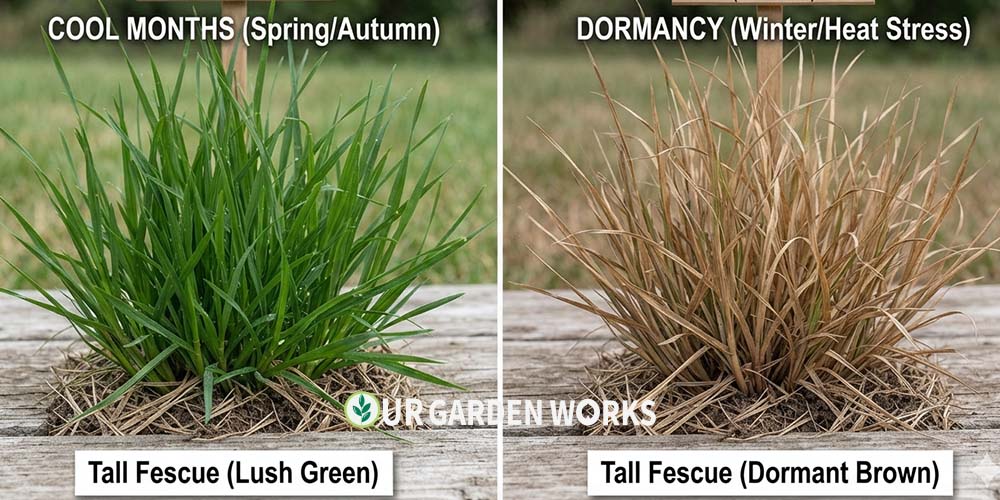
This is the single biggest fork in the identification process, and your region is the first clue. Cool-season grasses dominate the northern half of the U.S. and stay green through fall and into early winter, going semi-dormant in summer heat.
Warm-season grasses dominate the South, thriving in summer heat and going brown and dormant in winter. If your lawn is green in January but brown by July, you’re almost certainly looking at a cool-season grass. The reverse pattern points to warm-season.
The Common Cool-Season Grasses
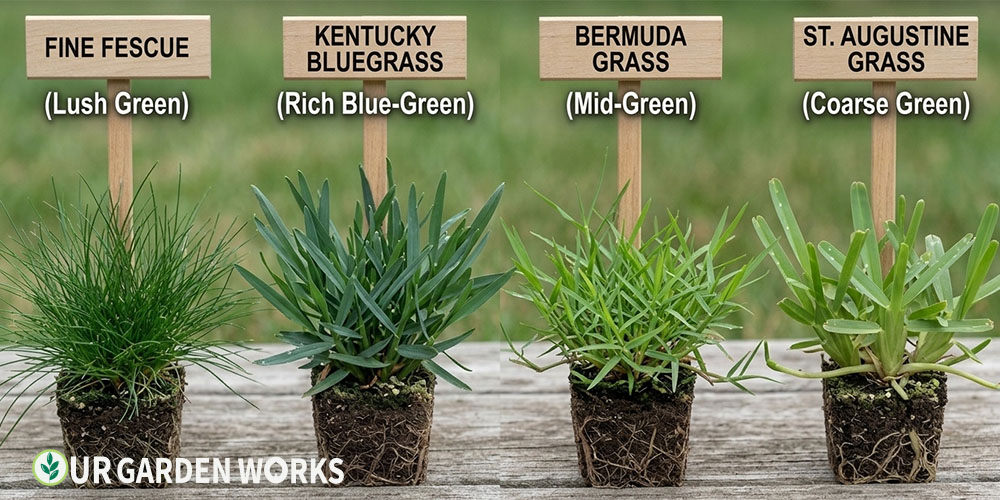
Kentucky Bluegrass
Medium-width blades with a distinctive boat-shaped tip (the blade narrows to a point that looks folded, like the bow of a small boat). Spreads by underground rhizomes, forming a dense, self-repairing turf. Rich blue-green color.
Tall Fescue
Coarser, wider blades than bluegrass, with visible parallel veins running the length of the blade. Grows in clumps rather than spreading aggressively, which is why tall fescue lawns often look slightly less uniform up close.
Fine Fescue
Very thin, almost needle-like blades — noticeably finer than tall fescue despite the similar name. Shade-tolerant and low-growing, often used in shade mixes or no-mow blends.
Perennial Ryegrass
Shiny, glossy blade surface is the giveaway — ryegrass catches light differently than the duller-surfaced fescues and bluegrass. Bunch-type growth habit, germinates fast, often used for quick repairs and overseeding.
The Common Warm-Season Grasses
Bermuda Grass
Fine to medium blades with an aggressive spreading habit via both above-ground stolons and underground rhizomes. Extremely heat and drought tolerant. Turns straw-brown and goes fully dormant at the first hard frost.
St. Augustine Grass
Broad, coarse blades — among the widest of common lawn grasses — with a visibly thick, almost succulent texture. Spreads via above-ground stolons only, forming a dense mat. Common throughout Florida and the Gulf Coast.
Zoysia Grass
Stiff, dense blades that feel noticeably firm underfoot compared to other turf types. Spreads slowly via both stolons and rhizomes, which makes it slow to establish but also slow to be invaded by weeds once mature.
Centipede Grass
Light green, almost yellow-green color is the quickest identifier. Low-growing and slow-spreading, popular specifically because it needs less mowing and fertilizing than most other warm-season types.
Why Blade Shape and Growth Habit Are the Most Reliable Clues
Color alone is a weak identifier, since fertilization, watering, and even time of day affect how green a lawn looks. Blade shape and growth habit are structural — they don’t change based on care.
The boat-shaped tip on bluegrass, for instance, comes from the way the leaf folds during development inside the stem sheath, a trait fixed in the plant’s genetics rather than something care practices can alter.
This is why checking blade tip shape under good light, ideally with a hand lens, is far more reliable than judging by color from a few feet away.
Growth habit works the same way. Whether a grass spreads via rhizomes, stolons, both, or stays in tight clumps is a fixed trait of the species.
Watching how a patch fills in (or doesn’t) over a season tells you which category you’re dealing with, even if you can’t immediately match it to an exact variety name.
What If You Have More Than One Grass Type?
This is genuinely common, and not necessarily a problem. Many lawns, especially older ones, contain a blend — often a fescue and bluegrass mix in cool-season regions, or Bermuda mixed with whatever weedy grass crept in over the years.
If you’re trying to identify a blend, look at the dominant pattern across most of the lawn rather than getting hung up on a few unusual patches. Those patches may simply be a different grass that crept in from a neighboring yard or an old reseeding.
For fertilizing and mowing purposes, manage according to whichever type dominates — trying to perfectly satisfy two different grass types’ competing needs in one lawn usually isn’t practical.
The Transition Zone — Where Both Types Overlap
A wide band across the middle of the country, often called the transition zone, can support both cool- and warm-season grasses, which makes identification slightly trickier for lawns in this region.
If you live somewhere like the mid-Atlantic, parts of the Midwest, or the lower Great Plains, your lawn could genuinely be either category.
In this zone, blade shape and growth habit become even more important than regional assumption, since you can’t simply guess based on “what grows here.” Many transition zone lawns are actually tall fescue, which tolerates more heat than other cool-season types and was specifically bred for exactly this in-between climate.
A Simple At-Home Test You Can Try
The Pull Test
- Find a small patch of grass and gently dig around one plant with a trowel, loosening the soil.
- Pull the plant up gently, trying to keep the root system intact.
- Look at the base — rhizome-spreading grasses (bluegrass, Bermuda, zoysia) will show horizontal underground stems connecting to neighboring plants.
- Stolon-spreading grasses (St. Augustine, Bermuda) will show above-ground runners visible at the surface, rooting down at intervals.
- Bunch-type grasses (tall fescue, ryegrass) will pull up as a single clump with no connecting runners at all.
This test won’t narrow things down to an exact species on its own, but combined with blade shape, it usually gets you to a confident answer.
A grass with rhizomes, a boat-shaped blade tip, and a cool-season region is almost certainly Kentucky bluegrass — there’s very little else it could be.
Why This Knowledge Actually Changes How You Care for Your Lawn
Identifying your grass type isn’t just a curiosity — it directly determines several practical decisions you’ll make all season. Mowing height is a good example: cool-season grasses generally want to be cut at 2.5–4 inches, while some warm-season types like Bermuda tolerate or even prefer a much shorter cut.
Fertilizer timing flips entirely between the two categories too, as covered in our lawn fertilizing guide — feeding a warm-season lawn on a cool-season schedule (or vice versa) wastes product and can stress the grass at exactly the wrong point in its growth cycle.
Even weed control products often specify which grass types they’re safe to use on, since some herbicides that are perfectly fine on Bermuda will damage St. Augustine or fine fescue. Knowing your type before reaching for any product on the shelf avoids an expensive mistake.
Frequently Asked Questions
Does it matter if I don't know my exact grass type?
Knowing the general category (cool-season vs. warm-season) matters more than pinning down the exact species, since fertilizing and mowing schedules are built around that broader distinction. The species-level detail helps with finer points like shade tolerance or disease resistance, but isn’t essential for basic care.
Can I identify grass type just from a photo, without seeing it in person?
Often yes, if the photo is a close, well-lit shot showing blade width and tip shape clearly. Color and overall texture are harder to judge accurately from photos, especially with different lighting and camera settings, so a photo ID is a good starting point but worth confirming in person if possible.
My grass doesn't match any of these descriptions exactly — what should I do?
There are more grass species and cultivars than any single guide can cover, and many newer cultivars are bred specifically to blend traits from multiple types. If nothing matches closely, a local extension office can usually identify a sample, or a lawn care professional in your region will likely recognize it immediately since they see the same regional types repeatedly.
Why does my lawn seem to change grass type between seasons?
This is usually a blend lawn where one type is more visually dominant at different times of year. A Bermuda lawn overseeded with ryegrass for winter color, for example, looks like ryegrass in winter and Bermuda in summer — it’s actually both, just taking turns being the visible majority.
Does soil type affect which grass I have, or just which grass will grow well?
Soil type doesn’t determine what grass is currently growing — that’s a matter of what was originally planted or seeded in. It does strongly affect which grass types will thrive going forward, which is worth knowing if you’re considering switching types or reseeding a struggling lawn.
Related Articles in Our Soil & Fertility Guide
Free Tools
We hope this helps you finally put a name to what’s growing in your yard. Once you know your grass type, every other lawn care decision — fertilizing, mowing height, watering — gets a lot more straightforward.
For the rest of a complete lawn routine, our soil and fertility guides cover what comes next.
Share this post with a fellow homeowner trying to figure out their lawn — and let us know in the comments what type you landed on. Happy growing!
