

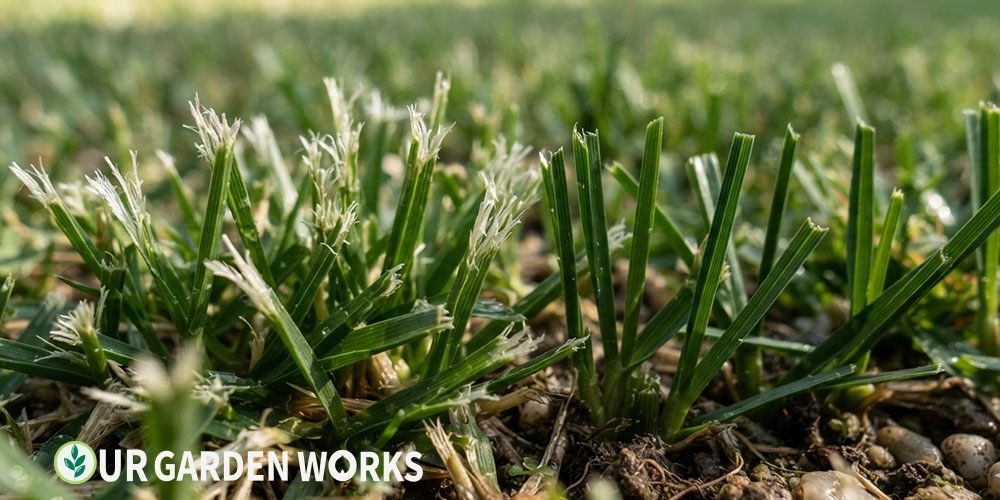
This is one of the more reliably single-cause symptoms in our entire lawn series: white, frayed, or torn grass blade tips visible right after mowing point almost exclusively to one issue — a dull mower blade tearing rather than cleanly slicing through grass tissue.
We’ll cover the simple confirmation and fix here, since this particular symptom genuinely doesn’t require much diagnostic uncertainty once you know what to check.
Quick Answer: White, frayed, or torn grass blade tips visible right after mowing almost always mean a dull mower blade. The tearing action exposes lighter, whitish inner tissue and creates a ragged edge rather than the clean, dark green cut a sharp blade produces. Sharpen or replace mower blades — most need attention every 20-25 hours of use, roughly once or twice per season.
Why Dull Blades Specifically Produce White Tips
A sharp mower blade slices cleanly through grass tissue, leaving a smooth, dark green cut surface that quickly seals and shows minimal visible damage.
A dull blade, by contrast, doesn’t cut so much as tear and crush the grass blade, splitting and shredding the tissue in a way that exposes lighter-colored inner cell structure — this is what produces the whitish, frayed appearance at the cut edge.
This torn tissue is also more vulnerable to further drying, browning, and disease entry than a clean cut, which is why dull blade damage often progresses from initially white tips to a more generally browned, hazy appearance across the lawn within a day or two of mowing, as covered in more detail in our lawn browning guide.
💡 A simple paper test confirms blade sharpness
Hold a sheet of regular paper and try slicing it with your mower blade (with the mower safely off and the spark plug disconnected for safety).
A sharp blade cuts cleanly through the paper, while a dull blade tears or fails to cut it at all. This quick test, done before mowing, tells you definitively whether sharpening is needed without waiting to see the resulting damage on your lawn.
How to Confirm This Diagnosis on Your Lawn
- Examine several freshly cut grass blade tips closely, ideally with a magnifying glass or your phone’s camera zoom for a clearer view
- Look for a ragged, torn edge with visible white or pale coloring at the cut surface, rather than a clean, uniform dark green edge
- Check how long it’s been since your mower blade was last sharpened — if it’s been more than about 20-25 hours of cumulative use, or you simply can’t remember the last time, this strongly supports the diagnosis
The Fix — Sharpening or Replacing Your Mower Blade
Directions
- Disconnect the spark plug or remove the battery (for electric mowers) before doing any blade work, as a critical safety step.
- Remove the blade following your mower’s specific instructions, noting the orientation for correct reinstallation.
- Sharpen using a file, grinding wheel, or blade sharpening tool, maintaining the blade’s original cutting angle as closely as possible.
- Check and correct blade balance after sharpening — an unevenly sharpened or unbalanced blade can cause vibration and uneven cutting, sometimes producing its own version of inconsistent cut quality.
- Reinstall the blade in the correct orientation, and reconnect the spark plug or battery before resuming use.
If sharpening isn’t something you’re comfortable doing yourself, many hardware stores, lawn equipment shops, and some lawn care services offer blade sharpening for a modest fee, or you can purchase a pre-sharpened replacement blade if your existing one is significantly worn, damaged, or bent.
Building a Regular Sharpening Schedule
Rather than waiting for visible white-tip damage to prompt a sharpening session, building blade maintenance into your regular seasonal mower care prevents this issue from recurring at all.
Most residential mowers benefit from sharpening every 20-25 hours of cumulative use, which for a typical suburban lawn mowed weekly during the growing season often works out to once or twice per full mowing season.
Keeping a simple note of your last sharpening date, or doing the paper test described above at the start of each mowing season and periodically throughout, removes the guesswork from timing this maintenance task appropriately.
Does Blade Material or Quality Affect How Often Sharpening Is Needed?
Higher-quality mower blades, typically made from hardened or specially tempered steel, generally hold an edge longer than basic, economy-grade blades, meaning the 20-25 hour sharpening guideline is more of a general baseline than a precise figure that applies identically to every blade on the market.
If you’re noticing white-tip damage developing faster than this typical window, even with reasonably regular mowing, it’s worth considering whether your specific blade is a lower-quality option that simply dulls faster than average.
Mowing conditions also affect how quickly any blade dulls, regardless of its base quality — frequently mowing over small rocks, debris, or uneven, gritty soil surfaces accelerates blade wear considerably compared to mowing consistently clean, debris-free turf.
If your lawn has these kinds of rougher conditions, either from soil type, nearby gravel paths, or other debris sources, building in more frequent sharpening checks than the standard guideline suggests is a reasonable adjustment specific to your situation.
Why Some Grass Types Show This Damage More Visibly Than Others
Certain grass types display the white-tip tearing damage more dramatically and visibly than others, even when cut with an identically dulled blade, due to differences in blade tissue structure and color contrast between the outer surface and inner tissue.
Grasses with notably dark green coloring tend to show the lighter, torn tissue more starkly by contrast than grass types with naturally lighter green coloring, where the color difference between healthy and torn tissue is less visually dramatic.
This means two lawns with equally dull mower blades, but different grass types, might show quite different degrees of visible white-tip damage, which is worth knowing if you’re comparing your own lawn’s symptoms against general descriptions or photos that may have been taken on a different grass variety.
Regardless of how visually dramatic the symptom appears on your specific grass type, the underlying cause and the fix remain exactly the same.
Are There Any Other Possible Causes Worth Ruling Out?
While dull blades explain the overwhelming majority of white-tip cases, it’s worth briefly noting that mowing wet grass, covered in our broader lawn browning guide, can produce a similar torn, frayed appearance even with a perfectly sharp blade, since wet grass tissue is inherently more prone to tearing regardless of blade condition.
If your blade genuinely passes the paper test for sharpness but you’re still seeing white, frayed tips, checking whether grass was wet at mowing time is the next most likely explanation.
Beyond these two closely related causes, white blade tips specifically (as opposed to general browning or yellowing) really don’t have a long list of alternative explanations, which is exactly what makes this one of the more straightforward diagnoses in our lawn troubleshooting series.
Frequently Asked Questions
Will white-tipped grass recover on its own, or do I need to do anything beyond sharpening the blade?
Existing damaged tips will eventually be removed through subsequent regular mowing sessions as the grass continues growing, and no special remediation is typically needed beyond fixing the blade issue itself.
The lawn should look noticeably better within one to two mowing cycles after switching to a properly sharpened blade.
How can I tell if my blade is dull without doing the paper test?
Visual inspection of the blade edge itself is the most direct alternative — a sharp blade has a distinct, relatively thin cutting edge, while a dull blade often shows a rounded, thickened, or visibly nicked edge when examined closely. Running your finger very carefully along the blade (with the mower off and disconnected) can also help you feel whether a defined sharp edge is still present, though this should be done cautiously given the blade’s potential sharpness even when “dull” by cutting standards.
Does blade type (mulching vs standard) affect how quickly blades dull?
Mulching blades, with their additional cutting surfaces designed to chop clippings into finer pieces, can sometimes dull slightly faster than standard blades due to the additional cutting work they perform on each pass, though this difference is generally modest rather than dramatic.
Regardless of blade type, the same general sharpening frequency guidance and the same paper test for confirming sharpness apply equally.
Should I sharpen all blades on a multi-blade mower at the same time?
Yes, sharpening all blades together, even if only one seems visibly duller, ensures even, consistent cutting across the entire mower deck rather than risking a mismatched cut quality where one freshly sharpened blade cuts cleanly while an older, still-dull blade continues tearing in its specific path.
This consistency also helps maintain proper deck balance, which affects overall cutting performance and mower vibration beyond just the individual blade sharpness question.
Related Articles in Our Lawn Care Guide
Final Thoughts
We hope this guide has given you a quick, confident fix for white-tipped grass blades — sharpening your mower blade really is almost always the complete answer here.
For more lawn care guidance, our full collection of lawn articles on the soil and fertility page covers everything from seasonal maintenance to equipment care.
Share this post with a fellow homeowner who’s noticed frayed grass tips after mowing — and let us know in the comments whether the paper test confirmed a dull blade. Happy growing!
