

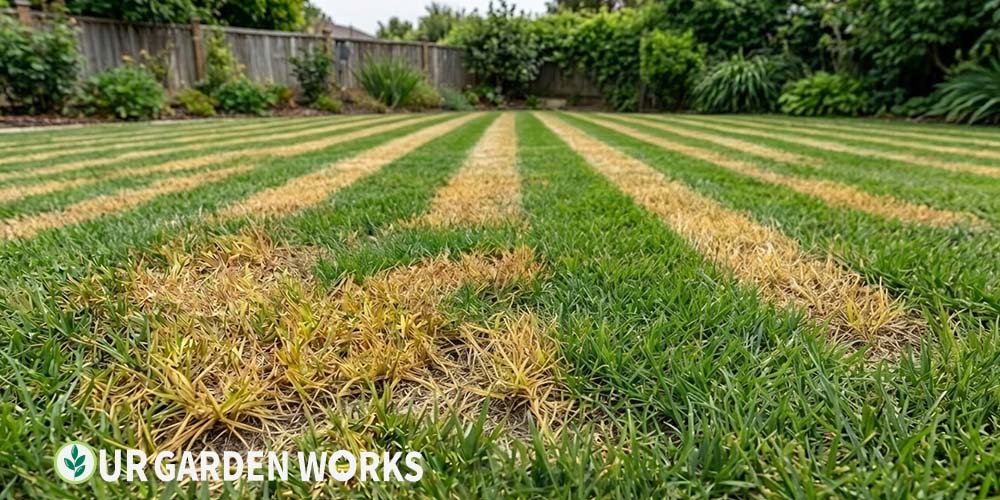
A genuine striped pattern of dying or yellowing grass is one of the more mechanically diagnosable lawn problems out there, since stripes almost always trace back to equipment — a mower, spreader, or sprayer — passing over the lawn in a defined path.
This is fundamentally different from the random or circular patterns covered in our other lawn diagnostic guides.
We’ll walk through the equipment-related causes that produce this specific pattern, since identifying which piece of equipment is responsible usually points directly to the fix.
Editor’s Note: Lawn dying in stripes is almost always caused by uneven fertilizer or herbicide application (spreader overlap or gaps), a mower issue (dull blades, scalping on uneven ground, or a fuel/oil leak dripping in a line), or irrigation system stripes (a malfunctioning or misaligned sprinkler zone). Match the stripe width and spacing to your specific equipment to confirm which one is responsible.
Cause 1 — Fertilizer or Herbicide Spreader Pattern
Uneven application from a fertilizer or herbicide spreader is probably the most common cause of true striping, and the pattern typically shows either double-strength damage where passes overlapped, or thin, under-treated strips where passes had gaps between them.
Both patterns follow the spreader’s actual width and the spacing between your walking passes.
How to confirm it’s spreader-related:
- Stripe width roughly matches your spreader’s effective spread width
- Damage (yellow/brown) or under-treatment (thin, pale) appeared following a recent fertilizer or herbicide application
- Pattern is most visible at turn-around points where overlap tends to concentrate
Fix: For overlap burn, water thoroughly to dilute and flush excess product. For under-application gaps, a follow-up light application can even out the missed strips once any existing damage has been addressed. Going forward, overlap passes by about half the spreader’s width consistently, and use a fertilizer calculator to confirm the correct rate before applying.
Cause 2 — Mower Blade or Mowing Technique Issues
A dull or damaged mower blade tears rather than cleanly cuts grass blades, and if one blade on a multi-blade mower is duller or more damaged than the others, it can produce a visibly different cut quality in a consistent stripe matching that specific blade’s path.
Scalping on uneven ground — where the deck dips low enough to cut grass too short in low spots — produces a similar striped pattern of stressed, shorter grass.
How to confirm it’s mower-related:
- Stripe width matches roughly one blade’s width on a multi-blade mower, or the full deck width for a single-blade scalping issue
- Grass blade tips look frayed or torn rather than cleanly cut when examined closely
- Pattern correlates with known low or uneven spots in the lawn’s terrain
Fix: Sharpen or replace mower blades, checking that all blades on a multi-blade deck are evenly sharp and properly balanced. For scalping on uneven terrain, raising the mowing height slightly or addressing the underlying grade with topdressing reduces the recurring low-spot scalping.
Cause 3 — Fuel, Oil, or Chemical Drip Lines
A mower with a small fuel or oil leak can drip a thin, continuous line of damaging liquid along its entire path, producing a narrow, straight stripe of dead or severely stressed grass that follows wherever the mower traveled, including turns.
This is a distinct pattern from blade-related stripes since it tends to be much narrower and follows the machine’s actual travel path rather than its cutting width.
How to confirm it’s a drip line:
- Stripe is notably narrow, much less than the mower’s cutting width
- Pattern follows the mower’s travel path including turns, not just straight cutting passes
- A petroleum or chemical odor may be present, especially soon after mowing
Fix: Have the mower inspected and repaired to stop the leak before continuing to use it on the lawn. For the affected stripe, water thoroughly to help dilute any remaining contamination in the soil, and reseed once the leak source is fixed and the area has had time to flush.
Cause 4 — Irrigation System Zone Issues
A malfunctioning, clogged, or misaligned sprinkler head can create a striped or banded watering pattern, where some areas receive consistent irrigation while adjacent zones are under or overwatered, producing a corresponding pattern of differently stressed grass that follows the irrigation system’s actual coverage zones rather than any mowing or fertilizing equipment.
How to confirm it’s irrigation-related:
- Pattern follows sprinkler zone boundaries rather than a mower or spreader’s typical path width
- Running the irrigation system and observing actual water distribution reveals uneven coverage
- Affected stripes may show either drought stress (under-watered zones) or waterlogging symptoms (over-watered zones)
Fix: Inspect and adjust or replace malfunctioning sprinkler heads, checking for clogs, misalignment, or pressure issues causing uneven distribution. A simple catch-cup test, placing several containers across a zone and running the system to compare water collected in each, confirms whether distribution is genuinely uneven before assuming equipment is the issue.
Telling the Four Causes Apart at a Glance
| Cause | Stripe Width | Pattern Source | Key Clue |
|---|---|---|---|
| Fertilizer/herbicide | Matches spreader width | Application path | Worse at overlap/turns |
| Mower blade/technique | Matches blade or deck width | Mowing path | Frayed tips, low-spot pattern |
| Fuel/oil/chemical drip | Very narrow | Mower travel path | Follows turns too, odor |
| Irrigation zone | Matches sprinkler zone | Watering pattern | Catch-cup test confirms |
Can Disease Ever Mimic a Striped Pattern?
While true stripes almost always trace back to equipment as covered above, it’s worth knowing that a couple of disease and pest situations can occasionally produce a pattern that superficially resembles striping, especially if a previous equipment-related stripe created uneven grass density that then made disease symptoms more visible in that specific zone.
A weakened stripe from old mower damage, for instance, might show disease symptoms more readily than the surrounding healthier turf, creating a kind of compound pattern that looks stripe-like but actually has disease as a secondary, opportunistic factor layered on top of the original equipment-caused weakness.
Genuinely random, non-linear lawn diseases covered in our other guides — brown patch, dollar spot, necrotic ring spot — don’t typically produce true straight-line stripes on their own, which is the key distinguishing factor.
If you’re seeing a pattern with notably straight, parallel edges rather than the more organic, circular, or irregular shapes typical of fungal disease, equipment remains the far more likely primary explanation even if a secondary disease factor might be contributing to what you’re seeing.
Robotic Mowers and Striping Patterns
Robotic lawn mowers, increasingly common in many neighborhoods, can produce their own distinct striping patterns related to their programmed or randomized travel paths, sometimes creating a more subtle, repeating pattern than traditional push or riding mower stripes.
A robotic mower with a dull blade, similar to any other mower, can create the same kind of frayed-tip stress pattern covered above, though the specific shape of the affected area may follow the robot’s particular navigation pattern rather than the simple back-and-forth stripes typical of conventional mowing.
If you’re using a robotic mower and noticing unusual patterns in your lawn, checking the blade condition and confirming the mower’s programmed coverage settings provide even, complete coverage without excessive concentration in any particular zone addresses the most likely causes specific to this equipment type.
Many robotic mower manufacturers also recommend periodic manual inspection of cutting height and blade sharpness, since the automated nature of these devices means issues can sometimes go unnoticed longer than with manually operated equipment that gets more direct human observation during each use.
Measuring Stripe Width as Your First Diagnostic Step
Before considering anything else, measure the actual width of the affected stripes and compare it against your known equipment widths — your mower’s deck and individual blade width, your spreader’s effective spread width, and your irrigation system’s typical zone or sprinkler spacing.
This single measurement, taking just a couple of minutes, often points directly to the responsible equipment before you need to investigate further.
If the stripe width doesn’t clearly match any of your equipment’s known dimensions, it’s worth double-checking your measurements or considering whether multiple overlapping issues might be creating a combined pattern that doesn’t cleanly match any single piece of equipment on its own.
Frequently Asked Questions
Can I prevent striping without buying new equipment?
Yes, in most cases — sharpening existing mower blades, adjusting walking technique and overlap when spreading fertilizer, and properly maintaining or adjusting existing irrigation components address the great majority of striping causes without requiring new equipment purchases.
Equipment replacement is really only necessary if a mower or sprinkler component is genuinely damaged beyond repair or adjustment.
Will striped lawn damage recover on its own, or does it need reseeding?
It depends on severity and cause — mild stress from uneven fertilizing or minor mowing issues often recovers with consistent care once the underlying equipment problem is corrected, while severe chemical drip damage or significant scalping may kill grass crowns outright, requiring reseeding to fully restore the affected stripe.
How can I avoid creating overlap stripes when fertilizing by hand or with a spreader?
Using a spreader with a deflector shield along the lawn’s edges, walking at a consistent pace matching the product label’s calibration assumptions, and deliberately overlapping each pass by about half the spreader’s width (rather than either avoiding overlap entirely or overlapping too generously) produces the most even coverage and the least striping risk.
Related Articles in Our Lawn Care Guide
Final Thoughts
We hope this guide has helped you trace that striped pattern back to the actual piece of equipment responsible — measuring stripe width really does point you in the right direction quickly.
For more lawn care guidance, our full collection of lawn articles on the soil and fertility page covers everything from seasonal maintenance to equipment technique.
Share this post with a fellow homeowner who’s noticed striping in their lawn — and let us know in the comments which cause matched what you found. Happy growing!
