

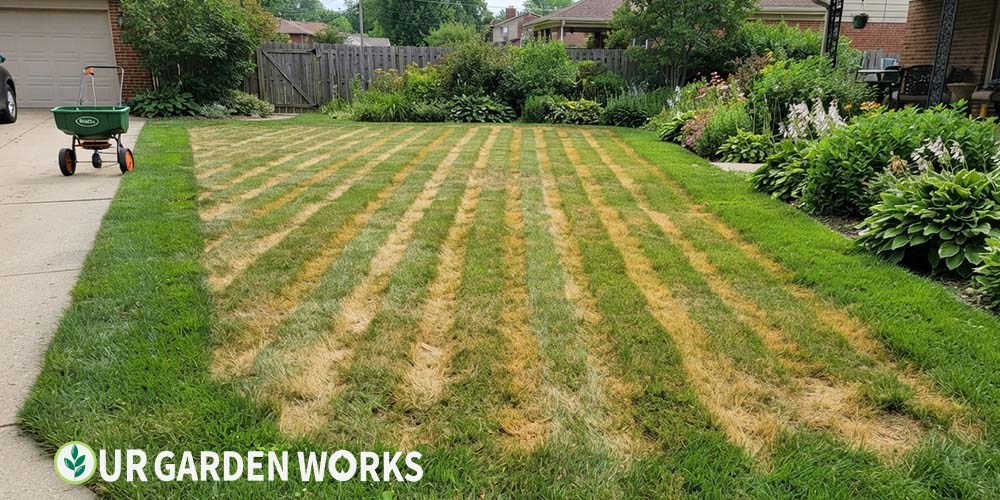
It feels backward — fertilizer is supposed to help, and yet your lawn looks worse right after applying it. This is genuinely one of the more common and most fixable lawn problems, and the cause is almost always identifiable from the pattern alone.
We’ll walk through what’s actually happening, how to confirm it, and the immediate steps that limit the damage and speed recovery.
Quick Answer: Lawn turning yellow after fertilizing is almost always fertilizer burn — excess nitrogen salts drawing moisture out of grass tissue, often visible as stripes matching the spreader’s application pattern. Less commonly, it can reflect a pre-existing deficiency that fertilizer hasn’t yet corrected, or a fertilizer applied during drought-stressed conditions. Water thoroughly and immediately to dilute and flush excess fertilizer salts.
Cause 1 — Fertilizer Burn (By Far the Most Common)
Fertilizer burn happens when nitrogen and other mineral salts are applied at too high a concentration, drawing moisture out of grass blades and roots through a process similar to how salt draws moisture out of food.
The classic giveaway is a striped pattern of yellow or brown damage that matches exactly where a fertilizer spreader’s path overlapped, since double-coverage areas received roughly twice the intended rate.
How to confirm it’s fertilizer burn:
- Yellowing or browning appeared within 1-3 days of a fertilizer application
- Pattern often follows visible stripes matching a spreader’s path, especially at turn-around points or overlap zones
- Affected grass may feel slightly crispy or dry to the touch despite adequate soil moisture otherwise
Immediate Response
- Water the affected area thoroughly and immediately — this is the single most effective step, diluting and flushing excess fertilizer salts out of the root zone before they cause further damage.
- Continue watering deeply for several days following the burn, rather than a single treatment, to ensure salts are genuinely flushed rather than just temporarily diluted.
- Avoid applying any additional fertilizer to the burned area until recovery is well underway, typically several weeks.
⚠️ Speed matters with fertilizer burn
The sooner you water after noticing burn symptoms, the better the outcome — fertilizer salts continue drawing moisture out of grass tissue the longer they sit concentrated in the soil. If you suspect over-application immediately after spreading, watering right away, even before symptoms appear, can prevent burn from developing at all.
Cause 2 — Pre-Existing Deficiency Not Yet Corrected
Sometimes a lawn was already showing yellowing from a nutrient deficiency before fertilizing, and the timing simply makes it look like the fertilizer caused the problem when it actually hasn’t had enough time yet to take effect and correct an issue that predates the application.
Fertilizer typically takes 1-2 weeks to show visible improvement, and yellowing noticed within just a day or two of application is more likely pre-existing than newly caused.
How to confirm it’s pre-existing deficiency:
- Yellowing was already present, even if subtle, before the fertilizer application
- No striped pattern matching a spreader’s path
- Yellowing is more uniform and gradual rather than appearing suddenly in defined zones
Fix: Continue with consistent, properly timed fertilizing following label rates, and give it the full 1-2 week window before assessing whether further adjustment is needed. A soil test can confirm which specific nutrient deficiency, if any, is genuinely present.
Cause 3 — Fertilizing During Drought Stress
Applying fertilizer to grass that’s already drought-stressed and not actively growing puts additional salt concentration stress on a plant that’s already struggling, often worsening yellowing rather than helping.
This compounds the basic fertilizer burn mechanism with the underlying vulnerability of a plant that wasn’t well positioned to handle any additional stress in the first place.
How to confirm this is the situation:
- Lawn was already showing some drought stress symptoms before fertilizing
- No recent watering before or shortly after the fertilizer application
- Symptoms are more severe or widespread than a typical isolated burn pattern would suggest
Fix: Water thoroughly now to address both the drought stress and help flush fertilizer salts. Going forward, water the lawn before fertilizing (never apply to bone-dry, stressed grass) and avoid fertilizing during active drought stress or extreme heat.
Telling the Three Causes Apart at a Glance
| Cause | Pattern | Timing | Pre-existing Stress? |
|---|---|---|---|
| Fertilizer burn | Striped, matches spreader path | 1-3 days after application | No, healthy before |
| Pre-existing deficiency | Uniform, gradual | Present before application | Yes, already yellowing |
| Drought + fertilizer | Widespread, severe | Following application to dry lawn | Yes, drought-stressed |
Calibrating Your Spreader to Prevent Future Burn
Most fertilizer burn traces back to spreader calibration or technique issues rather than the product itself being inherently risky when used correctly.
Overlapping passes too generously, applying at too slow a walking speed (which deposits more product per square foot than the label rate assumes), or using a spreader setting higher than what the specific product requires all contribute to over-application.
Using a fertilizer calculator to confirm the correct application rate for your specific lawn size and product before spreading, and walking at a consistent, label-appropriate pace with deliberate, non-overlapping passes, prevents the vast majority of fertilizer burn cases before they ever happen.
Does Fertilizer Type Affect Burn Risk?
Quick-release, water-soluble nitrogen fertilizers carry meaningfully higher burn risk than slow-release formulations, since they deliver their full nutrient load to the soil almost immediately rather than gradually over several weeks.
This is part of why budget, fast-acting lawn fertilizers are more commonly associated with burn incidents than the somewhat pricier slow-release or controlled-release products that spread their nitrogen delivery out over a longer window.
Organic fertilizers, derived from sources like composted manure or plant-based meals, generally present lower burn risk than synthetic quick-release products, partly because their nutrients are released more gradually as soil microorganisms break down the organic material rather than dissolving immediately and concentrating in soil moisture.
If fertilizer burn has been a recurring frustration despite careful application technique, switching to a slow-release or organic product provides a more forgiving margin of error than continuing to use a fast-release formula that demands more precise application.
This doesn’t mean quick-release fertilizers should be avoided entirely — they have legitimate uses, particularly when a faster green-up response is specifically desired — but it does mean extra care with calibration and watering technique matters more when using this type of product compared to a slower-release alternative.
How Weather Timing Affects Burn Risk
Applying fertilizer immediately before a stretch of hot, sunny weather increases burn risk considerably compared to applying before cooler, overcast conditions or ahead of expected rainfall.
Heat accelerates the moisture-drawing mechanism behind fertilizer burn, while an immediate rain shower or planned watering session after application helps dissolve and distribute the product into the soil before it has a chance to concentrate dangerously at the surface where grass blades and crowns are most vulnerable.
Checking the forecast before fertilizing, and timing application for a stretch with either planned irrigation immediately after or genuine rain forecast within a day, meaningfully reduces burn risk beyond just careful spreader calibration alone.
Many lawn care professionals specifically avoid fertilizing during the hottest, driest stretches of summer for exactly this reason, preferring spring and fall applications when temperature and moisture conditions are inherently more forgiving.
How Long Until a Burned Lawn Fully Recovers?
Mild fertilizer burn, caught and watered promptly, often shows visible improvement within a week or two as the grass recovers from the temporary moisture stress without permanent damage to the crown or roots.
More severe burn, where grass tissue has actually died rather than just stressed, requires the dead material to be replaced through natural lateral growth from surviving grass or through reseeding the affected area, typically taking 3-6 weeks for full recovery depending on severity and season.
Consistent watering throughout the recovery period, beyond just the initial flush, supports faster regrowth and helps you assess sooner whether reseeding is genuinely necessary or whether the lawn is recovering well enough on its own.
Frequently Asked Questions
Can I apply more fertilizer to fix yellow grass from fertilizer burn?
No — adding more fertilizer to an already-burned area makes the salt concentration problem worse, not better.
The correct response is watering to dilute and flush the excess, not additional fertilizing, even though the affected grass may look like it needs more nutrients.
Is fertilizer burn permanent, or will the grass grow back?
Mild to moderate burn is typically not permanent, and grass recovers with proper watering as excess salts are flushed from the root zone.
Severe burn that has actually killed grass crowns and roots may require reseeding the affected area, since dead tissue won’t regenerate on its own regardless of subsequent watering.
Should I water before fertilizing to prevent burn in the future?
Yes — watering the lawn a day or two before fertilizing ensures grass isn’t already drought-stressed when it receives the additional salt load from fertilizer, and many product labels specifically recommend applying to slightly moist (not soaking wet or bone dry) soil for the best results and lowest burn risk.
Related Articles in Our Lawn Care Guide
Final Thoughts
We hope this guide has put your mind at ease about a lawn that’s gone the wrong direction right after fertilizing — quick, thorough watering really is the fix for the vast majority of these cases.
For more lawn care guidance, our full collection of lawn articles on the soil and fertility page covers everything from seasonal maintenance to proper fertilizing technique.
Share this post with a fellow homeowner who’s dealing with post-fertilizer yellowing — and let us know in the comments how your lawn recovered. Happy growing!
