

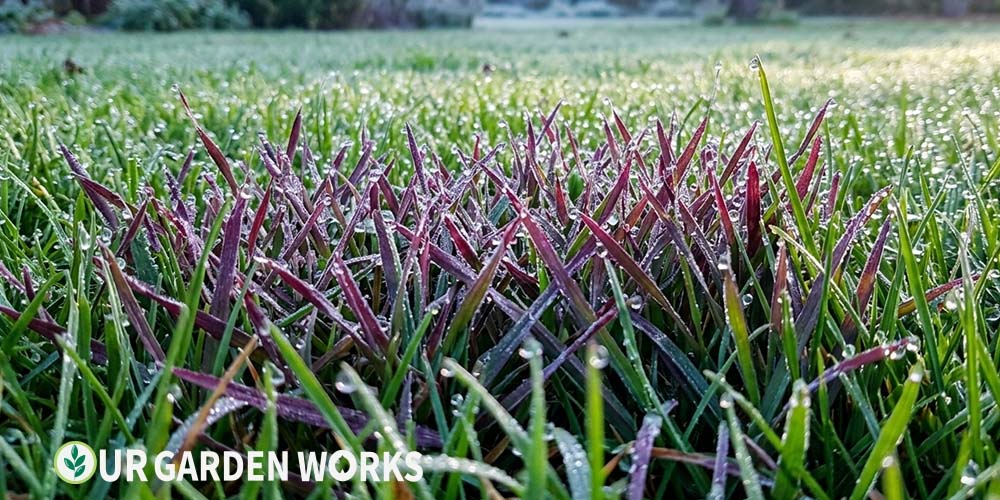
Purple-tinted grass blades follow the same basic logic as the purple leaves covered in our tomato plant guide — this isn’t a coincidence, since the same plant pigment and the same two interconnected causes are at work here too, just in turf grass instead of a vegetable.
The cause list here is mercifully short, which makes this one of the quicker diagnoses in our lawn problem series.
Quick Answer: Purple grass blades are almost always caused by phosphorus deficiency or cold stress, and the two are connected — cold soil temperatures directly reduce a lawn’s ability to take up phosphorus even when it’s present in adequate amounts. This is most common in early spring on newly seeded or recently established lawns. Soil temperature and recent weather history usually explain which specific version you’re seeing.
Cause 1 — Phosphorus Deficiency
Phosphorus deficiency in grass produces a purple-to-reddish tint, most visible in cooler morning light or on young, recently established turf, caused by a buildup of anthocyanin pigments the plant produces when phosphorus availability is limited.
This is more commonly seen in newly seeded lawns, where the developing root system hasn’t yet established efficient nutrient uptake, than in mature, established turf.
How to confirm it’s phosphorus deficiency:
- Purple tint is most visible in cooler conditions, often more pronounced in morning light
- Most common on newly seeded or recently established lawn areas
- Overall grass growth and density may seem slower than expected
- A soil test, if available, shows low phosphorus levels
Fix: Apply a starter fertilizer with a higher phosphorus content (look for a higher middle number in the N-P-K ratio) specifically formulated for new lawn establishment. For established lawns showing this symptom, a standard balanced lawn fertilizer addressing overall nutrient needs, applied using a fertilizer calculator for the correct rate, resolves true deficiency over a few weeks.
Cause 2 — Cold Stress (The Connected Cause)
This is the cause that surprises many homeowners, since it produces an identical symptom to true phosphorus deficiency even when soil phosphorus levels are perfectly adequate.
Cold soil temperatures significantly impair grass roots’ ability to actually absorb and use available phosphorus, regardless of how much is physically present in the soil — the uptake mechanism itself is what’s limited, not the supply.
How to confirm it’s cold-related:
- Purple tint appeared following a recent cold spell or unusually cool overnight temperatures
- Most common in early spring before soil has fully warmed
- Affects newly seeded lawns especially, since young root systems are more sensitive to cold-impaired nutrient uptake
Fix: Patience — this typically resolves on its own as soil warms with the season, without needing fertilizer intervention. Adding more phosphorus fertilizer doesn’t speed up recovery in this specific case, since the limiting factor is uptake capability in cold soil, not the nutrient’s actual availability.
💡 Check soil temperature before assuming you need more fertilizer
A simple soil thermometer, checking for a consistent 55-60°F or warmer reading, helps distinguish whether cold soil is genuinely the limiting factor before you spend money on additional phosphorus fertilizer that won’t actually speed up recovery if cold uptake impairment is the real cause.
Telling the Two Causes Apart
| Cause | Timing | Lawn Age | Resolves With |
|---|---|---|---|
| Phosphorus deficiency | Any time, soil-dependent | Any age, common on new lawns | Phosphorus fertilizer |
| Cold stress | Early spring, after cold spells | Especially newly seeded lawns | Soil warming, patience |
Does Grass Type Affect How Visible This Symptom Is?
Some grass types show purple discoloration more readily and visibly than others, which is worth knowing if you’re comparing your lawn’s symptoms against general descriptions.
Ryegrass and certain fescue varieties tend to display the purple tint quite noticeably even with relatively mild phosphorus limitation, making them something of an early warning indicator compared to grasses that mask the same underlying nutrient stress more subtly.
Kentucky bluegrass and many warm-season grasses like Bermuda can experience the same underlying phosphorus uptake limitation without showing nearly as obvious a color change, which means the absence of visible purpling in these grass types doesn’t necessarily rule out an underlying phosphorus issue the way its absence might in a more visually expressive variety like ryegrass.
If you have a mixed-grass lawn and only certain sections show purple tinting, this could partly reflect genuine differences in local soil phosphorus or temperature, but it could equally reflect differences in how visibly each grass type expresses the same degree of underlying stress.
Soil Testing Before You Fertilize
Given that the two causes covered in this guide call for genuinely opposite responses — adding phosphorus fertilizer for true deficiency, versus simply waiting for soil to warm in the cold-stress case — a basic soil test removes much of the guesswork before you spend money or time on the wrong intervention.
A home soil test kit checking phosphorus levels specifically, available inexpensively at most garden centers, gives you a reasonably reliable read on whether your soil’s actual phosphorus supply is adequate.
If a soil test confirms adequate phosphorus levels despite visible purple tinting, that result strongly supports the cold-stress explanation, and your time is better spent simply waiting for warmer soil temperatures rather than adding fertilizer that won’t address the actual limiting factor.
Conversely, a soil test showing genuinely low phosphorus justifies moving forward with a phosphorus-focused fertilizing plan regardless of current temperature, since the underlying nutrient supply issue will persist even once soil warms unless directly corrected.
What to Do If Symptoms Persist Despite Warm Soil and Adequate Phosphorus
Occasionally, purple grass blade symptoms persist even after soil has clearly warmed into an appropriate range and a soil test confirms adequate phosphorus, which suggests a third, less common possibility worth considering: a broader root health issue limiting nutrient uptake regardless of soil temperature or nutrient availability.
Compacted soil, as covered in our brown patches guide, can restrict root function enough to mimic a nutrient deficiency symptom even when the nutrient itself is genuinely present and the temperature is no longer a limiting factor.
In this less common scenario, addressing soil compaction through aeration, rather than continuing to add phosphorus fertilizer that the roots simply can’t access efficiently due to physical restriction, is the more appropriate next step.
This is a good example of why working through a methodical checklist — temperature, then soil test, then root health — produces a more reliable diagnosis than assuming the first explanation that comes to mind is automatically correct.
Why New Lawns Show This Symptom More Than Established Ones
Newly seeded or recently sodded lawns are considerably more prone to purple blade coloring than mature, well-established turf, for two compounding reasons.
First, young root systems are inherently less efficient at nutrient uptake than the deeper, more developed root systems of established grass, making any phosphorus limitation — whether from true deficiency or cold-related uptake impairment — show up more readily.
Second, new lawns are most commonly established in spring or fall, exactly when soil temperatures are most likely to be in the marginal range that triggers cold-related phosphorus uptake issues.
This combination of factors is why starter fertilizers specifically formulated with higher phosphorus content are such a standard recommendation for new lawn establishment, addressing the deficiency-prone period directly rather than waiting for symptoms to develop.
Frequently Asked Questions
Will purple grass blades affect my lawn's overall health long-term?
Mild, temporary cold-related purpling rarely causes lasting harm, since the lawn typically resumes normal green color and growth once soil warms.
True, sustained phosphorus deficiency left unaddressed over a longer period can contribute to weaker root development and overall reduced lawn vigor, making correction worthwhile if the cause turns out to be genuine deficiency rather than temporary cold stress.
How long does it take for purple grass to turn green again?
For cold-related purpling, expect green color to return within 1-2 weeks once soil temperatures warm consistently into the 55-60°F range.
For true phosphorus deficiency treated with appropriate fertilizer, a similar 1-2 week timeline typically applies for visible improvement in new growth.
Should I avoid seeding a new lawn in early spring to prevent this issue?
Not necessarily — early spring remains a perfectly reasonable seeding window for many cool-season grass types, and the temporary purple tint some seedlings show due to cold-related phosphorus uptake limitation is a minor, self-resolving cosmetic issue rather than a reason to delay planting.
Using a starter fertilizer with adequate phosphorus at seeding time helps minimize this symptom regardless of timing.
Can mowing too short make purple grass blades more noticeable or worse?
Mowing too short doesn’t cause the underlying phosphorus or cold-stress issue, but it can make existing symptoms appear more visually prominent, since shorter grass exposes more of the blade’s overall surface and color at a glance compared to longer grass where the tinting might be partially hidden within a denser canopy.
Maintaining a slightly taller mowing height during the affected period, alongside addressing the actual underlying cause, can make the lawn look less alarming while the real fix takes effect.
Related Articles in Our Lawn Care Guide
Final Thoughts
We hope this guide has cleared up why your grass turned purple — and reassured you that, especially for the cold-related version, this resolves itself without much intervention at all.
For more lawn care guidance, our full collection of lawn articles on the soil and fertility page covers everything from seasonal maintenance to soil health.
Share this post with a fellow homeowner who’s troubleshooting purple grass blades — and let us know in the comments which cause matched what you found. Happy growing!
