

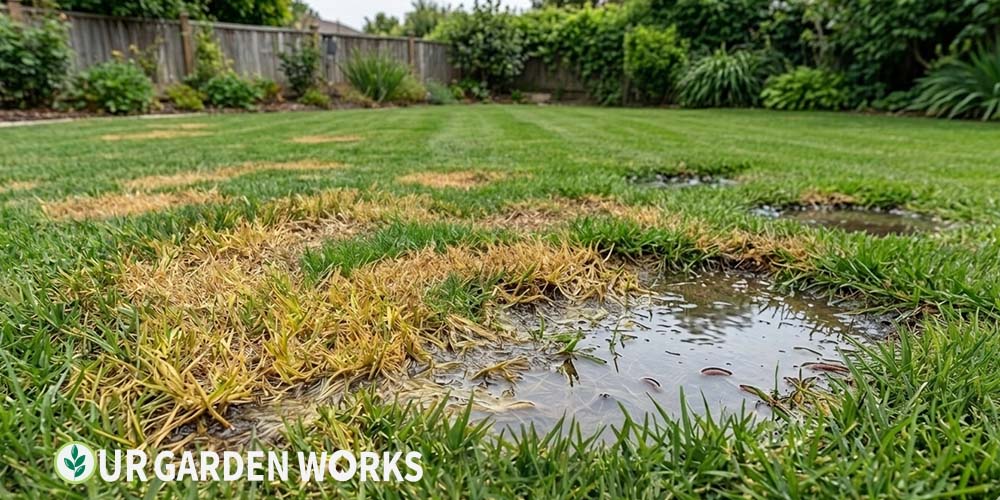
It seems counterintuitive that rain — the thing your lawn usually wants — can be exactly what causes a patch of grass to die, but waterlogging and the conditions heavy rain creates are genuinely common culprits.
The pattern and location of the damage tell you most of what you need to know here.
We’ll walk through the specific ways rain itself, or the conditions it creates, leads to dead patches, since this is a more specific scenario than general brown patches covered elsewhere in our lawn guides.
Editor’s Note: Dead patches after rain are most often caused by waterlogging in low-lying or compacted areas (roots suffocate without oxygen), fungal disease activated by extended leaf wetness, runoff carrying fertilizer or chemicals to a concentrated low spot, or simply revealing pre-existing damage that was masked until rain made the contrast more visible. Check whether the area is a known low spot and how long water actually stands there.
Cause 1 — Waterlogging in Low Spots or Compacted Soil
Grass roots need oxygen, and soil that stays saturated for an extended period after rain effectively drowns roots by displacing the air pockets they depend on.
Low-lying areas of a yard, or spots with compacted soil that drains slowly, are particularly prone to this, and repeated waterlogging events gradually weaken and eventually kill the grass in that specific location.
How to confirm it’s waterlogging:
- The dead patch is in a known low spot or area where water visibly pools after rain
- Soil feels compacted or drains noticeably slower than the rest of the yard
- Pattern recurs in the same location after multiple rain events
- Grass may show a grayish or wilted appearance even though the area is clearly wet, not dry
Fix: Core aeration improves drainage in compacted areas — see our lawn aeration guide for the full process. For persistent low spots, regrading the area or installing a French drain addresses the underlying water flow problem more permanently than aeration alone.
Cause 2 — Fungal Disease Activated by Extended Leaf Wetness
Several lawn fungal diseases, including brown patch and pythium blight, require extended periods of leaf wetness to germinate and spread, which is exactly what heavy or prolonged rain provides.
A lawn that looked fine before a multi-day rainy stretch can show new disease symptoms within days of conditions clearing, since the fungus had the wet window it needed to establish during the rain itself.
How to confirm it’s fungal disease:
- Patches are roughly circular or show a defined edge, sometimes with a darker ring
- Symptoms appeared or worsened specifically during or right after an extended wet, humid stretch
- Not necessarily in a low or poorly draining spot — can appear anywhere conditions favor fungal growth
Fix: A fungicide labeled for the specific disease helps manage active outbreaks. Improving airflow through selective pruning of nearby trees or shrubs, and avoiding additional overhead watering on top of natural rain, both reduce the extended wetness window the fungus depends on.
Cause 3 — Runoff Concentrating Fertilizer or Chemicals
Heavy rain can wash fertilizer, herbicide, or other chemicals from higher areas of a yard down into a lower collection point, concentrating these products well beyond their intended application rate in that specific spot.
This concentrated runoff can chemically burn or kill grass in the collection area even though the rest of the yard, which received the product at the correct diluted rate, shows no damage at all.
How to confirm it’s runoff concentration:
- Dead patch is in a low collection point that would naturally gather runoff from higher areas
- A fertilizer or chemical product was applied to the yard recently, before the rain event
- Damage appeared specifically after a heavy rain following that application
Fix: Flush the affected area with plain water to help dilute and disperse any remaining concentrated product. Going forward, avoid applying fertilizer or chemical treatments immediately before forecasted heavy rain, since this combination is exactly what creates this concentrated runoff risk.
Cause 4 — Pre-Existing Damage Becoming More Visible
Sometimes a patch wasn’t actually caused by the rain at all — it was already weakened or dying from an unrelated cause (drought stress recovery, mild disease, thin turf) and the contrast simply became more visible once surrounding healthy grass greened up vigorously in response to the rain while the already-struggling patch couldn’t keep pace. This is a case of timing coincidence rather than true causation.
How to confirm it’s pre-existing damage revealed by contrast:
- The patch was present, even if less noticeable, before the rain event
- Doesn’t correlate with a low spot, recent chemical application, or classic fungal disease pattern
- Surrounding grass shows a notable vigor increase that makes the patch stand out more than before
Fix: Address whatever underlying issue was already present — this requires its own separate diagnosis using our general brown patches guide, since the rain itself isn’t the actual cause needing treatment here.
Telling the Four Causes Apart at a Glance
| Cause | Location Pattern | Timing | Key Clue |
|---|---|---|---|
| Waterlogging | Known low spot or compacted area | Recurs after each heavy rain | Standing water, slow drainage |
| Fungal disease | Anywhere | During/after extended wet stretch | Circular shape, defined edge |
| Runoff concentration | Low collection point | After rain following product application | Recent fertilizer/chemical use |
| Pre-existing damage | Anywhere | Was present before, more visible after | Doesn’t fit other three patterns |
Checking Drainage Before You Diagnose Anything Else
Given how central drainage is to several of these causes, a simple observation during and immediately after your next rain event provides genuinely useful diagnostic information.
Watching where water actually pools, how long it takes to drain, and whether the affected patch sits in one of these slower-draining areas tells you more in a few minutes of direct observation than guessing based on the dried-out patch alone days later.
If you can’t wait for the next natural rain event, a simple test — running a hose in the suspected area for several minutes and timing how long visible water takes to disappear — gives you similar information on demand.
Areas taking significantly longer to drain than the rest of the yard are the ones most likely to develop waterlogging-related dead patches with any future heavy rain.
Does the Season Affect Which Cause Is More Likely?
Seasonal timing adds another useful layer to this diagnosis, since several of these causes have a stronger seasonal association than the general year-round possibility of waterlogging.
Fungal diseases like brown patch and pythium blight are overwhelmingly more active during warm, humid summer conditions, making fungal disease a more likely explanation for post-rain dead patches appearing in July or August than the same symptom appearing after a cool spring rain.
Waterlogging-related damage, by contrast, can occur in any season but tends to be most severe during late winter and early spring, when soil is already saturated from accumulated winter moisture and a heavy rain event pushes already-soggy ground past what roots can tolerate.
Runoff concentration issues correlate more with your own fertilizing and treatment schedule than with any particular season, making recent product application history the more relevant timing factor for that specific cause regardless of time of year.
Long-Term Solutions for Chronically Wet Areas
If the same spot in your yard repeatedly develops dead patches after rain year after year, treating each occurrence individually misses the more durable fix available.
Regrading a persistent low spot to improve natural runoff, installing a French drain or dry creek bed to redirect water away from the problem area, or amending the soil with organic matter to improve its structure and drainage capacity all address the underlying issue rather than just managing symptoms after each rain event.
For chronically wet areas where regrading isn’t practical, switching to a grass variety or ground cover genuinely suited to occasional wet conditions, rather than continuing to fight standard turf grass in a spot it’s poorly matched to, is sometimes the more realistic long-term solution.
Frequently Asked Questions
How long does it take for a waterlogged lawn patch to recover once it dries out?
If the roots haven’t been damaged too severely, recovery can begin within 1-2 weeks once the soil dries and oxygen returns to the root zone.
For patches where roots have been significantly damaged from prolonged saturation, full recovery may require reseeding rather than waiting for natural regrowth, since severely waterlogged roots sometimes don’t recover even after conditions improve.
Should I avoid mowing a lawn that's recently had dead patches appear after rain?
Avoid mowing while the area is still wet or soggy regardless of the cause, since mowing wet, stressed grass risks additional damage and can spread fungal disease spores if that’s the underlying cause. Wait until the soil has dried to a reasonable firmness before resuming normal mowing in the affected area.
Can heavy rain alone kill healthy grass, even without any of these specific causes?
Extremely heavy or prolonged rain, especially flooding-level events lasting several days, can stress or kill even healthy grass through prolonged oxygen deprivation alone, without needing any additional disease or chemical factor.
This is essentially an extreme version of the waterlogging cause covered above, just from a single severe event rather than a chronically poor-draining spot.
Related Articles in Our Lawn Care Guide
Final Thoughts
We hope this guide has helped you understand why rain, of all things, might be behind the dead patch in your lawn — and given you a clear path to figuring out which of these four explanations actually applies.
For more lawn care guidance, our full collection of lawn articles in soil and fertility page covers everything from seasonal maintenance to drainage solutions.
Share this post with a fellow homeowner who’s troubleshooting their lawn after a rainy stretch — and let us know in the comments which cause matched what you found. Happy growing!
