

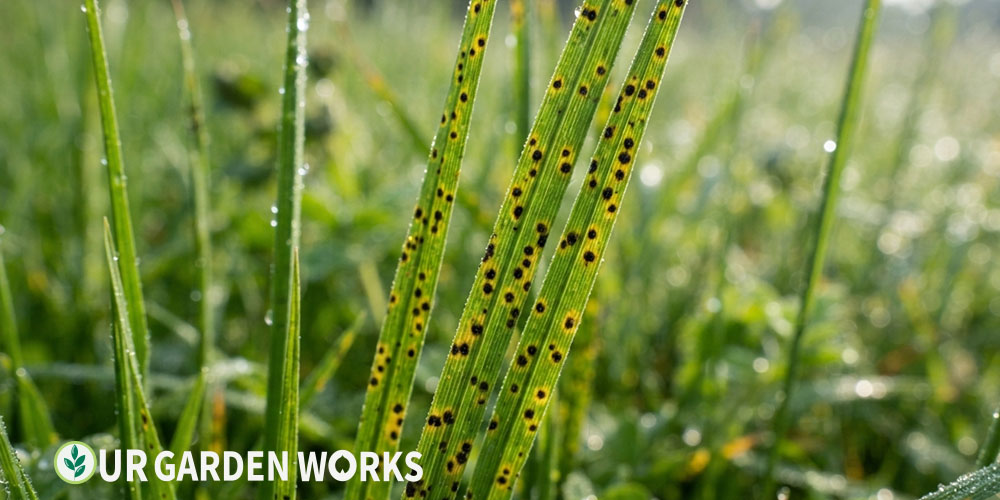
Black spots specifically on individual grass blades, rather than the broader patch or ring patterns covered elsewhere in our lawn guides, point to a more specific set of causes worth examining at the blade level rather than just the overall lawn pattern.
We’ll cover the most likely explanations, since spot size, texture, and a slime mold look-alike are all worth distinguishing carefully here.
Quick Answer: Black spots on grass blades are most often a fungal leaf spot disease (small, dark lesions, sometimes with a lighter center, worse in humid conditions) or slime mold (a temporary, harmless gray-to-black coating that appears after rain and disappears within days, often mistaken for a serious disease). Check whether the black material wipes off easily and how long it persists to tell them apart.
Cause 1 — Fungal Leaf Spot Disease
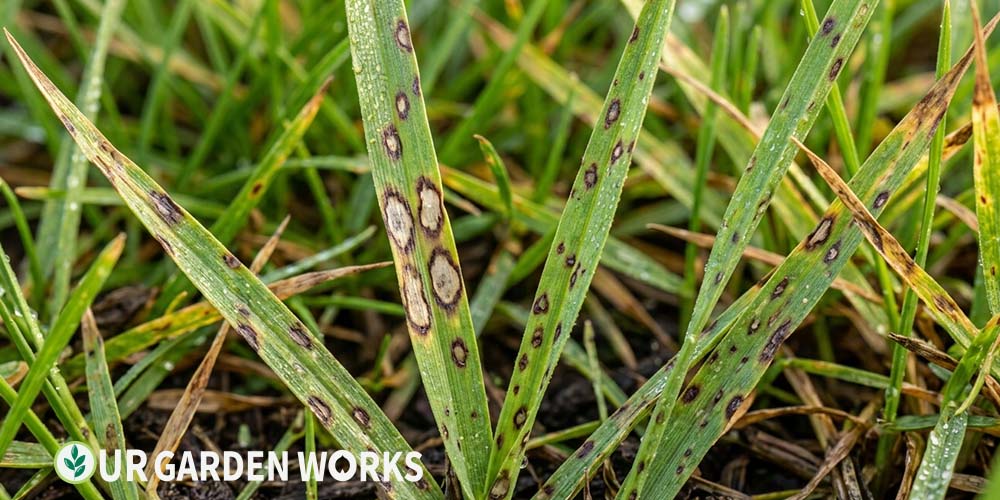
Several fungal pathogens produce small, dark, often slightly sunken lesions directly on grass blades, sometimes with a lighter tan or gray center surrounded by a darker border.
These diseases generally favor warm, humid conditions and can cause progressive blade dieback if left unmanaged, eventually contributing to overall thinning of affected turf.
How to confirm it’s fungal leaf spot:
- Spots are discrete lesions on individual blades, not a surface coating that wipes off
- May show a lighter center with a darker border, depending on the specific disease
- Persists and potentially worsens over days to weeks rather than disappearing quickly
- Worse during warm, humid weather, especially with extended leaf wetness
Fix: A fungicide labeled for leaf spot diseases helps manage active outbreaks. Reducing leaf wetness duration through morning watering (rather than evening) and improving airflow through proper mowing height and reduced thatch supports better long-term resistance.
Cause 2 — Slime Mold (Harmless, Often Mistaken for Disease)
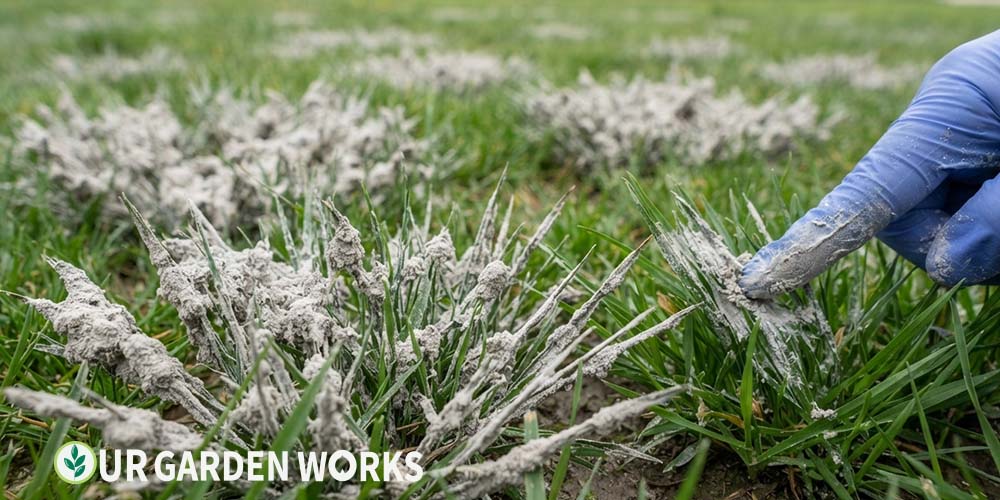
Slime mold isn’t actually a fungus at all, and despite its alarming appearance, it’s essentially harmless to grass — a temporary organism that briefly colonizes the surface of grass blades, typically appearing as a gray, white, or black powdery to slimy coating following warm, wet conditions.
It looks dramatic, especially when it appears suddenly across a noticeable area, but it causes no real damage to the grass beneath.
How to confirm it’s slime mold:
- Coating wipes or brushes off relatively easily, unlike true fungal lesions embedded in blade tissue
- Appeared suddenly, often overnight, following warm, wet conditions
- Typically disappears on its own within a few days to about a week without any treatment
- Grass beneath the coating looks essentially normal once the slime mold is removed or dries up
Fix: None needed in most cases — slime mold is self-limiting and resolves on its own. If you want to speed up its disappearance for cosmetic reasons, a strong spray from a hose or light raking helps dislodge it, or simply mowing at the next regular interval typically removes most of the visible coating.
💡 The wipe test quickly separates these two causes
Gently rubbing a finger across affected grass blades resolves this diagnosis almost immediately. Slime mold smudges and comes off relatively easily, while true fungal leaf spot lesions are embedded in the blade tissue itself and won’t wipe away the same way.
Telling the Two Causes Apart at a Glance
| Cause | Wipes Off? | Duration | Harmful to Grass? |
|---|---|---|---|
| Fungal leaf spot | No | Persists, may worsen | Yes, can cause dieback |
| Slime mold | Yes, easily | Days to about a week | No, cosmetic only |
Why Slime Mold Looks So Much More Alarming Than It Actually Is
Slime mold’s sudden, often extensive appearance — sometimes covering a significant area of lawn within just a day or two following the right warm, wet conditions — triggers more concern than the situation actually warrants given how harmless it ultimately is.
Unlike most lawn problems that develop gradually, slime mold’s nearly overnight appearance feels urgent and serious, which is exactly the opposite of how it should actually be treated.
Understanding that this organism is essentially using grass blades as a temporary physical surface to grow on, rather than parasitizing or damaging the grass tissue itself, helps reframe the alarming visual as the harmless, temporary nuisance it actually represents.
Once you’ve confirmed the wipe test and ruled out true fungal disease, the most appropriate response to slime mold is genuinely just patience.
The Different Colors Slime Mold Can Appear In
Slime mold doesn’t always appear black specifically, and knowing the range of colors it can present in helps avoid confusion if what you’re seeing doesn’t precisely match a black coating.
Depending on the specific organism and its life stage, slime mold can appear gray, white, yellow, pink, or black, sometimes shifting color over just a few days as it progresses through its life cycle from an active, often more colorful growing stage to a drier, typically darker spore-producing stage.
This color variability is part of why slime mold sometimes gets mistaken for several different problems depending on which color phase someone happens to observe it in — a white or gray stage might prompt concern about a different type of fungal issue entirely, while the black, dried spore stage looks more like the leaf spot disease covered as the primary alternative in this guide.
Regardless of the specific color observed, the wipe test and the rapid appearance-and-disappearance timeline remain the most reliable ways to confirm slime mold across any of its color variations.
Does Grass Type Affect Susceptibility to Leaf Spot Diseases?
Susceptibility to fungal leaf spot diseases varies across different grass types, which is useful context if you’re trying to understand why your lawn seems more prone to this issue than a neighbor’s with a different grass variety.
Many cool-season grasses, particularly certain Kentucky bluegrass cultivars, show meaningful susceptibility to various leaf spot pathogens, while some modern disease-resistant cultivars bred specifically with improved leaf spot tolerance perform considerably better under the same environmental conditions.
Warm-season grasses aren’t immune either, with Bermuda and zoysia both having their own associated leaf spot disease pressures, though the specific pathogens and typical severity can differ from those affecting cool-season lawns.
If leaf spot disease has been a recurring, significant problem despite reasonable watering and mowing practices, researching whether more disease-resistant cultivars are available for your specific grass type and climate is worth considering for future renovation or overseeding projects, since genetic resistance often outperforms management adjustments alone for chronic disease pressure.
Preventing True Fungal Leaf Spot Going Forward
Since fungal leaf spot diseases share the same humid, extended-leaf-wetness preference common to many lawn fungal problems covered throughout this series, the same core prevention habits apply here as elsewhere.
Watering in the morning rather than evening gives grass blades the entire day to dry before nighttime conditions favor fungal growth, while avoiding excessive nitrogen fertilization prevents the lush, tender growth that’s generally more susceptible to leaf spot infection.
Maintaining proper mowing height and frequency, along with managing thatch buildup as covered in our dedicated thatch guide, both support better airflow at the grass blade level, reducing the humid microclimate fungal leaf spot diseases depend on to establish and spread.
Frequently Asked Questions
Is slime mold dangerous to pets or children playing on the lawn?
Slime mold is generally considered low risk for typical incidental outdoor contact, though it’s reasonable to avoid direct handling or close contact with actively growing slime mold, similar to general caution around any unfamiliar organism found outdoors. It’s not known to cause significant illness from typical lawn exposure.
Will fungal leaf spot disease on my lawn spread to my garden plants?
Most lawn-specific leaf spot fungal pathogens are host-specific to turf grass and won’t typically spread to unrelated garden plants like vegetables or ornamentals.
They can spread between different areas of the same lawn, however, which is why addressing the underlying humid conditions matters for limiting spread within your turf.
Can I prevent slime mold from recurring in my lawn?
Reducing thatch and improving drainage somewhat lowers the favorable conditions slime mold needs to appear, though given how harmless and self-resolving it is, most lawn care guidance doesn’t treat slime mold prevention as a priority the way genuine fungal disease prevention deserves attention.
If it recurs occasionally after wet weather, this is normal and not a sign of an underlying lawn health problem worth addressing.
Why does slime mold seem to appear in the exact same spot in my lawn every year?
This typically reflects a consistent local pattern of moisture retention and organic matter availability in that specific spot — perhaps a slightly low area, a section with more thatch buildup, or simply somewhere that stays a bit more humid than the surrounding lawn under similar weather.
Since slime mold spores are commonly present in many lawn environments generally, the recurring location usually says more about that spot’s specific moisture and organic matter conditions than about anything uniquely wrong with the grass growing there.
Related Articles in Our Lawn Care Guide
Final Thoughts
We hope this guide has put your mind at ease if a simple wipe test revealed slime mold rather than true disease — and given you a clear treatment path if it turns out to be genuine fungal leaf spot instead.
For more lawn care guidance, our full collection of lawn articles on the soil and fertility page covers everything from seasonal maintenance to disease management.
Share this post with a fellow homeowner who’s spotted black marks on their grass — and let us know in the comments which cause matched what you found. Happy growing!
