

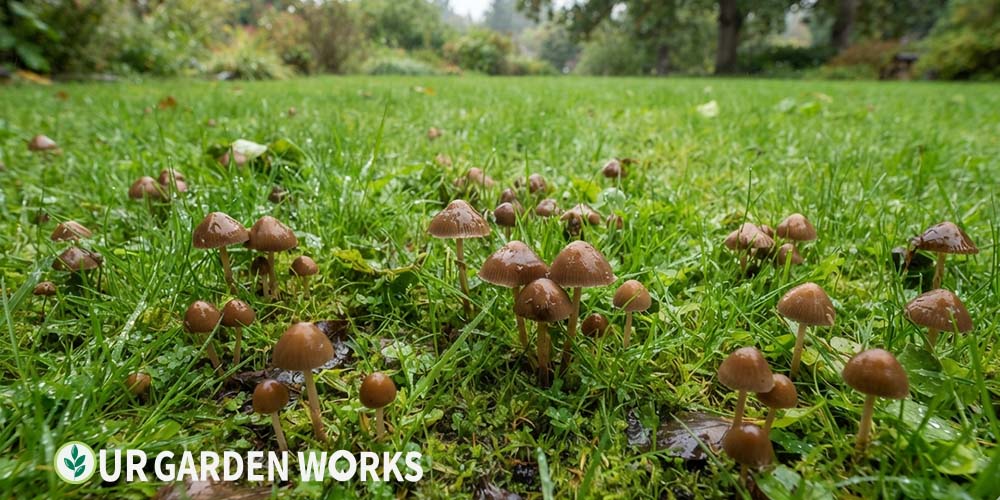
Finding mushrooms scattered across your lawn often triggers more alarm than the situation actually warrants. In the vast majority of cases, mushrooms are a sign that something is working correctly underground — organic matter is decomposing — rather than a sign that something is going wrong with your grass.
We’ll cover why mushrooms actually appear, when they genuinely signal something worth addressing, and the practical considerations around removing them if you’d simply rather not have them around.
Quick Answer: Mushrooms in lawns are the visible fruiting bodies of fungi decomposing organic matter in the soil — old roots, buried wood, leaf litter, or even thatch. They’re generally not harmful to grass and often indicate healthy soil biology rather than a problem. The main considerations are cosmetic preference and safety around pets or children, since some lawn mushroom species can cause mild illness if eaten.
Why Mushrooms Actually Appear in Lawns
Mushrooms are simply the visible, above-ground reproductive structure of a much larger fungal network living in the soil, and that fungal network is there because it’s decomposing organic material — dead grass roots, buried wood, old tree roots, leaf litter, or thatch buildup.
This decomposition process is a normal, generally beneficial part of soil ecology, breaking down organic matter into nutrients that become available to plants over time.
Mushrooms typically appear suddenly after rain or a period of high humidity, since fungi need moisture to produce these visible fruiting structures, even though the underlying fungal network has likely been present and active in the soil for a much longer period before any mushrooms became visible above ground.
💡 No mushrooms doesn’t mean no fungus
The absence of visible mushrooms doesn’t mean fungal decomposition isn’t happening in your soil — it simply means conditions haven’t recently been right for fruiting body production.
Mushrooms can appear and disappear somewhat unpredictably based on moisture and temperature, even as the underlying organic matter breakdown continues steadily underground.
Are Mushrooms Actually Harming My Lawn?
In most cases, no — mushrooms themselves don’t damage grass, and the fungal decomposition process they represent is generally a sign of healthy soil biology rather than active harm.
The exception is fairy ring fungus specifically, covered in our dedicated guide, which can sometimes produce a visible ring of stressed or discolored grass alongside the mushrooms, though even this is more of a cosmetic nuisance than a serious threat to lawn health in most cases.
If mushrooms are appearing without any accompanying grass discoloration, dead patches, or other stress symptoms, it’s reasonable to view them as a harmless, even mildly beneficial, sign of active soil biology rather than something requiring intervention.
When Mushrooms Do Signal Something Worth Addressing
A few specific situations do warrant a closer look. If mushrooms appear in a ring pattern accompanied by discolored or dying grass, this points toward fairy ring fungus, covered in detail in our fairy ring guide, which is worth managing if the cosmetic ring pattern bothers you, even though it’s still not a serious lawn health threat.
If mushrooms are unusually abundant and concentrated in one specific spot, it can indicate a particularly significant amount of buried organic matter decomposing there — sometimes an old stump or significant root mass — which is useful context but rarely requires action beyond simple awareness.
Persistent, heavy mushroom growth combined with a spongy or sunken feeling in the soil occasionally suggests a buried void or significant decomposed material creating a settling risk, which is worth a closer look if you’re concerned about the structural stability of that specific area, though this is a relatively uncommon scenario for typical residential lawns.
Should You Remove Lawn Mushrooms?
Removal is largely a matter of personal preference rather than lawn health necessity, since mushrooms themselves don’t need to be removed to protect your grass.
The most common reasons people choose to remove them are appearance preferences and safety around pets or small children, since some lawn mushroom species can cause mild to moderate gastrointestinal upset if ingested, and reliably identifying edible versus toxic mushroom species without expert knowledge isn’t something we’d recommend relying on.
If You Choose to Remove Them
- Pick or rake mushrooms before they fully mature and release spores, which reduces (though doesn’t eliminate) the chance of new mushrooms developing nearby.
- Mow over the area, which physically breaks up mushrooms and can be combined with regular routine mowing rather than requiring a separate task.
- Dispose of removed mushrooms in household trash rather than composting, since spores can survive and spread through compost used elsewhere.
Keep in mind that removing visible mushrooms doesn’t address the underlying fungal network or organic matter decomposition happening below the surface, so new mushrooms may well reappear after future rain even with consistent removal efforts.
Common Types of Mushrooms Found in Lawns
While precise species identification is best left to mycology experts given the safety considerations involved, lawn mushrooms generally fall into a few broad visual categories worth knowing about.
Small, brown, umbrella-shaped mushrooms appearing in scattered clusters are among the most common types found in residential lawns, typically the fruiting bodies of various decomposer fungi breaking down grass thatch or buried organic debris.
Puffball mushrooms, round and white to tan, sometimes appear in lawns as well, releasing a visible cloud of spores when disturbed or stepped on once fully mature.
Larger, more substantial mushrooms with a more developed cap and stem structure often indicate decomposition of more significant buried material like an old stump or large root mass, since these typically require a larger food source to support their bigger fruiting bodies compared to the smaller, more numerous mushrooms associated with thatch or smaller organic debris.
Regardless of visual type, the underlying principle remains consistent across all of these — mushrooms represent fungal decomposition of organic matter, and the specific appearance mostly reflects which fungal species happens to be present and what kind of material it’s breaking down, rather than indicating meaningfully different levels of risk or lawn health impact in most typical residential situations.
Seasonal Patterns in Lawn Mushroom Appearance
Mushroom appearance follows fairly predictable seasonal patterns tied closely to moisture and temperature conditions favorable for fungal fruiting.
Late summer and early fall, when soil retains accumulated warmth from summer while also receiving the more frequent rain typical of changing seasons, often produces the most noticeable mushroom flushes in many regions, as this combination of warmth and moisture creates ideal fruiting conditions.
Spring can also produce a secondary flush, particularly following a wet spring after winter dormancy, though generally less dramatic than the late-summer pattern in most climates.
Understanding this seasonal rhythm helps set realistic expectations — a sudden, generous crop of mushrooms appearing during a predictably wet, warm stretch isn’t a sign that something has changed for the worse in your lawn, but simply the normal seasonal expression of decomposition processes that have likely been ongoing in the soil throughout the year.
Reducing Mushroom Frequency Long-Term
If mushrooms are a persistent, unwanted presence and you’d like to reduce their frequency rather than just removing them as they appear, addressing the underlying organic matter and moisture conditions that support fungal growth offers a more lasting approach.
Removing buried stumps, large root masses, or significant wood debris where practical eliminates a major food source for decomposer fungi in that specific area.
Improving drainage and reducing excess soil moisture through aeration also makes conditions less consistently favorable for fungal fruiting, since most lawn mushroom species need fairly sustained moisture to produce visible mushrooms reliably.
Reducing thatch buildup, covered in our thatch guide, similarly removes one more organic matter source that fungi might otherwise be decomposing near the soil surface.
Frequently Asked Questions
Are lawn mushrooms safe for dogs to be around?
Most common lawn mushroom species aren’t seriously toxic, but some can cause vomiting, diarrhea, or other mild illness if a dog eats them, and a small number of more dangerous species do exist that could pose a more serious risk.
Since reliable species identification is difficult without expert knowledge, the safest approach is simply removing mushrooms promptly if you have a dog that tends to investigate or eat things in the yard, rather than trying to determine which specific species you’re dealing with.
Will a fungicide get rid of mushrooms in my lawn permanently?
Fungicides offer limited, often temporary control at best, since they don’t address the underlying organic matter the fungal network is decomposing, and that decomposition process can continue for years depending on how much buried material is present.
Most lawn care professionals don’t recommend fungicide as a primary mushroom control strategy specifically because of this limited, short-lived effectiveness relative to the underlying cause.
Why do mushrooms keep appearing in the exact same spot every year?
This pattern typically means there’s a substantial, slow-decomposing source of organic matter in that specific location — commonly an old tree stump, a significant root system, or buried construction debris — that continues feeding the same fungal colony year after year as it gradually breaks down over an extended period.
This is essentially the same underlying mechanism as fairy ring fungus, even if the visual ring pattern isn’t present.
Related Articles in Our Lawn Care Guide
Final Thoughts
We hope this guide has eased any worry about the mushrooms popping up in your lawn — in most cases, they’re a sign of healthy soil activity rather than a problem needing urgent attention.
For more lawn care guidance, our full collection of lawn articles on the soil and fertility page covers everything from seasonal maintenance to soil health.
Share this post with a fellow homeowner who’s spotted mushrooms in their yard — and let us know in the comments whether you decided to remove them or let them be. Happy growing!
