

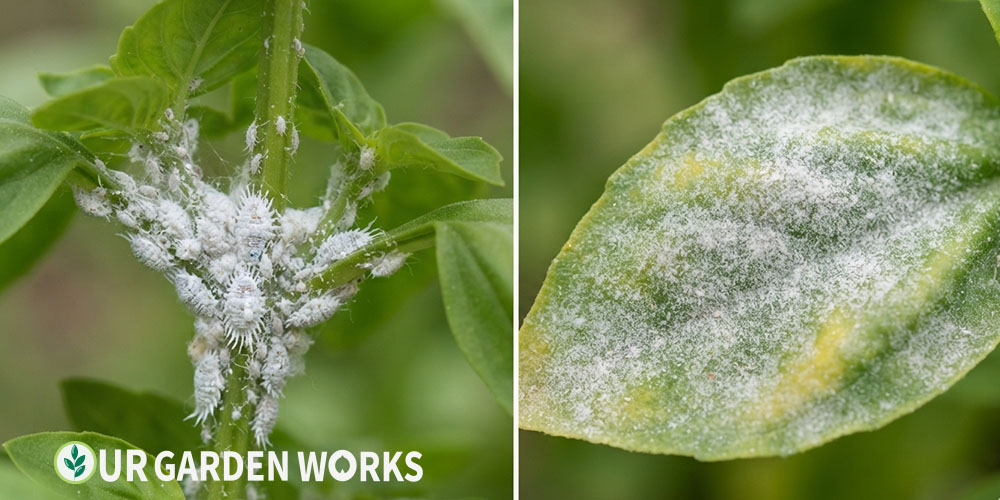
White fuzz on plant leaves splits cleanly into two very different categories — a living insect pest or a fungal disease — and the good news is that distinguishing between them takes only a few seconds once you know what to check.
Getting this right matters, since the treatments for each are completely different.
We’ll cover the simple test that separates the two, then the details specific to each so you can move straight to the right treatment.
Quick Answer: White fuzz on plant leaves is either mealybugs (distinct cottony clusters concentrated at leaf joints and stems, doesn’t wipe away easily, may move slightly) or powdery mildew (an even, dusty coating across the leaf surface, smudges or wipes off readily). Touch the fuzz gently — mealybugs feel waxy and cluster in specific spots, while powdery mildew transfers as a fine dust across your finger.
The Touch Test — Your Fastest Way to Tell Them Apart
Before anything else, gently touch the white fuzz with a finger or cotton swab. Powdery mildew is a fine, dry, dusty coating that readily smudges and transfers onto your finger, leaving the leaf surface visibly clearer where you touched it.
Mealybugs, by contrast, feel more waxy and cottony, holding their shape more distinctly, and you may even notice the cluster shift slightly or individual insects beneath the waxy coating if you look closely.
💡 Location is a secondary clue
Powdery mildew spreads across the general leaf surface, often starting in patches that expand outward. Mealybugs concentrate specifically at leaf joints, along stems, and in other protected nooks of the plant, rarely spreading evenly across an open leaf surface the way mildew does.
If It’s Mealybugs
Mealybugs are small, soft-bodied insects covered in a white, waxy, cottony secretion that gives them their fuzzy appearance. They feed on plant sap, excrete sticky honeydew as a byproduct (see our sticky leaves guide for more on this), and reproduce readily in warm, indoor growing conditions especially.
How to confirm mealybugs specifically:
- Fuzz appears as distinct clusters rather than an even coating
- Concentrated at leaf joints, stem nodes, and other protected areas
- Texture feels waxy and somewhat resistant to easy wiping
- Sticky honeydew residue often present on nearby leaves or surfaces below the plant
Treatment Directions
- For light infestations, dab visible mealybugs directly with a cotton swab soaked in rubbing alcohol, which kills them on contact.
- For broader infestations, spray the entire plant thoroughly with insecticidal soap or neem oil, making sure to reach leaf joints and stem nodes where mealybugs cluster.
- Repeat treatment every 7-10 days for 2-3 cycles, since mealybug eggs and newly hatched nymphs often survive a single treatment.
- Isolate heavily infested plants from others while treating to prevent spread.
If It’s Powdery Mildew
Powdery mildew is a fungal disease producing a fine, dusty white to grayish coating across leaf surfaces, thriving in conditions of high humidity combined with warm days and cooler nights. Unlike mealybugs, it’s not a living pest you’re trying to kill directly, but a fungal growth you’re managing through environmental adjustment and fungicide treatment.
How to confirm powdery mildew specifically:
- Coating is even and dusty, spreading across the general leaf surface
- Easily smudges or transfers when touched
- No honeydew stickiness, since this isn’t an insect-related symptom
- Often starts in patches that gradually expand and merge
Treatment Directions
- Mix a baking soda spray (1 tablespoon baking soda, 1 teaspoon mild liquid soap, 1 gallon water) and apply thoroughly to affected leaves, including undersides.
- Improve airflow around the plant by increasing spacing or thinning dense growth.
- Avoid overhead watering and wetting foliage, switching to soil-level watering if possible.
- For severe infections, a sulfur or potassium bicarbonate-based fungicide provides stronger control — see our complete powdery mildew guide for the full treatment approach.
Telling the Two Apart at a Glance
| Feature | Mealybugs | Powdery Mildew |
|---|---|---|
| Texture | Waxy, cottony, holds shape | Fine, dusty, smudges easily |
| Location | Leaf joints, stem nodes | General leaf surface |
| Honeydew/stickiness | Often present | Absent |
| Cause type | Living insect | Fungal disease |
Preventing Mealybugs Before They Establish
Mealybugs often arrive on a new plant brought home from a nursery or shared as a cutting from another gardener, making inspection at the point of acquisition one of the most effective prevention steps available.
Checking leaf joints and stem nodes carefully on any new plant before introducing it to your existing collection catches an infestation before it has the chance to spread.
For plants with a known history of mealybug problems, periodic inspection — even just a quick check of leaf joints every couple of weeks — catches a new, small infestation while it’s still easy to manage with a few cotton swab applications, rather than letting it build into a more extensive problem requiring repeated full-plant treatment.
Avoiding overcrowding plants too closely together also reduces how easily mealybugs travel from one plant to its neighbors.
Preventing Powdery Mildew Through Growing Conditions
Since powdery mildew depends on specific environmental conditions rather than simply needing a host plant to arrive on, prevention focuses much more heavily on growing conditions than on inspection and early detection the way mealybug prevention does.
Spacing plants generously to improve airflow, avoiding overhead watering that wets foliage unnecessarily, and choosing mildew-resistant varieties where available all reduce how readily this fungal disease establishes in the first place.
Morning watering, rather than evening, gives any incidental leaf moisture a full day to dry before the cooler nighttime conditions that favor mildew development arrive.
This same principle — keeping leaves dry and well-ventilated — appears as a recurring prevention theme across nearly every fungal disease covered throughout this entire leaf problems series, which reflects just how consistently moisture management determines fungal disease risk regardless of which specific plant or pathogen is involved.
Special Considerations for Houseplants
Houseplants face a somewhat different balance of risk between these two causes compared to outdoor garden plants.
Indoor environments typically run drier in terms of ambient humidity than many outdoor garden settings, which can actually reduce powdery mildew risk somewhat indoors, while the stable warmth of most homes favors continuous mealybug reproduction without the seasonal die-off that outdoor populations experience during cooler months.
This shifted balance is part of why mealybugs are often the more frequently encountered of the two causes specifically on houseplants, particularly on common susceptible types like succulents, ficus, and many tropical foliage plants.
If you’re dealing with white fuzz on an indoor plant specifically and the touch test is ambiguous, leaning toward mealybugs as the more statistically likely explanation, while still confirming with the touch and location checks, is a reasonable starting assumption for indoor growing situations.
Could It Be Both at the Same Time?
It’s entirely possible for a single plant to host both mealybugs and powdery mildew simultaneously, particularly on a stressed or weakened plant that’s more vulnerable to multiple problems at once, or on a densely grown plant where high humidity favors mildew while also providing good hiding spots for mealybugs.
If you’re seeing white fuzz in multiple distinct patterns — some concentrated clusters at leaf joints and some broader dusty coating elsewhere — both explanations may genuinely apply.
In this situation, treat each condition according to its specific protocol rather than assuming one treatment will address both, since insecticidal soap effective against mealybugs won’t meaningfully treat an established fungal infection, and a baking soda fungicide spray won’t kill mealybugs.
Addressing both simultaneously, while also improving the underlying growing conditions (better airflow, appropriate watering, balanced fertilizing) that may have allowed both problems to develop, gives the plant the best chance at a full recovery.
Frequently Asked Questions
Can white fuzz from either cause spread to my other plants?
Yes, both can spread — mealybugs can crawl or be transported between plants, especially ones placed close together, while powdery mildew spores travel through the air and can infect nearby susceptible plants under the right humidity and temperature conditions.
Isolating an affected plant while treating, when practical, helps limit spread to your broader plant collection or garden.
Are houseplants or outdoor plants more prone to white fuzz problems?
Mealybugs are somewhat more commonly a houseplant and greenhouse problem, since indoor conditions lack the natural predators and weather fluctuations that help control them outdoors, though they certainly occur outdoors as well, especially on woody ornamentals.
Powdery mildew occurs in both settings but is particularly common outdoors on susceptible plants like squash, roses, and many ornamentals during the specific warm-day, cool-night conditions that favor its spread.
How long does treatment typically take to fully resolve either problem?
Mealybugs typically require 2-3 treatment cycles spaced 7-10 days apart to fully resolve, since a single application rarely catches every life stage present on the plant.
Powdery mildew treatment timelines vary more with weather — symptoms can improve within a week or two under favorable, less humid conditions, but may persist longer if the humid, favorable conditions for the fungus continue throughout treatment.
Is it safe to keep an infested plant near my other houseplants while treating it?
It’s better to isolate an affected plant if at all possible, since both mealybugs and powdery mildew spores can spread to nearby susceptible plants during the treatment period before the infestation or infection is fully controlled.
A separate room, or even just a few feet of distance combined with not letting leaves touch neighboring plants, meaningfully reduces this spread risk while treatment takes effect.
Related Articles in Our Plant Care Guide
- Sticky Leaves on Plants — What’s Causing It
- White Powder on Squash Leaves — Powdery Mildew Guide
- Insecticidal Soap vs. Neem Oil: Which Is Better?
- Brown Leaf Tips on Peace Lily
- 3 Possible Causes of White Spots On Basil Leaves & How To Treat Them
- (Free tool) Garden Pest Identifier — What’s Eating My Plants?
- (Free tool) Plant Disease Identifier — What’s Wrong With My Plant?
- Plant Care Guides (Hub)
Final Thoughts
We hope this guide has made the mold-versus-mealybugs distinction quick and easy to resolve — that simple touch test really does settle the question in seconds for most cases.
Share this post with a fellow gardener who’s troubleshooting white fuzz on their plants — and let us know in the comments which one turned out to be the culprit. Happy growing!
