

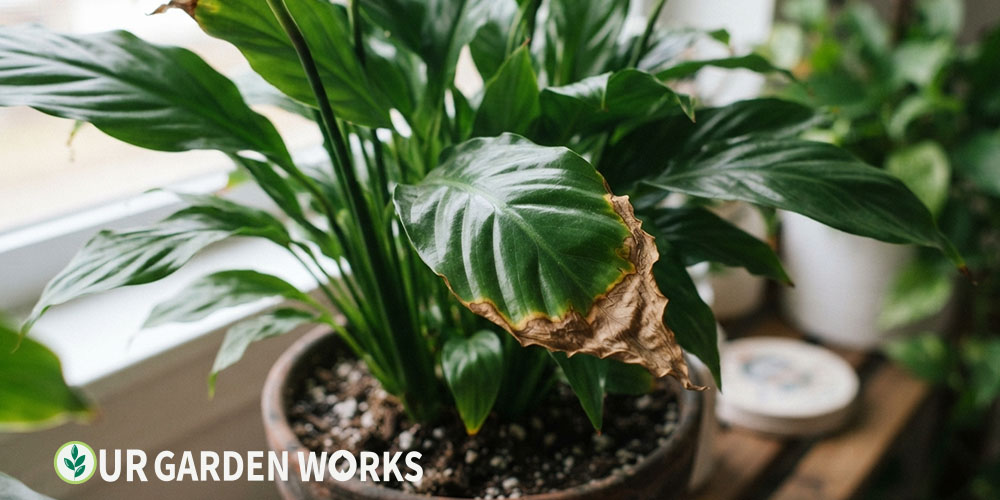
Brown tips on a peace lily are one of the most common houseplant complaints we hear, and the frustrating part is that peace lilies are otherwise considered one of the easier, more forgiving houseplants to grow.
The tip browning tends to happen even to attentive plant owners, which is exactly why understanding the actual cause matters so much.
Most cases trace back to just two or three culprits, and the good news is that none of them are difficult to fix once identified. We’ll walk through each cause in order of how often we actually see it.
Quick Answer: Brown leaf tips on peace lily are most often caused by tap water minerals (fluoride and chlorine sensitivity), underwatering, low humidity, or fertilizer salt buildup. Switch to filtered or distilled water, water more consistently before the plant fully wilts, increase humidity, and flush soil periodically to remove built-up salts.
Cause 1 — Tap Water Sensitivity (Most Common)
Peace lilies are notably sensitive to the fluoride and chlorine commonly found in municipal tap water, more so than many other common houseplants.
Over time, these compounds accumulate in leaf tissue and cause the tips and margins to brown and die back, even when watering frequency and amount are otherwise perfectly appropriate.
How to confirm it’s water sensitivity:
- Browning appears as a fairly uniform tip and edge pattern across multiple leaves
- Plant otherwise looks healthy — good color, normal growth, no wilting
- You’re using untreated municipal tap water for watering
- Problem has developed gradually over weeks or months rather than suddenly
Fix: Switch to filtered water, distilled water, or tap water left to sit out uncovered for 24 hours to allow chlorine to dissipate before use. Existing brown tips won’t reverse, but new growth should come in clean once you’ve switched water sources.
💡 Rainwater is ideal if you can collect it
Peace lilies, like many tropical houseplants, respond particularly well to rainwater, which contains none of the minerals or treatment chemicals found in tap water. If you have an easy way to collect rainwater, even just leaving a container out during rain, it’s worth using for this particular plant.
Cause 2 — Underwatering and Inconsistent Moisture
Peace lilies are famous for dramatically wilting, almost collapsing, when they need water — and while the plant typically recovers fully once watered, repeated cycles of severe wilting before watering eventually stress leaf tips enough to cause browning.
This is different from tap water sensitivity in that the underlying pattern is inconsistency rather than steady mineral accumulation.
How to confirm it’s underwatering:
- Plant has a history of wilting dramatically between waterings
- Browning tends to follow especially severe wilting episodes
- Soil is often quite dry when you check it
- Some leaves show wilting alongside the brown tips, not just browning alone
Fix: Water before the plant reaches the dramatic wilting stage — check soil moisture every few days and water when the top inch or two feels dry, rather than waiting for visible wilting as your cue. A consistent schedule prevents the repeated stress cycles that lead to tip browning.
Cause 3 — Low Humidity
Peace lilies are native to tropical rainforest understories and prefer considerably more humidity than the average home, especially during winter when indoor heating dries out indoor air significantly.
Low humidity causes leaf tips, which lose moisture fastest due to their position furthest from the plant’s water source, to brown and crisp even when soil moisture is adequate.
How to confirm it’s low humidity:
- Problem is worse in winter or in air-conditioned spaces
- Plant is positioned near a heating vent, radiator, or drafty window
- Soil moisture and water quality have already been ruled out or addressed
- Other tropical houseplants nearby show similar symptoms
Fix: Group plants together to create a more humid microclimate, use a pebble tray with water beneath the pot, or run a humidifier nearby. Misting provides only brief, temporary relief and isn’t a reliable long-term solution on its own.
Cause 4 — Fertilizer Salt Buildup
Over-fertilizing, or fertilizing without occasionally flushing the soil, causes mineral salts to accumulate in the potting mix, which then damages root tips and shows up as leaf tip browning above ground.
This is a slower, more gradual cause than the others and often goes unsuspected since it’s less intuitive than water quality or watering frequency.
How to confirm it’s salt buildup:
- You fertilize regularly, possibly more frequently than the product label recommends
- A white, crusty residue is visible on the soil surface or pot rim
- Plant hasn’t been repotted or had its soil flushed in a long time
Fix: Flush the soil thoroughly by running a large volume of water through the pot (several times the pot’s volume) and letting it drain completely. Reduce fertilizing frequency going forward, and consider diluting fertilizer to half the label-recommended strength for a more forgiving feeding schedule.
Cause 5 — Direct Sun or Heat Exposure
Peace lilies prefer indirect, filtered light and can scorch in direct, intense sun exposure, particularly through south or west-facing windows in summer.
This produces a different pattern than the causes above — often a more localized browning on the side of the plant facing the light source, sometimes with a slightly bleached appearance rather than uniform brown crisping.
How to confirm it’s sun or heat exposure:
- Browning is concentrated on the side of the plant facing a window or light source
- Plant was recently moved to a brighter location
- Affected areas may look slightly bleached or scorched rather than uniformly brown
Fix: Move the plant to a spot with bright, indirect light rather than direct sun exposure, or add a sheer curtain to filter intense afternoon sun coming through a window.
Telling the Five Causes Apart at a Glance
| Cause | Pattern | Other Clues |
|---|---|---|
| Tap water sensitivity | Uniform tip/edge browning, gradual | Using untreated tap water |
| Underwatering | Follows wilting episodes | History of dramatic wilting |
| Low humidity | Worse in winter/heated rooms | Near vents or AC |
| Salt buildup | Gradual, soil crust visible | Regular fertilizing, no flushing |
| Sun/heat exposure | Localized to light-facing side | Recently moved to brighter spot |
When Repotting Solves the Problem Entirely
If you’ve addressed water quality, watering consistency, and humidity but brown tips persist, an old, depleted potting mix or a rootbound plant is worth investigating as the underlying cause.
Peace lilies that have been in the same pot and soil for several years often accumulate exactly the kind of mineral buildup covered above, and a full repot with fresh potting mix resolves this more thoroughly than soil flushing alone.
Rootbound plants — where roots have filled the entire pot and circled around themselves — also struggle to take up water and nutrients efficiently even with perfect watering habits, since there’s simply no room left for healthy root expansion.
If you gently remove your peace lily from its pot and see a dense mass of roots with little visible soil remaining, sizing up to a slightly larger pot with fresh soil often produces a noticeable improvement in overall plant vigor within a few weeks.
Should You Trim the Brown Tips?
Trimming already-brown tips is purely cosmetic and won’t affect the plant’s health one way or the other, since that tissue is already dead regardless of whether you remove it.
Many plant owners prefer to trim for appearance, using clean scissors to cut just into the green tissue at a slight angle that mimics the leaf’s natural shape.
It’s worth addressing the underlying cause before or alongside trimming, since cutting away brown tips without fixing the actual problem just means new growth will develop the same issue. Think of trimming as cosmetic maintenance, not treatment.
Frequently Asked Questions
Will brown tips spread to the rest of my peace lily leaf?
Generally no, especially if the underlying cause is addressed promptly. Brown tips from water quality, humidity, or underwatering typically stay contained to the leaf margin and tip area rather than progressing to consume the entire leaf, as long as the plant’s overall care improves going forward.
Why is my peace lily drooping even though the soil is moist?
This combination usually points to root problems rather than a watering issue, often root rot from previous overwatering or a pot without adequate drainage.
Check the roots by gently removing the plant from its pot — healthy roots are firm and pale, while rotted roots are dark, soft, and mushy and need to be trimmed away.
How often should I water my peace lily to avoid both underwatering and overwatering?
Check the soil every 3-4 days and water thoroughly when the top inch or two feels dry, rather than following a fixed calendar schedule that doesn’t account for seasonal changes in light, temperature, and humidity.
Peace lilies are fairly forgiving of this check-and-water approach, which is part of why they’re considered a good beginner houseplant despite their dramatic wilting reputation.
Can I use a water filter pitcher instead of buying distilled water for my peace lily?
Yes, a standard household water filter pitcher removes much of the chlorine and some other compounds that bother sensitive plants like peace lilies, making it a convenient and more affordable alternative to consistently buying distilled water.
It won’t remove fluoride as effectively as distillation, but it’s a meaningful improvement over straight tap water for most municipal water supplies.
Related Articles in Our Houseplant Care Guide
- How to Care for a Peace Lily – Complete Guide (2026)
- Growing Peace Lily From Seed: A Step-by-Step Guide
- Propagation Q&A: Can You Propagate Peace Lily From Cutting?
- How Tall Can Peace Lily Grow? [15 Varieties From Tallest to Shortest]
- Natural Air Purifiers: Does Peace Lily Clean The Air?
- Sticky Leaves on Plants — What’s Causing It
- White Fuzz on Plant Leaves — Mold or Mealybugs
- Wrinkled Leaves on Succulents — Causes
Final Thoughts
We hope this guide has helped you pin down exactly why your peace lily’s leaf tips are browning — and given you confidence that it’s almost always a fixable, common issue rather than a sign of serious plant distress.
Most peace lily owners deal with this at some point, and a water source change alone resolves a large share of cases. For more houseplant care guidance, our full collection of plant care articles covers everything from watering to pest management.
Share this post with a fellow plant parent who’s troubleshooting their peace lily — and let us know in the comments which cause matched what you found. Happy growing!
