

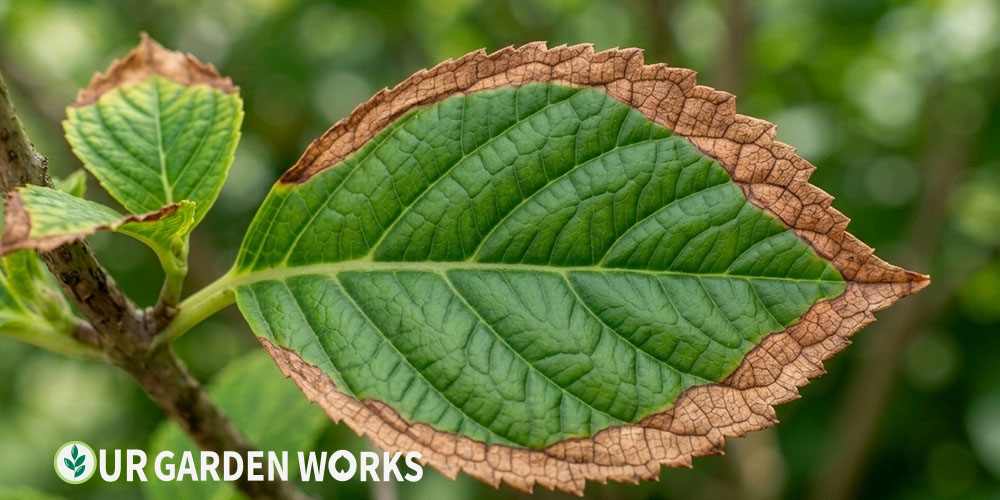
Brown edges on hydrangea leaves are visually distinct from spots or general yellowing — the damage is concentrated specifically along the leaf margin, which actually narrows the cause list considerably compared to other hydrangea symptoms. Most cases trace back to some version of water stress, whether too little, too much, or too salty.
We’ll walk through the most common causes, with the details that help you tell a simple underwatering problem from something that needs a more involved fix.
Quick Answer: Brown edges on hydrangea leaves are most often caused by underwatering or heat stress (crispy margins, worse in afternoon sun), fertilizer or salt burn (margin browning following a recent feeding), transplant shock (temporary, after a recent move), or a fungal leaf scorch disease (less common, often with a yellow border between green and brown tissue). Check recent watering, fertilizing, and weather first.
Cause 1 — Underwatering and Heat Stress (Most Common)
Hydrangeas have notably high water needs compared to many other shrubs, and their large, broad leaves lose moisture quickly in hot or windy conditions. When the plant can’t take up water fast enough to match what it’s losing through its leaves, the margins — furthest from the central vein’s water supply — are the first tissue to dry out and brown.
How to confirm it’s underwatering or heat stress:
- Browning is concentrated specifically along leaf margins, often starting at the tips
- Worse on plants in full sun or exposed to wind
- Plant may also show afternoon wilting or drooping
- Soil feels dry when checked at root depth
Fix: Increase watering frequency, aiming for deep, consistent moisture rather than light frequent sprinkles. A 2-3 inch mulch layer significantly helps retain soil moisture between waterings, and afternoon shade — even partial, from a nearby structure or taller planting — reduces water loss on the hottest days.
💡 Big-leaf hydrangeas need more water than other types
Bigleaf hydrangeas (Hydrangea macrophylla), the classic mophead and lacecap types, have particularly large, thin leaves that lose water faster than the smaller, tougher leaves of panicle or smooth hydrangeas. If you’re growing a bigleaf variety in full sun, expect to water more frequently than general hydrangea care advice might suggest.
Cause 2 — Fertilizer or Salt Burn
Over-fertilizing, or applying fertilizer too close to the plant’s base or during dry conditions, can cause salt burn that shows up as browning concentrated at leaf margins, similar in appearance to underwatering but tied specifically to a recent feeding rather than general dry conditions.
Excess mineral salts draw moisture out of leaf tissue at the cellular level, producing this characteristic edge damage.
How to confirm it’s fertilizer burn:
- Browning appeared within days of a recent fertilizer application
- You may have applied more than the label-recommended rate, or applied during dry soil conditions
- A white, crusty residue may be visible on the soil surface near the plant
Fix: Flush the soil thoroughly with water to dilute and wash away excess salts. Going forward, follow label rates precisely, water before fertilizing (never feed dry soil), and consider diluting fertilizer to half-strength for a more forgiving margin of error.
Cause 3 — Transplant Shock
A hydrangea recently moved, divided, or newly planted can show temporary leaf margin browning as the root system adjusts to its new location, even under otherwise appropriate care. This is a normal, usually self-limiting stress response rather than an ongoing care problem.
How to confirm it’s transplant shock:
- Browning began shortly after a move or new planting
- No other clear signs of over- or under-watering, or recent fertilizing
- New growth, once it appears, looks healthy
Fix: Patience and consistent watering during the establishment period, typically the first full growing season after transplanting. Avoid fertilizing during this adjustment window.
Cause 4 — Fungal Leaf Scorch (Less Common)
A handful of fungal pathogens can produce a leaf scorch appearance similar to environmental browning, but typically with a more defined yellow halo separating the dead brown margin from the still-green interior leaf tissue.
This is less common than the environmental causes above but worth ruling out if symptoms don’t improve with watering and fertilizing adjustments.
How to confirm it’s fungal scorch:
- A distinct yellow band separates brown margin tissue from green healthy tissue
- Doesn’t improve despite corrected watering and fertilizing
- May be accompanied by other spotting or lesions elsewhere on the leaf
Fix: Remove affected leaves and improve airflow around the plant. A copper-based fungicide can help manage active spread if the condition is confirmed and progressing despite environmental corrections.
Telling the Four Causes Apart at a Glance
| Cause | Pattern | Recent History |
|---|---|---|
| Underwatering/heat stress | Margin browning, worse in sun | Dry soil, hot/windy weather |
| Fertilizer/salt burn | Margin browning, sudden onset | Recent fertilizing |
| Transplant shock | Temporary, mild | Recent move or planting |
| Fungal leaf scorch | Yellow halo between brown/green | No improvement with watering fixes |
Watering Strategy by Climate
How aggressively you need to manage hydrangea watering to prevent brown edges depends considerably on your regional climate, and it’s worth calibrating expectations accordingly.
In hot, dry climates like much of the Southwest and interior California, even well-sited, appropriately shaded hydrangeas often need supplemental watering multiple times per week during peak summer, and brown edges should be treated as an early warning sign worth responding to immediately rather than tolerating.
In more humid, temperate climates — much of the Southeast, Mid-Atlantic, and Pacific Northwest — natural rainfall and ambient humidity reduce how often supplemental watering is needed, and brown edges appearing despite generally favorable conditions more often point toward fertilizer burn or transplant shock than simple drought stress.
Knowing which category your climate falls into helps you interpret symptoms more accurately rather than assuming the same explanation applies everywhere.
Container hydrangeas, regardless of regional climate, behave more like the hot, dry climate scenario described above, simply because pot soil heats and dries faster than garden soil everywhere.
This is worth keeping in mind even if you garden in a naturally humid region but happen to be growing your hydrangea in a container on a sunny deck or patio.
Try our free tool: Garden Watering Calculator — How Much Water Your Crops Actually Need
The Role of Soil and Mulch in Preventing Margin Browning
Soil quality plays a meaningful supporting role in how well a hydrangea tolerates heat and manages its water needs, beyond just the watering schedule itself.
Soil rich in organic matter holds moisture more evenly and for longer between waterings than sandy or heavily compacted soil, effectively buying the plant a larger buffer against the kind of rapid drying that triggers margin browning.
Working compost into the soil around an established hydrangea, even without fully replanting it, gradually improves this moisture-holding capacity over a season or two.
Combined with a generous mulch layer — ideally extending out to the plant’s drip line rather than just a token ring close to the stem — this soil improvement approach reduces how often you need to actively water to prevent the underlying stress that leads to brown leaf edges in the first place.
Matching Hydrangea Type to Your Sun Exposure
Since heat and sun stress is the most common cause of brown leaf edges, choosing the right hydrangea type for your specific planting location prevents a recurring problem rather than fighting it every summer.
Bigleaf hydrangeas generally want morning sun with afternoon shade, while panicle hydrangeas (like Limelight and similar varieties) tolerate considerably more sun and heat without the same margin browning risk.
If brown edges have been a persistent, season-after-season issue despite consistent watering adjustments, it’s worth honestly assessing whether the planting location simply provides more sun and heat than that particular hydrangea type is suited for.
In some cases, relocating to a more appropriately shaded spot, or replacing with a more sun-tolerant variety, solves the problem more completely than continuing to compensate with extra watering.
Frequently Asked Questions
Will brown edges spread to consume the whole hydrangea leaf?
Generally no, especially once the underlying cause is corrected — the margin tissue that’s already brown won’t recover, but the damage typically stays contained to the edge rather than progressing inward across the whole leaf.
Continued spreading despite correction is a signal to reconsider the diagnosis, possibly toward the fungal scorch cause covered above.
Should I trim off the brown edges on my hydrangea leaves?
Trimming is purely cosmetic and doesn’t affect the plant’s health either way, since that margin tissue is already dead. Many gardeners leave affected leaves alone unless the browning is extensive or particularly unsightly, since trimming many individual leaves is time-consuming for a purely aesthetic benefit.
Can container-grown hydrangeas get brown edges more easily than in-ground plants?
Yes, significantly — container soil dries out and heats up faster than garden soil, making underwatering and heat stress considerably more likely for potted hydrangeas, especially in full sun.
Container hydrangeas typically need daily watering attention during hot summer stretches, more frequent than most in-ground plantings of the same variety would require.
How quickly should I expect improvement after fixing the underlying cause?
Already-browned margins won’t reverse regardless of cause, but new growth emerging after correction should come in healthy if the underlying issue has genuinely been resolved.
For watering adjustments specifically, expect to see the rate of new browning slow within about a week, with fully healthy new leaves following over the next few weeks as the plant’s overall water balance stabilizes.
Related Articles in Our Hydrangea Care Guide
- Yellow Leaves on Hydrangeas — 7 Causes + Fixes
- Black Spots on Hydrangea Leaves – 2 Causes and Treatment
- 10 Best Fungicides For Hydrangeas in 2026
- Common Hydrangea Problems: Why Is My Hydrangea Not Growing?
- 5 Easy Ways to Fix Hydrangea Leaves Wilting Or Drooping
- (Free tool) Garden Watering Calculator — How Much Water Your Crops Actually Need
Final Thoughts
We hope this guide has helped you pin down why your hydrangea’s leaf edges are browning — water stress in one form or another explains the large majority of cases, which is good news since it’s also the most straightforward to fix.
For more hydrangea care guidance, our plant care guides cover everything from blooming to disease management.
Share this post with a fellow gardener who’s troubleshooting their hydrangea — and let us know in the comments which cause matched what you found. Happy growing!
