

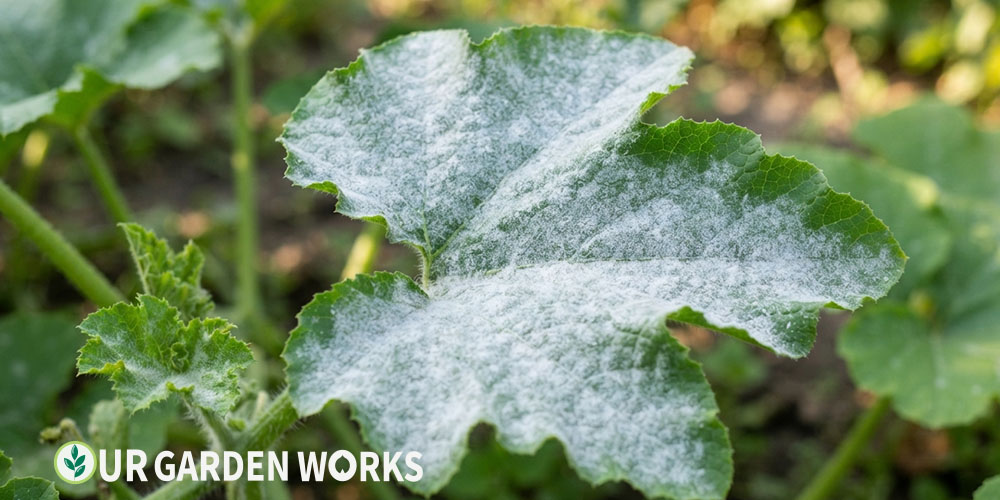
White powder on squash leaves is one of the most recognizable plant problems out there, and it’s almost always exactly what it looks like: powdery mildew. Unlike many leaf problems with several competing explanations, this one is refreshingly straightforward to diagnose with real confidence.
What’s less straightforward is managing it well, since powdery mildew is also one of the most persistent and recurring squash problems home gardeners face.
This guide covers confirming the diagnosis, treating an active outbreak, and the habits that meaningfully reduce how bad it gets each season.
Quick Answer: White powder on squash leaves is powdery mildew, a fungal disease that thrives in warm days, cool nights, and high humidity without necessarily needing actual rain. Treat with a baking soda or potassium bicarbonate spray for mild cases, or a sulfur or neem oil fungicide for established infections. Improve airflow, avoid overhead watering, and choose resistant varieties to reduce recurrence.
What Powdery Mildew Actually Looks Like
Powdery mildew produces a distinctive white to grayish, powdery or dusty coating across leaf surfaces, often starting as small circular patches that expand and merge as the infection progresses.
Unlike most fungal diseases, it doesn’t require wet leaves to spread — high humidity alone is often enough, which is why it shows up reliably even during dry spells if nighttime humidity stays high.
It typically starts on older, lower leaves and on the undersides of leaves before becoming visible on top surfaces, then spreads upward and outward across the plant as the season progresses. Left untreated, severely affected leaves eventually turn yellow, then brown, and die, reducing the plant’s overall productivity.
💡 Squash bug damage can look similar from a distance
Squash bug feeding can cause leaves to develop a stippled, somewhat pale or mottled appearance that some gardeners mistake for early mildew from a distance.
Up close, mildew has a genuinely powdery, dusty texture you can sometimes wipe off with a finger, while squash bug damage looks more like discrete pale speckling without that dusty coating.
Why Powdery Mildew Happens
Powdery mildew fungi thrive in a specific combination of conditions: warm daytime temperatures, cooler nights, and high humidity, particularly the kind that develops from dense plant canopy trapping moist air rather than from rainfall itself.
This is why powdery mildew often appears even during a dry stretch of summer weather, confusing gardeners who assume fungal disease requires wet conditions.
Dense, crowded plantings with poor airflow create exactly the humid microclimate this fungus favors, which is part of why summer squash and zucchini — often grown in tight spacing for maximum yield — are so frequently affected.
Late summer is typically the peak period, as plants have grown large and dense by that point in the season, and cooling nighttime temperatures begin creating the day-night contrast the fungus thrives on.
Treating an Active Infection
For Mild, Early-Stage Infections
- Mix 1 tablespoon of baking soda, 1 teaspoon of mild liquid soap, and 1 gallon of water for a simple home spray. Potassium bicarbonate-based commercial products work on the same principle and are often slightly more effective.
- Spray all affected leaf surfaces thoroughly, including undersides, in the early morning or evening to avoid leaf burn from sun exposure on wet leaves.
- Repeat every 5-7 days as needed, and after any rain that washes off the previous application.
For Established or Severe Infections
- Remove the most severely affected leaves to reduce the overall fungal load on the plant, but avoid removing more than 20-25% of total foliage in one session.
- Apply a sulfur-based or neem oil fungicide according to label instructions, typically every 7-14 days during active disease pressure.
- Improve airflow immediately by thinning surrounding growth or removing some of the densest foliage, even beyond just the infected leaves.
⚠️ Don’t apply sulfur and oil-based products too close together
Sulfur fungicides and oil-based products like neem oil can react poorly when applied within a couple weeks of each other, sometimes causing leaf burn. If switching between treatment types, allow at least 2 weeks between applications, or check product labels for specific compatibility guidance.
Preventing Powdery Mildew From Taking Over
Spacing plants generously from the start, rather than maximizing the number of plants in a given bed, does more to prevent powdery mildew than almost any treatment applied after the fact.
Good airflow between plants reduces the humid microclimate the fungus needs, and this single planning decision pays off across the entire season.
Watering at the soil level rather than overhead, and watering in the morning rather than evening, both help — not because powdery mildew specifically needs leaf wetness to spread the way some other fungi do, but because overall plant stress from poor watering habits makes any disease take hold more readily.
Choosing resistant varieties, increasingly common and clearly labeled on seed packets for popular summer squash and zucchini types, is one of the most effective single changes available if mildew has been a recurring, significant problem in your garden.
A weekly preventive spray with the baking soda solution above, started before any symptoms appear once the season’s heat and humidity pattern typically brings mildew on, can meaningfully delay or reduce the severity of infection compared to a purely reactive approach.
Which Squash Varieties Are Most and Least Susceptible
Susceptibility to powdery mildew varies meaningfully across different types of squash, which is worth knowing both for prevention planning and for setting realistic expectations about how much disease pressure to expect.
Zucchini and other summer squash varieties tend to be among the most susceptible, partly due to their typically dense, sprawling growth habit that naturally limits airflow even with reasonable spacing.
Winter squash varieties like butternut and acorn generally show somewhat better natural tolerance, though they’re far from immune, especially in regions with consistently humid late-summer conditions.
Pumpkins sit somewhere in between, with significant variation between specific cultivars — some modern pumpkin varieties have been bred with meaningful powdery mildew resistance specifically because the disease is such a common problem for commercial pumpkin growers heading into the critical fall harvest window.
If you’ve found certain squash varieties in your garden consistently succumb to mildew earlier or more severely than others planted in the same bed under the same conditions, that’s useful information for next season’s variety selection, not just bad luck.
Seed catalogs increasingly list powdery mildew resistance ratings directly, making this an easy factor to filter for when choosing what to plant next year.
Will Powdery Mildew Kill My Squash Plant?
Powdery mildew rarely kills a squash plant outright, but it does reduce the plant’s photosynthetic capacity as more leaf surface becomes coated and eventually dies, which translates into reduced fruit production and smaller, less vigorous fruit as the season progresses.
Plants caught early and treated promptly often continue producing reasonably well through the rest of the season despite some ongoing mildew presence.
Severely affected plants that lose most of their foliage to the disease do decline significantly and may stop producing new fruit altogether, since there simply isn’t enough healthy leaf surface left to support continued growth.
This is why early intervention, at the first sign of those small white patches, makes such a meaningful difference in overall season-long productivity compared to waiting until the infection is already widespread.
Frequently Asked Questions
Can I still eat squash from a plant with powdery mildew?
Yes — powdery mildew affects leaves, not fruit directly, and squash from an infected plant is perfectly safe to eat as long as the fruit itself looks and feels normal. The main concern is reduced overall yield from a heavily infected plant, not food safety.
Will powdery mildew spread to my other vegetables?
It can spread to other cucurbits — cucumbers, melons, pumpkins — since they’re closely related and susceptible to similar mildew species. It’s less likely to significantly affect unrelated vegetables like tomatoes or beans, though some powdery mildew species do have a broader host range, so monitoring nearby plants is still worthwhile.
Why does powdery mildew keep coming back every single year in my garden?
Powdery mildew spores can overwinter in plant debris and survive on nearby weeds or volunteer plants, reinfecting new plantings each season regardless of in-season treatment.
Thorough fall cleanup of all squash plant debris, combined with crop rotation and resistant varieties, addresses this recurring pattern far more effectively than treatment alone during the growing season.
Is there a difference between powdery mildew and downy mildew on squash?
Yes, despite the similar names, these are different diseases caused by different organisms. Powdery mildew produces the white, dusty surface coating covered throughout this guide, while downy mildew produces yellow to brown angular spots on the upper leaf surface with a grayish, fuzzy growth specifically on the underside — a meaningfully different appearance once you know to look for the distinction.
Does removing infected leaves actually slow the spread of powdery mildew?
Somewhat, though it’s a supporting measure rather than a primary treatment on its own.
Removing the most heavily coated leaves reduces the total amount of fungal spore production happening on the plant at any given time, which can meaningfully slow progression when combined with an actual fungicide treatment, but pruning alone without treatment rarely stops an established infection from continuing to spread to remaining foliage.
Related Articles in Our Squash & Cucurbit Leaf Problems Guide
- Yellow Spots on Squash Leaves – 3 Causes and Fixes
- Silvery Leaves on Squash — Spider Mite Guide
- Yellow Leaves on Zucchini Plants – 5 Causes and Fixes
- Why Are My Cucumbers Turning Yellow?: 8 Possible Reasons & How To Fix Them
- 8 Best Companion Plants for Cucumbers – And What to Keep Away
- Vegetable Gardening Guide
Final Thoughts
We hope this guide has given you the confidence to identify and manage powdery mildew without much guesswork — it’s one of the more visually obvious garden problems, even though staying ahead of it takes consistent effort. Good spacing and airflow planning at the start of the season really do prevent most of the trouble.
For all our vegetable growing guides, our vegetable gardening guide links to everything.
Share this post with a fellow gardener who’s battling powdery mildew this season — and let us know in the comments what’s worked best in your squash patch. Happy growing!
