

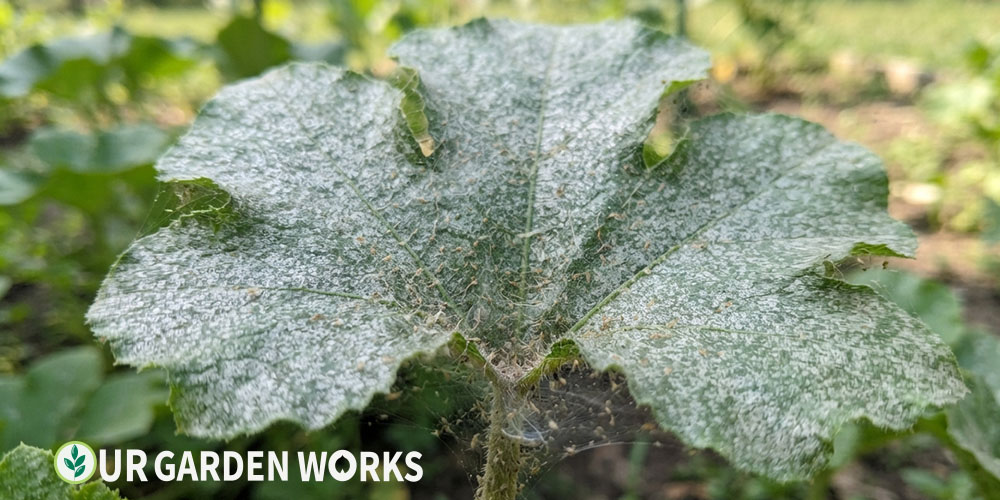
Silvery or bronzed squash leaves, especially when the discoloration has a fine, stippled, almost dusty texture, point quite reliably to spider mites — tiny pests easy to overlook entirely until the damage they cause becomes visually obvious.
This guide covers confirming the diagnosis with a simple, reliable test, then treating an active infestation effectively.
Spider mites thrive in conditions many other garden pests don’t, which is worth understanding since it explains both why they show up when they do and why prevention looks a bit different from typical insect pest management.
Quick Answer: Silvery, stippled discoloration on squash leaves is almost always spider mites — tiny pests that feed by puncturing leaf cells, leaving behind a fine, dusty-looking stippled pattern. Confirm with the paper test: tap a leaf over white paper and look for tiny moving specks. They thrive in hot, dry conditions. Treat with a strong water spray, insecticidal soap, or predatory mites for biological control.
What Spider Mite Damage Actually Looks Like
Spider mites feed by piercing individual leaf cells and extracting their contents, and the cumulative effect of thousands of these tiny feeding punctures across a leaf surface produces the characteristic silvery, bronzed, or stippled discoloration that gives this problem its name.
Unlike most insect feeding damage, which removes visible chunks of tissue, spider mite damage leaves the leaf structure intact while draining its color and vigor from within.
In more advanced infestations, fine webbing becomes visible, typically concentrated near leaf bases, stem joints, and the undersides of leaves where mites cluster most densely.
Severely affected leaves eventually yellow, brown, and die as the cumulative cellular damage overwhelms the leaf’s ability to function.
💡 The paper test confirms spider mites in seconds
Hold a sheet of white paper beneath a suspicious leaf and tap or shake the leaf firmly. Tiny specks, often described as looking like moving dust or pepper flakes, that fall onto the paper and then crawl are spider mites.
This simple test, taking less than a minute, confirms the diagnosis far more reliably than trying to spot the mites directly on the plant, since they’re genuinely difficult to see with the naked eye against green foliage.
Why Spider Mites Thrive in Conditions Other Pests Don’t
Spider mites are unusual among common garden pests in that they actively prefer hot, dry conditions, reproducing explosively during stretches of summer heat and drought stress that suppress many other pest populations.
This is part of why spider mite outbreaks often coincide with the most challenging weather conditions of the growing season, when plants are already somewhat stressed and less able to defend against additional pest pressure.
Dusty conditions also favor spider mites, since dust on leaf surfaces can interfere with some of the natural predators that would otherwise help keep mite populations in check.
This is one reason periodically hosing down squash foliage, beyond just direct pest treatment, can help reduce spider mite pressure as a secondary benefit.
Treating an Active Spider Mite Infestation
Directions
- Start with a strong, direct spray of water targeted at leaf undersides, where mites concentrate most heavily. This physically dislodges many mites and disrupts their webbing, providing real control for light to moderate infestations on its own.
- For more established infestations, apply insecticidal soap or horticultural oil, making sure to thoroughly coat leaf undersides where mites live and feed.
- Repeat treatment every 5-7 days for 2-3 cycles, since mite eggs often survive a single treatment and continue hatching afterward.
- Avoid broad-spectrum insecticides not specifically labeled for mites, since these can kill the natural predators that would otherwise help control mite populations, sometimes making the underlying problem worse rather than better.
⚠️ Broad-spectrum insecticides can backfire against spider mites
Spider mites reproduce extremely quickly, and broad-spectrum insecticides that also kill their natural predators (certain beneficial mites, ladybugs, and other predatory insects) can paradoxically lead to a worse mite outbreak than before treatment, since the pest population rebounds faster than the predator population that was keeping it in check. Sticking to targeted treatments — water spray, insecticidal soap, horticultural oil — avoids this backfire risk.
Biological Control — Predatory Mites
For persistent or severe spider mite problems, introducing predatory mites — a different, beneficial mite species that specifically hunts and consumes spider mites — provides effective, ongoing biological control without any chemical treatment at all.
These predatory mites are commercially available for purchase and release, particularly useful in greenhouse settings or for gardeners managing repeated seasonal spider mite pressure.
This biological approach works best as part of an integrated strategy rather than a single intervention, since predatory mites need time to establish and build their own population before they can meaningfully suppress an existing severe outbreak.
For light to moderate infestations caught early, predatory mites released proactively can prevent populations from ever reaching damaging levels in the first place.
Distinguishing Spider Mites From Other Squash Leaf Problems
Silvery, stippled discoloration is distinctive enough that it’s rarely confused with the fungal diseases covered in our other squash guides, but it’s worth a quick comparison to be certain.
Powdery mildew produces a visible white, dusty surface coating rather than the more subtle, internal-looking silvering of mite damage, and the textures feel quite different when touched — mildew smudges as a fine powder, while mite-damaged leaves simply feel dry and slightly brittle without any removable coating.
Downy mildew’s angular yellow spots and underside fuzzy growth also look nothing like spider mite stippling once you’ve seen both side by side, since mite damage tends to be more uniformly distributed across the leaf surface rather than following the leaf’s vein pattern.
If you’re genuinely unsure after visual comparison, the paper test described above remains the most definitive way to confirm or rule out spider mites specifically, since it directly reveals the pests themselves rather than relying on damage pattern interpretation alone.
Companion Planting for Spider Mite Deterrence
Certain companion plants can help reduce spider mite pressure on squash, working through both direct deterrence and by supporting the beneficial predatory insects that naturally keep mite populations in check.
Strongly aromatic herbs like dill and cilantro, allowed to flower, attract predatory insects including some that feed on spider mites directly, providing a layer of natural biological control similar in concept to the predatory mites covered earlier but achieved through garden planning rather than a commercial purchase.
Avoiding companion plants known to be particularly spider-mite-prone themselves, such as certain ornamental plants that commonly host heavy mite populations, prevents creating a nearby reservoir population that could spread to your squash.
This is a less commonly discussed companion planting consideration compared to the more familiar pest-deterrent and pollinator-attracting benefits covered in our cucumber and pepper companion planting guides, but it’s a real factor worth considering if spider mites have been a persistent problem in a specific garden bed.
Preventing Spider Mites Through Watering and Plant Health
Since spider mites favor hot, dry, dusty conditions and stressed plants, consistent watering that prevents drought stress is one of the more effective indirect prevention strategies available, working against the exact conditions that favor explosive mite population growth.
A well-hydrated, vigorous squash plant tolerates incidental mite presence better than a drought-stressed one, where the same mite population can cause more severe, faster-developing damage.
Periodically rinsing foliage with a hose, particularly during hot, dry stretches, serves double duty as both a direct mite-dislodging treatment and a dust-reduction measure that removes one of the environmental factors favoring mite reproduction.
This is a low-effort habit worth incorporating into regular summer garden care, especially in regions or seasons known for hot, dry conditions where spider mite pressure tends to run highest.
Frequently Asked Questions
Will spider mite damage on squash leaves affect the fruit?
Spider mites feed on leaves rather than fruit directly, so existing squash fruit is generally unaffected in terms of safety or direct damage.
The indirect risk is reduced fruit production and size if leaf damage becomes severe enough to significantly limit the plant’s overall photosynthetic capacity and energy available for fruit development.
Can spider mites spread to other plants in my garden, not just squash?
Yes, spider mites affect a very wide range of garden plants beyond just cucurbits, including many vegetables, ornamentals, and houseplants.
If you’re seeing spider mite damage on squash, it’s worth checking other nearby susceptible plants, particularly anything also experiencing drought stress or hot, dry conditions, since the same favorable conditions for mites on squash likely apply to neighboring plants as well.
How quickly can a spider mite infestation go from unnoticed to severe?
Spider mites reproduce remarkably fast under favorable hot, dry conditions, with populations capable of multiplying many times over within just a week or two under ideal circumstances.
This rapid reproduction is exactly why regular plant inspection, including the paper test described above, matters so much for catching an infestation early rather than discovering it only once visible silvering has already become extensive.
Do spider mites prefer certain squash varieties over others?
Spider mites generally aren’t highly selective among squash varieties, affecting most types under favorable hot, dry conditions regardless of specific cultivar.
Plant vigor and overall stress level matter more than variety choice — a well-watered, healthy plant of any squash type tolerates incidental mite presence better than a drought-stressed plant of the same variety experiencing the exact same mite population.
Related Articles in Our Squash & Cucurbit Leaf Problems Guide
Final Thoughts
We hope this guide has given you a fast, reliable way to confirm spider mites — that paper test really is the quickest path to a confident diagnosis — and a clear treatment plan that avoids the common mistake of making things worse with the wrong product.
For all our vegetable growing guides, our vegetable gardening guide links to everything.
Share this post with a fellow gardener who’s troubleshooting silvery squash leaves — and let us know in the comments how your paper test turned out. Happy growing!
