

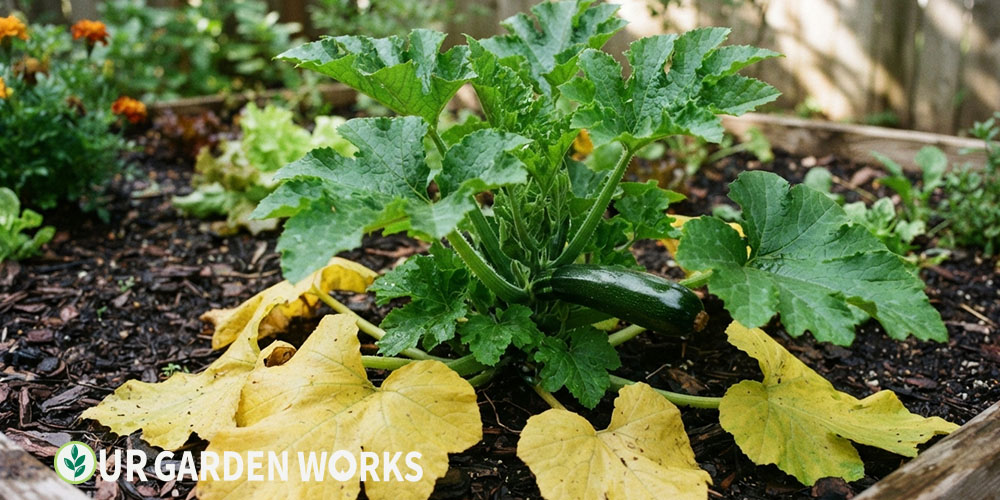
Zucchini plants are famous for their explosive growth and equally famous for alarming gardeners with sudden yellow leaves partway through a productive season.
Most causes are manageable, though one in particular — squash vine borer — deserves faster action than the others if you catch it early enough to matter.
We’ll walk through the most common causes in order of how often we actually encounter them, with the details that separate a simple watering fix from something requiring more immediate attention.
Quick Answer: Yellow leaves on zucchini plants are most often caused by natural lower leaf aging (a few oldest leaves only, otherwise healthy plant), squash vine borer (sudden wilting and yellowing of an entire vine, often with a hole near the base), bacterial wilt (rapid wilting despite moist soil), powdery mildew (yellowing following a white powdery coating), or nutrient deficiency (uniform yellowing, slow growth). Check the pattern and whether the whole vine or just lower leaves are affected.
Cause 1 — Natural Lower Leaf Aging (Most Common, Least Concerning)
Zucchini plants naturally shed their oldest, lowest leaves as the season progresses and the plant redirects energy toward new growth and fruit production. A few yellow leaves at the base of an otherwise vigorous, fruiting plant is normal and expected, not a sign of a problem.
How to confirm it’s natural aging:
- Only the oldest, lowest leaves are affected
- Rest of the plant looks vigorous with healthy new growth and fruit
- Yellowing progresses gradually rather than appearing suddenly
Fix: None needed. Remove the yellowed leaves for tidiness and better airflow if desired.
Cause 2 — Squash Vine Borer (Most Urgent)
This is the cause that deserves the fastest response, since squash vine borer larvae tunnel inside the plant’s main stem, cutting off water and nutrient flow to everything beyond the damage point. The result is often sudden wilting and yellowing of an entire vine or section of the plant, even though the soil is adequately moist.
How to confirm it’s squash vine borer:
- Wilting and yellowing affect a whole vine or large section suddenly, not just scattered leaves
- A small hole, often with a sawdust-like frass (greenish-yellow, granular debris) visible near the base of the stem
- Soil moisture is adequate, ruling out simple drought
- The stem near the entry hole may feel soft or hollow
Fix: If caught early, slit the stem lengthwise near the entry hole, remove the larva, and bury the damaged section of stem in soil to encourage new root development at that point. Once damage is extensive, the affected vine often can’t be saved, though the rest of the plant may survive if the borer hasn’t spread further.
⚠️ Prevention is far more reliable than treatment
Squash vine borer is notoriously difficult to treat successfully once larvae are established inside the stem. Floating row covers during the egg-laying period (early summer in most regions), removing and destroying affected plants promptly, and rotating squash plantings to new locations each year are all more reliable than trying to rescue a heavily infested plant.
Cause 3 — Bacterial Wilt
Bacterial wilt, transmitted by cucumber beetles, causes rapid wilting and yellowing that progresses much faster than typical drought stress — sometimes within just a few days of first symptoms. Unlike squash vine borer, there’s no visible hole or frass at the stem base, but a simple test can confirm the diagnosis.
How to confirm it’s bacterial wilt:
- Wilting and yellowing progress unusually fast
- Cutting a wilted stem and pressing it gently produces a sticky, stringy ooze when you touch and slowly pull apart the cut surfaces
- Cucumber beetles have been seen on the plant previously
Fix: No cure exists once a plant is infected — remove and dispose of affected plants to limit spread to nearby cucurbits. Controlling cucumber beetle populations with row covers or targeted insecticide application is the most effective prevention for future plantings.
Cause 4 — Powdery Mildew Progression
While powdery mildew’s primary symptom is the white, powdery leaf coating covered in our dedicated powdery mildew guide, heavily affected leaves often progress to yellowing and eventually browning and dying as the infection reduces the leaf’s ability to photosynthesize. If you’re seeing yellow leaves alongside visible white powdery patches, this progression is the likely explanation.
How to confirm it’s powdery mildew progression:
- Yellow leaves show or previously showed the characteristic white powdery coating
- Typically appears in mid-to-late summer as plants mature and canopy density increases
- Affects leaves somewhat randomly across the plant rather than just the lowest ones
Fix: Treat the underlying powdery mildew with a baking soda spray or appropriate fungicide, and remove the most severely affected leaves to slow further spread.
Cause 5 — Nutrient Deficiency
Zucchini are heavy feeders, and a uniform, whole-plant yellowing combined with slowed growth often points to nitrogen deficiency, especially in soil that hasn’t been fertilized since planting. This pattern is more gradual and generalized than the more urgent causes above.
How to confirm it’s nutrient deficiency:
- Yellowing is fairly uniform and affects the whole plant, not just lower leaves or one section
- Overall growth and fruit production seem slower than expected
- No recent fertilizing, or fertilizing only at initial planting
Fix: Apply a balanced fertilizer following label rates, then switch to a lower-nitrogen, higher-phosphorus and potassium formula once flowering and fruiting begins in earnest.
Telling the Five Causes Apart at a Glance
| Cause | Pattern | Speed | Key Clue |
|---|---|---|---|
| Natural aging | Lowest leaves only | Gradual | Plant otherwise vigorous |
| Squash vine borer | Whole vine/section | Sudden | Hole + frass at stem base |
| Bacterial wilt | Rapid, whole plant | Very fast (days) | Sticky ooze from cut stem |
| Powdery mildew progression | Scattered, mid-late season | Gradual | White coating present/previous |
| Nutrient deficiency | Uniform, whole plant | Gradual | No recent fertilizing |
Why Squash Vine Borer Deserves Extra Vigilance
Among the five causes covered here, squash vine borer is the one where early detection genuinely changes the outcome, since the larvae cause progressively more internal damage the longer they go unnoticed inside the stem.
Checking the base of zucchini plants weekly during the early-to-mid summer egg-laying period, looking specifically for small holes or frass, catches this problem at the stage where intervention still has a reasonable chance of saving the plant.
Once a vine has wilted significantly and yellowed extensively, the internal damage is usually too advanced for the slit-and-bury technique to succeed, which is exactly why this particular cause rewards proactive monitoring over reactive treatment.
If squash vine borer has been a recurring problem in your garden, succession planting a second round of zucchini a few weeks after the first can provide a backup harvest if early plants are lost to this pest.
Try our free tool: Succession Planting Scheduler — Never Run Out of Fresh Vegetables Again
Reducing Pest Pressure Through Companion Planting and Timing
Beyond direct monitoring and treatment, a few preventive strategies meaningfully reduce the chance of facing squash vine borer or bacterial wilt at all in a given season.
Staggering planting dates, putting in a first round of zucchini early and a second succession planting several weeks later, hedges against losing your entire harvest if vine borers target the earlier planting specifically during their peak egg-laying window.
Nasturtiums and radishes, already established as useful companions in our cucumber companion planting guide, offer some similar pest-deterrent benefits for zucchini and other squash, helping reduce cucumber beetle pressure that would otherwise increase bacterial wilt risk.
Floating row covers, removed once flowering begins to allow pollinator access, provide the most direct physical protection against both vine borer egg-laying and cucumber beetle feeding during the vulnerable early growth period.
Crop rotation also plays a meaningful role specifically for squash vine borer, since the pupae overwinter in soil near where infested plants grew.
Moving zucchini and other susceptible squash to a different part of the garden each year, rather than replanting in the exact same spot, reduces the likelihood of a new generation of borers emerging right where last year’s plants struggled.
Frequently Asked Questions
Can I still harvest zucchini from a plant with some yellow leaves?
Yes, as long as the cause is natural aging, nutrient deficiency, or early-stage powdery mildew — the plant can continue producing fruit while you address the underlying issue.
Squash vine borer and bacterial wilt are more serious, since both directly damage the plant’s ability to move water and nutrients to developing fruit, often reducing or stopping production on the affected vine.
How can I tell squash vine borer apart from simple drought stress?
The key distinguishing factor is soil moisture and the speed of onset — squash vine borer causes sudden wilting despite adequate soil moisture, while drought stress correlates directly with dry soil and improves within hours of watering.
Checking for the telltale hole and frass at the stem base provides the most definitive confirmation either way.
Will yellow leaves on zucchini spread to my cucumbers or other squash planted nearby?
Bacterial wilt and squash vine borer can both affect related cucurbits including cucumbers, melons, and other squash varieties, since cucumber beetles (the bacterial wilt vector) and vine borer moths aren’t picky about which cucurbit they target.
Powdery mildew likewise spreads readily among different cucurbit species planted near each other, making garden-wide monitoring worthwhile rather than treating each plant in isolation.
Related Articles in Our Squash & Cucurbit Leaf Problems Guide
- White Powder on Squash Leaves — Powdery Mildew Guide
- Yellow Spots on Squash Leaves – 3 Causes and Fixes
- Silvery Leaves on Squash — Spider Mite Guide
- Why Are My Cucumbers Turning Yellow?: 8 Possible Reasons & How To Fix Them
- How to Grow Zucchini: The Complete No-Fail Guide (2026)
- When to Harvest Zucchini – Size, Signs, and Harvesting Frequency
Final Thoughts
We hope this guide has helped you match the pattern on your zucchini plant to the right cause, especially the urgency of catching squash vine borer early if that’s what you’re dealing with.
For all our vegetable growing guides, our vegetable gardening guide links to everything.
Share this post with a fellow gardener who’s troubleshooting their zucchini — and let us know in the comments which cause matched what you found. Happy growing!
