

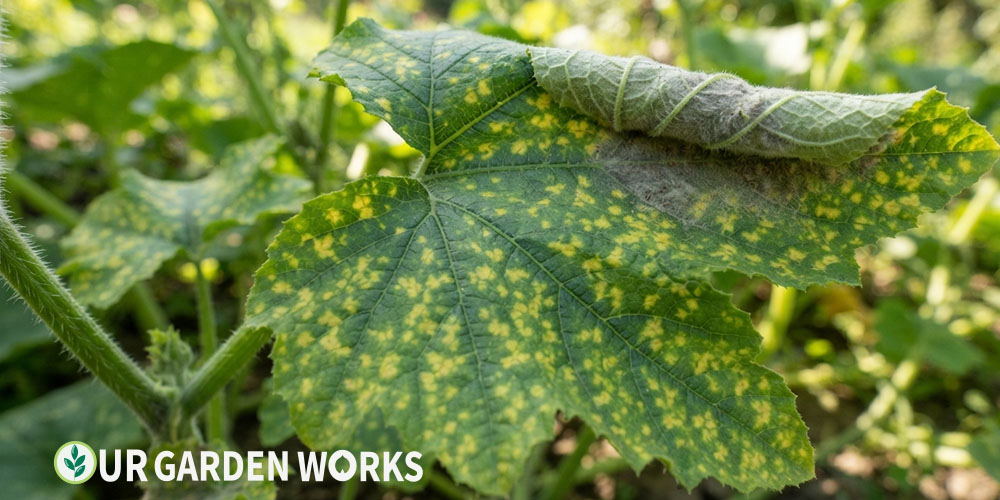
Yellow spots on squash leaves, distinct from the white powdery coating of powdery mildew or general overall yellowing, point to a more specific set of causes worth distinguishing carefully.
Downy mildew is the most likely culprit, but a couple of other explanations — including one that’s entirely harmless — are worth ruling out first.
We’ll walk through each cause with the details that set them apart, since spot shape and leaf underside texture do most of the diagnostic work here.
Quick Answer: Yellow spots on squash leaves are most often downy mildew (angular yellow spots between veins, grayish fuzz on undersides), cucumber mosaic virus (irregular yellow mottling, no fuzzy growth, no cure), or natural leaf variegation in certain ornamental gourd varieties (consistent pattern, no other stress signs). Check the underside for fuzzy growth first to confirm or rule out downy mildew.
Cause 1 — Downy Mildew
Downy mildew on squash, related to but a distinct pathogen species from the basil downy mildew covered elsewhere in this series, produces angular yellow spots that follow the leaf’s vein pattern, typically starting on older leaves and progressing through the canopy.
The defining confirmation, as with basil downy mildew, is a grayish to purplish fuzzy growth on the leaf underside directly beneath the yellow spots.
How to confirm it’s downy mildew:
- Yellow spots are angular, following the vein pattern rather than appearing as random round spots
- Grayish or purplish fuzzy growth visible on the leaf underside
- Spots may eventually turn brown and die as the infection progresses
- Spreads rapidly in humid conditions, especially with overnight leaf wetness
Fix: Remove and dispose of affected leaves promptly. Improve airflow through proper spacing, switch to soil-level watering, and apply a fungicide labeled for downy mildew if the infection is significant. Resistant varieties, where available for your specific squash type, provide the most reliable long-term solution.
💡 Downy mildew and powdery mildew are different diseases despite similar names
It’s easy to confuse these two given their similar names, but they look and behave quite differently. Powdery mildew produces a white, dusty surface coating, while downy mildew produces angular yellow spots with fuzzy growth specifically on the underside. See our powdery mildew guide if your symptoms match that description instead.
Cause 2 — Cucumber Mosaic Virus
Cucumber mosaic virus, despite the name, readily infects squash and other cucurbits, producing irregular yellow mottling and a patchwork pattern similar in concept to the tomato mosaic virus covered elsewhere in this series.
Unlike downy mildew, there’s no fuzzy underside growth, and the yellowing pattern tends to be more blotchy and irregular than the angular, vein-following pattern of downy mildew.
How to confirm it’s mosaic virus:
- Yellow mottling is irregular and patchy rather than following a vein pattern
- No fuzzy growth on either leaf surface
- Leaves may show some distortion or puckering alongside the mottling
- Plant growth may be generally stunted
Fix: There’s no cure — remove and dispose of infected plants to limit spread to nearby cucurbits. Controlling aphid populations, the primary vector for this virus, helps protect remaining and future plantings.
Cause 3 — Natural Variegation (Ornamental Varieties Only)
Some ornamental gourd and squash varieties are bred specifically with variegated, patterned foliage as a decorative trait, which can include yellow patches or mottling that’s entirely normal and not a sign of any problem at all.
This is uncommon among standard edible squash varieties but worth knowing if you’re growing an ornamental type specifically chosen for its leaf appearance.
How to confirm it’s natural variegation:
- Pattern is consistent and symmetrical rather than random or progressively spreading
- Plant otherwise grows vigorously with no other stress signs
- Variety is known or labeled as having variegated foliage
Fix: None needed — this is simply how the variety naturally looks.
Telling the Three Causes Apart at a Glance
| Cause | Spot Pattern | Underside Growth | Cure Available? |
|---|---|---|---|
| Downy mildew | Angular, follows veins | Gray/purple fuzz | No, but manageable |
| Mosaic virus | Irregular, blotchy mottling | None | No |
| Natural variegation | Consistent, symmetrical | None | N/A — not a problem |
Why Downy Mildew on Cucurbits Has Become More Aggressive in Recent Years
Cucurbit downy mildew has shown increasingly aggressive behavior in many growing regions over the past couple of decades, partly attributed to the pathogen evolving new strains that overcome resistance genes bred into earlier resistant varieties.
This evolving pressure is part of why staying current on which specific varieties show genuine resistance in your particular region matters more than simply relying on older resistance claims that may no longer hold up against newer pathogen strains.
Regional agricultural extension services often track which downy mildew strains are active in a given growing season and can offer more current, location-specific guidance than a general seed packet label alone provides.
For home gardeners in regions with known aggressive downy mildew pressure, checking with local extension resources before each season, rather than assuming last year’s resistant variety remains equally effective, is a worthwhile habit.
Tracking Weather Conditions for Proactive Treatment
Since downy mildew depends so heavily on specific weather conditions — extended periods of high humidity, particularly overnight, combined with moderate daytime temperatures — many serious squash growers track local weather patterns specifically to anticipate disease pressure before symptoms even appear.
Some regional agricultural extension services and university plant pathology programs publish downy mildew forecasting tools that predict outbreak risk based on current weather patterns and known disease presence in the region.
Using these forecasting resources, where available for your area, allows a more proactive fungicide application timed just ahead of predicted high-risk weather, rather than waiting for visible symptoms to appear before beginning treatment.
This proactive approach, similar to the preventive spray timing recommended for several other fungal diseases throughout this series, generally produces better disease control outcomes than a purely reactive treatment strategy that only responds after the infection has already established.
Even without access to formal forecasting tools, simply paying attention to your own local weather — recognizing that an extended humid, overcast stretch creates elevated risk — helps you decide when extra vigilance and more frequent plant inspection are warranted, catching new infections at their earliest, most treatable stage.
Container-Grown Squash and Disease Pressure
Container-grown squash, less common than in-ground plantings but increasingly popular for compact bush varieties suited to patio growing, generally face somewhat different disease pressure than traditional garden beds.
The improved airflow around an individual container, compared to a densely planted in-ground squash patch, can reduce downy mildew risk somewhat, though containers don’t eliminate the risk entirely if humidity and leaf wetness conditions are otherwise favorable for the pathogen.
Cucumber mosaic virus risk depends primarily on aphid activity rather than growing method, so container squash isn’t inherently more protected from this particular cause unless you’re also taking active steps to manage aphid populations nearby.
The fundamental prevention principles — adequate spacing (even between multiple containers), soil-level watering, and aphid control — apply consistently regardless of whether you’re growing in the ground or in containers.
Distinguishing This From the Brown Spot Pattern Covered Elsewhere
It’s worth noting that yellow spots specifically, as covered in this guide, are a distinct symptom from the white powdery coating of powdery mildew covered in our companion guide, even though both diseases can appear on the same plant simultaneously and both are extremely common on summer squash and zucchini.
If you’re seeing both symptoms together — yellow, angular, vein-following spots with underside fuzz in some areas, and a separate white, dusty coating elsewhere on the same or different leaves — it’s entirely possible to have both downy and powdery mildew present at once, since they’re caused by different organisms with somewhat different but overlapping favorable conditions.
Treating both simultaneously, following each disease’s specific protocol rather than assuming one treatment addresses both, gives the plant the best chance at managing this dual disease pressure.
This is similar to the both-at-once consideration covered in our white fuzz guide, where two different causes can coexist on a single stressed or favorably-conditioned plant.
Frequently Asked Questions
Will yellow spots from downy mildew affect my squash harvest?
Significant leaf loss from an advanced downy mildew infection can reduce both yield and fruit quality by limiting the plant’s overall photosynthetic capacity, though mild, well-managed infections often allow continued reasonable production through the rest of the season.
Catching and managing the infection early, before extensive leaf loss occurs, protects harvest potential more effectively than waiting until symptoms are severe.
Can downy mildew on my squash spread to my cucumbers planted nearby?
Yes, downy mildew affects a range of cucurbits including cucumbers, melons, and various squash types, with some strain-specific variation in which exact species are most susceptible.
If you’re growing multiple cucurbit types in the same garden area, monitoring all of them rather than just the most visibly affected plant helps catch spread early.
Is it worth trying to save a squash plant with mosaic virus, or should I remove it immediately?
Removing it promptly is the more responsible choice, since there’s no treatment that will improve the plant’s condition and continued presence in the garden only increases the risk of the virus spreading to nearby healthy cucurbits through aphid activity or incidental contact.
Some gardeners do continue growing a mildly affected plant if fruit production seems otherwise unaffected, but this carries real risk to the rest of the garden that’s worth weighing carefully.
Related Articles in Our Squash & Cucurbit Leaf Problems Guide
- White Powder on Squash Leaves — Powdery Mildew Guide
- Silvery Leaves on Squash — Spider Mite Guide
- Yellow Leaves on Zucchini Plants – 5 Causes and Fixes
- Why Are My Cucumbers Turning Yellow?: 8 Possible Reasons & How To Fix Them
- How to Harvest and Cure Winter Squash Perfectly
- Brown Spots on Basil Leaves – 3 Causes and Fixes
- Mosaic Pattern on Tomato Leaves — Virus Guide
Final Thoughts
We hope this guide has helped you match the yellow spot pattern on your squash leaves to the right cause, since checking the leaf underside for fuzzy growth really does resolve the majority of cases quickly.
For all our vegetable growing guides, our vegetable gardening guide links to everything.
Share this post with a fellow gardener who’s troubleshooting their squash plants — and let us know in the comments which cause matched what you found. Happy growing!
