

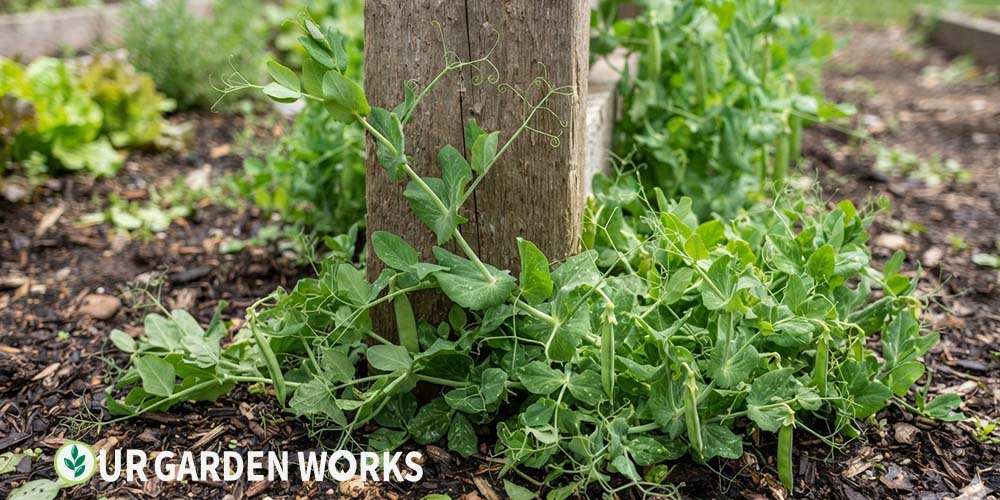
Peas climb using delicate, thread-like tendrils that need something genuinely thin to wrap around, and a surprising number of “pea trellis” failures come down to simply providing a support that’s too thick or smooth for these tendrils to actually grip.
We’ll cover why this happens and the practical fixes, since getting peas climbing properly is mostly about matching the support to how pea tendrils actually function, rather than anything wrong with the plant itself.
Quick Answer: Peas not climbing a trellis are most often struggling because the support is too thick or smooth for their thin, delicate tendrils to grip — pea tendrils need something no wider than about a pencil to wrap around effectively. Other causes include young plants simply not having reached climbing height yet, or tendrils needing manual guidance to initially contact the support. Provide netting, string, or thin wire mesh, and gently guide young vines onto the support early.
Cause 1 — Trellis Material Too Thick or Smooth
Pea tendrils are thin, curling structures that wrap around a support through repeated contact, but they genuinely can’t grip something too thick (like a wide wooden post or thick metal pole) or too smooth (like a slick plastic-coated pole) effectively.
This is the single most common reason peas fail to climb even with a structurally sound, properly placed trellis.
How to confirm this is the issue:
- Trellis material consists of wide posts, thick poles, or smooth surfaces rather than thin netting, string, or wire
- Tendrils are visible reaching out but not successfully wrapping around the support
Fix: Switch to or add netting, garden twine, thin bamboo stakes, or chicken wire — anything providing numerous thin gripping points no wider than roughly a pencil’s diameter. Pea netting specifically, widely available and inexpensive, is purpose-built for this exact need and remains one of the most reliable supports for this crop.
💡 String works as a simple, free alternative
If you don’t have netting on hand, running multiple horizontal lines of garden twine between two end posts, spaced every few inches vertically, gives pea tendrils plenty of thin gripping points using materials many gardeners already have around the house or garage.
Cause 2 — Plants Haven’t Reached Climbing Height Yet
Young pea seedlings need to grow to a certain height, typically several inches, before their tendrils are developed enough to begin actively reaching for and gripping a support.
A very young planting that hasn’t yet reached this stage simply hasn’t started its climbing behavior, which can look like a trellis problem when it’s really just normal early growth timing.
How to confirm this is the issue:
- Plants are still quite young and short, well below the height where climbing typically begins for the variety
Fix: Patience — continue normal care and check back as plants grow taller, since climbing behavior typically begins on its own once plants reach sufficient height and tendril development.
Cause 3 — Tendrils Need Initial Manual Guidance
Even with an appropriately thin support in place, young pea tendrils sometimes need a small amount of manual guidance to make their first contact with the trellis, especially if the support isn’t positioned in immediate, easy reach of the plant’s natural growth direction.
How to confirm this is the issue:
- Trellis material is appropriately thin, and plants are tall enough to be climbing, but vines are sprawling along the ground rather than reaching the support
Fix: Gently guide young vines toward the trellis by hand, loosely looping or leaning them against the support so their tendrils have an easy, close target to begin gripping. Once a few tendrils successfully attach, the plant typically continues climbing on its own without further manual help.
Telling the Three Causes Apart at a Glance
| Cause | Plant Height | Trellis Material | Key Clue |
|---|---|---|---|
| Trellis too thick/smooth | Tall enough to climb | Wide or slick | Tendrils reach but don’t grip |
| Too young to climb yet | Still short | Any | Hasn’t reached climbing stage |
| Needs manual guidance | Tall enough to climb | Appropriately thin | Vines sprawling, not reaching support |
Understanding How Pea Tendrils Actually Work
Pea tendrils are modified leaves that have evolved specifically for climbing, and understanding their actual mechanism helps explain both why thin supports work so much better and why the process sometimes seems to happen on its own once conditions are right.
A tendril extends outward in a searching motion, and when it makes contact with something suitably thin, specialized cells on the side touching the support grow more slowly than cells on the opposite side, causing the tendril to curl around the object over a period of several hours.
This means climbing isn’t instantaneous even under ideal conditions — a tendril that’s just made contact with appropriate support material needs time, typically less than a day, to complete its wrapping motion and achieve a secure grip.
If you’re checking very soon after providing a thinner trellis material and don’t yet see tendrils fully wrapped, this delay is completely normal and not a sign that the fix isn’t working.
Tendrils that fail to find any suitable contact within a reasonable search radius eventually give up and the plant continues growing in whatever direction gravity and its own structure take it, which is the sprawling behavior that prompts most trellis troubleshooting in the first place.
Simple DIY Trellis Options That Work Well for Peas
Beyond purpose-bought pea netting, several inexpensive or repurposed materials work just as effectively, which is useful if you’re trying to solve a climbing problem quickly without a special trip to the garden store.
A row of branches or twigs pushed into the soil at an angle, sometimes called a pea stick or brush trellis, provides numerous thin natural gripping points and has been a traditional pea support method for generations before modern netting became widely available.
Repurposed materials like an old piece of chain link fencing, a discarded box spring frame, or even a series of fishing line strands strung between stakes all provide the same basic thin-gripping-surface principle that makes commercial pea netting effective.
The specific material matters far less than the basic requirement of staying thin enough for tendrils to wrap around — once that condition is met, peas generally aren’t particular about climbing on something store-bought versus something improvised from materials already on hand.
Choosing the Right Trellis From the Start
Avoiding this problem entirely starts with selecting an appropriate trellis material before planting rather than troubleshooting after vines are already struggling.
Purpose-built pea and bean netting, garden twine strung between posts, or even a section of chicken wire or chain link fencing repurposed as a trellis all provide the thin gripping surfaces peas need, while a solid wooden lattice panel or thick decorative trellis, despite working well for other climbing plants, often disappoints specifically with peas.
Positioning the trellis close to where seeds are actually planted — within just a few inches — also reduces how much initial guidance young vines need, since they won’t have to stretch far to make their first contact with the support once they reach climbing height.
Frequently Asked Questions
Can I switch trellis material mid-season if my current support isn't working?
Yes, and this is a reasonable fix if you’ve already discovered your initial trellis material is too thick for pea tendrils to grip. Adding netting or string to an existing thicker support structure, rather than replacing the whole trellis, often solves the problem without needing to start over — simply attach the thinner material to the existing posts or frame as a supplemental gripping surface.
Do all pea varieties climb, or are some naturally bush-type without climbing?
Both types exist — many pea varieties are genuinely vining and benefit significantly from trellis support, while some “bush” or dwarf varieties are bred to grow shorter and more compact without needing to climb at all.
If your specific variety is a bush type, the absence of climbing behavior is simply expected and normal, not a sign of any of the causes covered in this guide.
How tall should I expect my pea trellis to need to be?
This varies considerably by variety, with dwarf and bush types needing minimal or no support, while many standard vining varieties reach 4-6 feet and some specific tall varieties can exceed this considerably.
Checking your specific variety’s expected mature height before building or buying a trellis ensures you’re providing adequate support height for the full growing season rather than running out of climbing room partway through.
Related Articles in Our Bean & Pea Growing Guide
Final Thoughts
We hope this guide has helped you get your pea vines climbing properly — in most cases, simply switching to a thinner support material solves the whole problem within days.
For all our vegetable growing guides, our vegetable gardening guide links to everything.
Share this post with a fellow gardener whose peas are sprawling instead of climbing — and let us know in the comments which fix got your vines on track. Happy growing!
