

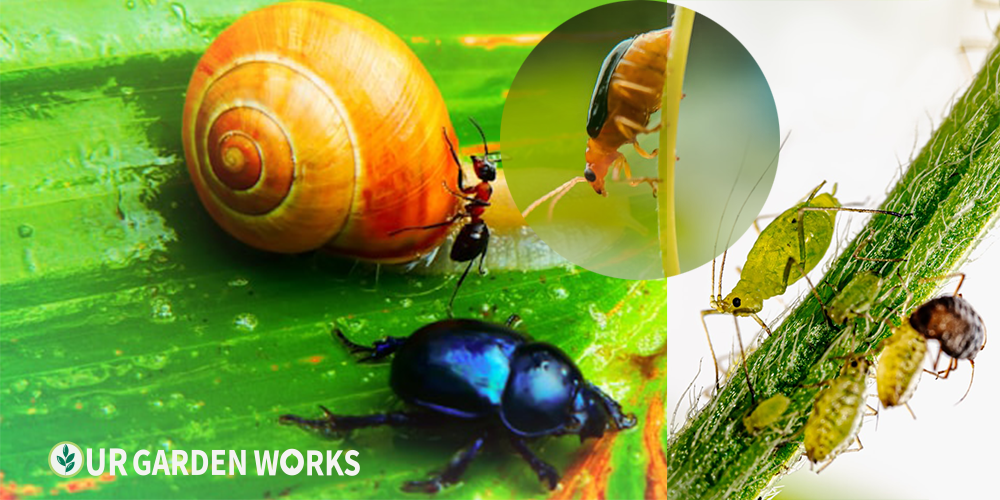
Every garden has pests. The goal isn’t to eliminate every insect — it’s to keep populations at a level where your plants can still thrive. Most pest problems are manageable organically, without resorting to synthetic chemicals that persist in soil, harm beneficial insects, and make their way into your food.
✅ Key Takeaways:
- Identify before you spray— damage pattern tells you who’s responsible and which treatment works
- Organic first— neem oil, insecticidal soap, and Bt handle 80% of common pest problems
- Companion planting works— lavender, marigolds, and citronella provide season-long passive protection
- Protect pollinators— spray in the evening when bees are inactive; avoid flowers when bees are visiting
- Wildlife needs deterrence not elimination— physical barriers + scent repellents are more effective than traps
- Weed prevention beats cure— mulch, early pulling, and pre-emergent herbicides before seeds set
This guide covers the full spectrum of garden pest control: identifying who’s eating your plants, choosing the right organic response, using companion planting strategically, and knowing when to bring in stronger measures.
Every section links to our in-depth articles and to the best external resources for deeper research.
🌿 Editor’s Note
“The first question I always ask is: are you sure it’s a pest? Beneficial insects outnumber harmful ones in most healthy gardens. Before you spray anything, spend five minutes identifying exactly who’s there and what they’re doing.”
Why Organic First — The Case Against Default Chemicals
Synthetic pesticides work fast, which is exactly the problem. They kill indiscriminately — the aphid on your tomato and the ladybug hunting it both die.
The aphid’s population recovers within days because their predators take weeks to rebuild. You’ve made the problem worse while feeling like you fixed it.
Organic pest control works differently. Instead of a one-time knockdown, it works with your garden’s existing ecosystem — using methods that kill or deter target pests while preserving or attracting the beneficial insects that do pest control work for free.
According to the USDA’s Integrated Pest Management program, the most effective long-term approach combines cultural controls, biological controls, and targeted organic treatments in that order — synthetic chemicals are a last resort.
⚠️ Important to Know
“Organic” does not always mean “safe to spray everywhere.” Neem oil, insecticidal soap, and pyrethrin are all organic — but they can still harm bees and beneficial insects if applied incorrectly. Timing (late afternoon or early morning when bees are inactive) and targeting (spray directly on pests, not entire plants) matter enormously.
Identify Before You Spray — Reading Damage Patterns
The damage pattern on a plant’s leaves tells you exactly who’s responsible — and which treatment will actually work.
Spraying neem oil on caterpillar damage does almost nothing, because neem works on soft-bodied insects and disrupts molting cycles, not on caterpillars in their mature form.
Common Damage Patterns
- Ragged holes with slime trails nearby — slugs or snails. Active at night, hide in soil during the day. Treat with iron phosphate bait or diatomaceous earth around the plant base.
- Small round holes punched through leaves — flea beetles. Tiny, jump when disturbed. Neem oil and row covers are your best options.
- Sticky residue + distorted new growth — aphids. Look on the undersides of leaves and at stem joints. Insecticidal soap applied directly to the colony is highly effective.
- Leaves stripped to the midrib — caterpillars or hornworms. Use Bacillus thuringiensis (Bt) — a naturally occurring bacteria that kills caterpillars when they eat treated leaves.
- Bronze or silver speckling on leaves — spider mites. Thrive in hot, dry conditions. Neem oil plus increased humidity is the standard treatment.
- Wilting despite adequate water — root damage from grubs, vine borers, or nematodes. Dig carefully to investigate the root zone before treating.
The University of California’s integrated pest management program maintains one of the most comprehensive pest identification databases for home gardeners — free to use and organized by crop and pest type. If you’re unsure what you’re looking at, this is the most reliable starting point.
💡 Pro Tip
Photograph the damage AND the pest (if you can find it) before treating. A good photo gives you a second opinion from gardening communities or your local extension office — and it helps you track whether the same pest returns the following season.
The Organic Pest Control Toolkit
Every organic gardener needs a working knowledge of three core treatments: neem oil, insecticidal soap, and diatomaceous earth. These three products handle the majority of common pest problems and are safe to use up to harvest day when applied correctly.
Neem Oil — The All-Purpose Organic Pesticide
Cold-pressed neem oil extracted from neem seeds contains azadirachtin — the active compound responsible for disrupting insect growth cycles, repelling pests, and acting as a contact insecticide.
Pure neem oil (look for OMRI-listed products) is more effective than clarified or processed versions because the azadirachtin concentration is higher. A strong garlic-like smell is a good sign of purity.
You might like: 10 Best Neem Oil Picks for 2026 — Reviews & Top Picks
Neem Oil vs Insecticidal Soap — Which to Use When
Both are effective organic insecticides, but they work differently.
Insecticidal soap works on contact — it disrupts the cell membrane of soft-bodied insects immediately. It has no residual effect, so it only works on the pests it directly hits.
Neem oil has both contact and systemic effects — absorbed by the plant, it makes the plant itself less hospitable to pests for days after application. For heavy, active infestations: insecticidal soap for immediate knockdown, then neem as a follow-up and preventive.
Our full comparison covers exactly when each is the right choice:
In-Depth Comparison: Neem Oil vs Insecticidal Soap — Which to Use When
Diatomaceous Earth
Food-grade diatomaceous earth (DE) is the fossilized remains of microscopic algae — it looks like white powder but under a microscope it’s razor-sharp.
When insects with soft exoskeletons walk through it, it physically damages their cuticle and they dehydrate. Effective against slugs, earwigs, ants, and flea beetles. Apply around plant stems and reapply after rain.
Bacillus Thuringiensis (Bt)
Bt is a naturally occurring soil bacteria that produces proteins toxic to caterpillar larvae when ingested. It has virtually no effect on beneficial insects, birds, or mammals. It’s the most effective treatment for hornworms, cabbage loopers, and any caterpillar-type pest.
Apply in the evening when caterpillars are actively feeding, and reapply after rain. The National Pesticide Information Center’s Bt fact sheet is the most comprehensive reference available.
Companion Planting for Natural Pest Control
Companion planting is one of the most underutilized pest control strategies because the benefits take a full season to see — but they’re real and cumulative.
Certain plants repel specific pests through volatile compounds in their leaves and flowers. Others attract the predatory insects that feed on your garden pests. The best companion planting strategies do both at once.
Lavender — Repels Spiders & More
Lavender is one of the most versatile companion plants for pest control. Its strong linalool content actively deters spiders, moths, fleas, and mosquitoes.
Planted at garden borders, it creates a scent barrier that many insects avoid. Understanding exactly which pests lavender deters — and which actually love it — is important before relying on it as your primary deterrent.
Companion Planting: Does Lavender Repel Spiders or Do They Love It?
Marigolds — The Classic Pollinator & Pest Deterrent
Marigolds are the most widely recommended companion plant for a reason: they produce thiophenes in their roots that suppress nematodes in the soil, and their flowers attract both pollinators and predatory insects.
The question most gardeners ask first is whether marigolds attract or deter bees — understanding the answer shapes how you use them in your garden layout.
Companion Planting: Do Bees Like Marigolds or Do They Repel Them?
Citronella — What It Actually Repels
Citronella is marketed primarily as a mosquito repellent, but the reality is more nuanced. The volatile compounds in citronella plants (as opposed to citronella candles or sprays) have a more limited range of effectiveness than most people expect.
Knowing which bugs citronella actually keeps away helps you decide whether it earns a place in your companion planting scheme.
Companion Planting: What Bugs Does Citronella Keep Away: 7 Most Annoying Pests
Rosemary — Does It Attract or Repel?
Companion Planting: Does Rosemary Attract Bees? What Gardeners Need to Know
Bee-Friendly Flowers — Protecting Pollinators While Controlling Pests
Pollinator protection is not optional in organic pest control — it’s foundational. Without bees, most of your food crops won’t set fruit regardless of how well you managed pests.
Understanding which flowers in your pest control strategy actually attract bees, and which types of bees visit them, helps you build a system that works for your crops, not against them.
- Companion Planting: Do Bees Like Lilies? Pollinator Guide for Garden Design
- External Resource: Companion Plants for Wildlife — What to Grow Together
Harmful Insects & Spiders — Identification & Treatment
Wolf Spiders
Wolf spiders are fast, ground-dwelling hunters that look intimidating but are actually beneficial to most gardens — they prey on many common garden pests. The exception is when they invade your home.
Knowing exactly how to get rid of wolf spiders from indoor spaces, and which pesticides work against them outdoors without harming beneficial spider species, matters before you treat.
Spider Control: How To Kill Wolf Spiders and Keep Them Out For Good
Brown Recluse Spiders
Unlike wolf spiders, brown recluse spiders pose a genuine health risk. Their venom causes necrotic tissue damage in some people, and they’re notoriously difficult to find because they hide in dark, undisturbed spaces.
The CDC identifies the brown recluse as one of two medically significant spiders in North America. Getting rid of them requires a different approach than general spider control.
Companion Planting: Getting Rid of Brown Recluse Spiders in 3 Easy Steps
Beetles That Look Like Cockroaches
Misidentification of beetles as cockroaches leads to the wrong treatment and wasted money.
Several common garden beetles — ground beetles, click beetles, and wood-boring beetles — closely resemble cockroaches in shape and movement. Ground beetles especially are highly beneficial in gardens, eating slugs, aphid eggs, and weed seeds.
Waterbugs
Insect Control: How To Get Rid of Waterbugs — 4 Most Effective Method
Springtails
Insect Control: How To Get Rid of Springtails For Good & Have a Pest-Free Home
Bees — When They’re Guests, Not Pests
Most bees are pollinators, not pests. The exception is carpenter bees, which bore into wood structures — fences, decks, pergolas — to create nesting tunnels.
Understanding whether carpenter bees sting (the answer is nuanced: males don’t sting, females rarely do) helps you decide whether and how to treat them.
The USDA explains the ecological role of bees in home gardens and why preserving them should be part of any pest control strategy.
Bee Behavior:
Tomato-Specific Insects
Tomato Pests:
Petunia & Flower Pests
Flower Pests: What Is Eating My Petunias & How to Save My Plants
Lawn Insects
Lawn insects often require different treatment approaches than garden pests — particularly because lawns are spaces where pets and children play.
Pet-safe products are not just a preference but a necessity for most families. The EPA’s guidance on lawn pest control covers both effectiveness and safety thresholds for common lawn insecticides.
Recommended Reads:
Wildlife Intruders — Humane Deterrence
Wildlife damage is often more severe than insect damage because deer, rabbits, and small mammals can eat significant portions of a plant in a single visit rather than the gradual feeding of insects.
The priority with wildlife is deterrence, not elimination — most of these animals are protected, ecologically important, or both.
Deer
Deer are the most damaging wildlife pest for most gardeners — a single deer can browse through an entire bed of lettuce overnight. Their browsing patterns (clean cuts on leaves and stems at a characteristic height of 2–5 feet) are distinctive.
The most effective deterrents combine physical barriers, scent repellents, and strategic planting of deer-resistant species.
Recommended Reads:
Prairie Dogs
Prairie dogs cause unique damage — their extensive burrowing networks can undermine raised beds and lawns while their foraging strips vegetation from a wide area around their colonies. Humane control is both ethically preferred and legally required in many states.
Chipmunks
Skunks
Garden Lizards — An Unlikely Ally
Not all wildlife is a pest. Garden lizards are one of the most effective natural predators of insects in warm-climate gardens — a single lizard can consume dozens of aphids, beetles, and caterpillars per day.
Before treating any reptile as a nuisance, understanding what they eat and what role they play is worth a few minutes.
🦎 Beneficial Wildlife: What Do Garden Lizards Eat? Your Reptile Ally in the Garden
Weed Control — Organic & Chemical Options
Weeds compete with your garden plants for water, nutrients, and light. Organic weed control works best as a prevention strategy rather than a cure — mulching, hand-pulling before seed set, and pre-emergent herbicides applied at the right time. Chemical herbicides are effective for difficult weeds but carry real risks to surrounding plants and soil microbiome if misapplied.
The key principle from Clemson University’s Integrated Weed Management guidelines: tackle weeds before they set seed.
A single dandelion can produce 15,000 seeds. A single nutsedge plant can produce several hundred tubers. Prevention is dramatically more effective than control.
Dandelions
Dandelions are arguably the most persistent lawn weed — their taproot can extend 10+ inches deep, regenerating even after the top is removed.
The most effective approach combines physical removal (a specialized dandelion puller that gets the taproot) with post-emergent herbicide for heavy infestations, or vinegar-based organic options for lighter cases.
🌼 Weed control:
Nutsedge
Nutsedge is one of the most difficult weeds to control because it reproduces via underground tubers, not just seeds.
Pulling it stimulates tuber production — up to 10 new plants can emerge from a single disturbed plant.
Post-emergent sedge-specific herbicides are usually required for established infestations. The UC IPM nutsedge control guidelines are the most comprehensive available.
Crabgrass
Pokeweed
Flower Bed Weeds
Organic Weed Killers
🌿 Product Guide: 9 Best Organic Weed Killers — Kid & Pet-Friendly (2026)
Product Reviews — Mosquitoes, Roses, Fungus & More
Mosquito Repellents
Mosquitoes are more than an annoyance — they’re one of the most significant disease vectors in the world.
The CDC recommends DEET, picaridin, IR3535, and oil of lemon eucalyptus as the most effective active ingredients in registered repellents.
For backyard and camping use, the product type (spray vs clip-on vs candle) matters as much as the active ingredient.

1 thought on “Garden Pest Control Guide: Organic Methods That Actually Work”