

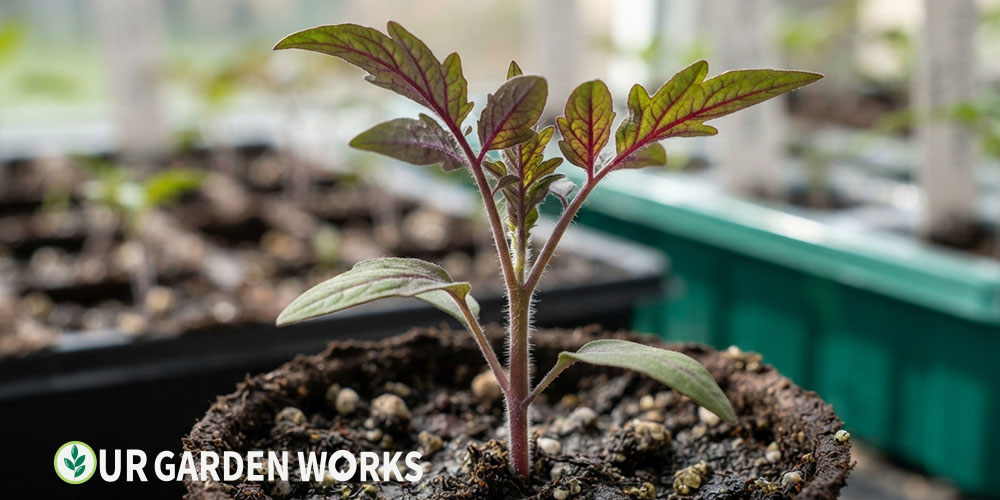
Purple leaves on tomato plants are a striking, somewhat unusual symptom compared to the more familiar yellowing or browning most gardeners watch for. The cause list is mercifully short, which makes this one of the more straightforward diagnoses in this whole series.
Two causes account for the vast majority of cases, and they’re closely related to each other in a way that’s worth understanding before you reach for any fertilizer.
Quick Answer: Purple leaves on tomato plants are almost always caused by phosphorus deficiency or cold stress — and the two are connected, since cold soil directly reduces a plant’s ability to take up phosphorus even when it’s present. A genetic, variety-specific purple tinge is a rare third possibility. Check soil temperature and recent weather first, since this is the most common underlying driver.
Cause 1 — Phosphorus Deficiency
Phosphorus deficiency produces a purple or reddish-purple discoloration, most visible on the undersides of leaves and along the veins, typically starting on older, lower foliage.
The purple color comes from a buildup of anthocyanin pigments, which the plant produces in greater quantities when phosphorus is limited.
How to confirm it’s phosphorus deficiency:
- Purple coloring concentrates on leaf undersides and veins
- Older, lower leaves affected first
- Plant growth may seem slow or stunted overall
- Soil test, if available, shows low phosphorus levels
Fix: Apply a phosphorus-rich fertilizer (look for a higher middle number in the N-P-K ratio, such as 10-20-10) according to label rates. Bone meal is a popular organic phosphorus source that many gardeners work into the soil at planting time specifically to prevent this issue.
Cause 2 — Cold Stress (The Connected Cause)
This is the cause most people don’t expect, and it’s directly linked to the phosphorus deficiency above: cold soil temperatures, even when phosphorus is adequately present in the soil, significantly impair a tomato plant’s ability to actually absorb and use that phosphorus.
The result looks identical to a true nutrient deficiency, even though the underlying soil chemistry might be perfectly fine.
How to confirm it’s cold-related:
- Purple coloring appeared after a recent cold spell or unusually cool nights
- Most common on young transplants set out before soil has fully warmed
- Soil temperature, if you check it, is below the ideal 60-65°F range for active root function
- Symptoms often appear most dramatically in spring on early transplants
Fix: Be patient — this typically resolves on its own as soil warms with the season, without needing any fertilizer intervention at all. If you want to speed things along, black plastic mulch or a soil-warming row cover raises soil temperature several degrees, helping roots resume normal phosphorus uptake sooner.
💡 Adding more fertilizer doesn’t help the cold-stress version
If cold soil is the actual cause, adding more phosphorus fertilizer won’t speed up recovery, since the problem isn’t a lack of phosphorus in the soil — it’s the plant’s reduced ability to access what’s already there while roots are cold. Warming the soil is the actual fix in this case, not additional feeding.
Cause 3 — Variety-Specific Genetic Coloring (Rare)
A small number of tomato varieties, along with some ornamental or specialty types, naturally show some purple pigmentation in their foliage as a genetic trait rather than any sign of stress or deficiency at all.
This is uncommon among standard garden tomato varieties but worth ruling out if the purple coloring doesn’t match the patterns described above.
How to confirm it’s genetic:
- Coloring is consistent and doesn’t correlate with cold weather or plant age
- Plant otherwise grows vigorously with no stunting
- Variety is known or labeled as having naturally pigmented foliage
Fix: None needed — this is simply how the variety naturally looks.
Telling the Causes Apart at a Glance
| Cause | Timing | Growth Impact | Resolves With |
|---|---|---|---|
| Phosphorus deficiency | Any time, soil-dependent | Slowed growth | Phosphorus fertilizer |
| Cold stress | Early season, after cold spells | Temporary slowing | Soil warming, patience |
| Genetic/variety trait | Consistent, not weather-linked | None — normal growth | No fix needed |
Why Cold Soil Affects Phosphorus Specifically
It’s worth understanding the actual mechanism here, since it explains why this particular nutrient and this particular symptom are so tightly linked in tomatoes.
Phosphorus uptake is more temperature-sensitive than most other nutrients, requiring active root metabolism that simply doesn’t function efficiently when soil temperatures stay below the optimal range for an extended period.
This is also why purple leaf coloring on tomatoes is so heavily concentrated in spring transplants and largely disappears as a concern once summer soil temperatures stabilize in the ideal range.
If you’re seeing this symptom in the middle of summer rather than shortly after spring transplanting, true phosphorus deficiency in the soil itself becomes the more likely explanation rather than temperature-related uptake issues.
Does This Happen to Other Nightshade Vegetables Too?
Peppers and eggplant, both close relatives of tomatoes in the nightshade family, can show similar purple leaf discoloration under the same conditions — cold soil and phosphorus deficiency affect their root systems in much the same way.
If you’re seeing purple leaves on tomatoes specifically alongside similar symptoms on nearby peppers or eggplant, that pattern actually supports a soil-wide or temperature-wide cause rather than something specific to an individual plant.
This cross-crop pattern is useful diagnostically: if only your tomatoes show purpling while peppers and eggplant in the same bed look completely normal, a tomato-specific genetic trait or a more localized stress factor affecting just that plant becomes more likely than a garden-wide soil or temperature issue.
Comparing symptoms across related crops planted in the same conditions is a quick, free diagnostic step worth taking before assuming the worst about any single plant.
Container-Grown Tomatoes and Purple Leaves
Container-grown tomatoes face a somewhat elevated risk of the cold-stress version of this symptom compared to in-ground plantings, since container soil volume is smaller and more responsive to ambient air temperature swings than the more thermally stable mass of in-ground garden soil.
A container left on a cool patio or exposed deck can experience more dramatic overnight temperature drops than a bed of soil with the same air temperature exposure.
This is part of why container tomato guides often recommend extra patience before transplanting, or moving containers to a more sheltered, sun-warmed location during the early weeks after transplanting if a cold spell is forecast.
Containers also offer an advantage in this specific situation that in-ground beds don’t: the ability to physically move the plant to warmer conditions temporarily, which can speed recovery from cold-related purpling more directly than waiting for ambient outdoor temperatures alone to rise.
For container plantings specifically, our guide to growing tomatoes in containers covers the broader watering and feeding considerations that interact with this temperature sensitivity, since container soil’s smaller volume affects more than just temperature stability.
How to Prevent Purple Leaves Next Season
Waiting to transplant until soil has genuinely warmed, rather than rushing transplants out at the earliest possible date, prevents the cold-stress version of this symptom from developing in the first place.
A simple soil thermometer, checking for a consistent 60°F or warmer reading at planting depth, removes the guesswork from this timing decision.
For gardens with a known history of low soil phosphorus, working bone meal or a phosphorus-rich amendment into the bed at planting time, rather than waiting to react once symptoms appear, prevents the true deficiency version proactively.
A soil test every few years is the most reliable way to know whether phosphorus levels in your specific garden actually need this kind of supplementation.
Frequently Asked Questions
Will purple leaves on my tomato plant affect the fruit?
Mild, temporary cold-related purpling rarely affects fruit production once the plant warms up and resumes normal growth. True, sustained phosphorus deficiency, if left unaddressed, can reduce flowering and fruit set since phosphorus plays a direct role in the plant’s reproductive development, making correction more important the longer the deficiency persists.
How long does it take for purple tomato leaves to turn green again?
For cold-related purpling, new growth typically emerges green within 1-2 weeks once soil temperatures warm consistently, though already-purple leaves may not fully reverse and instead get replaced by healthy new growth over time.
For true phosphorus deficiency treated with fertilizer, expect a similar 1-2 week timeline for improvement to become visible in new growth.
Can I prevent purple leaves by starting seeds indoors instead of direct sowing?
Starting seeds indoors doesn’t prevent the issue on its own, since the risk comes from transplanting into cold outdoor soil regardless of where the seedling was originally started.
The real prevention step is waiting for adequate soil warmth before transplanting outdoors, whether your seedlings came from an indoor start or a nursery purchase.
Is purple leaf coloring the same thing as anthocyanin found in purple tomato varieties bred for that trait?
It’s a related but distinct phenomenon — both involve the same anthocyanin pigment, but specialty purple tomato varieties are bred to express this pigment consistently and deliberately in fruit and sometimes foliage as a desirable trait, while stress-induced purpling in standard green-leaf varieties is the plant’s temporary response to a specific limiting condition.
Once that condition resolves, standard varieties return to normal green growth, while bred-in purple coloring in specialty varieties remains a permanent, consistent characteristic of the plant.
Related Articles in Our Tomato Leaf Problems Guide
- Wilting Tomato Plants (Not Drought) – What Is It
- Brown Spots on Tomato Leaves – What’s Causing It
- Tomato Leaves Turning Yellow: 7 Causes
- When to Plant Tomatoes — Regional Planting Guide (2026)
- 7 Best Potting Soils for Tomatoes — Tested & Reviewed (2026)
- How to Grow Tomatoes From Seed to Harvest (Complete 2026 Guide)
- Vegetable Gardening Guide
Final Thoughts
We hope this guide has cleared up why your tomato leaves turned purple — and reassured you that in most cases, especially the cold-related version, this resolves itself without much intervention at all.
For all our tomato and vegetable guides, our vegetable gardening guide links to everything.
Share this post with a fellow gardener who’s troubleshooting purple tomato leaves — and let us know in the comments which cause matched what you found. Happy growing!
