

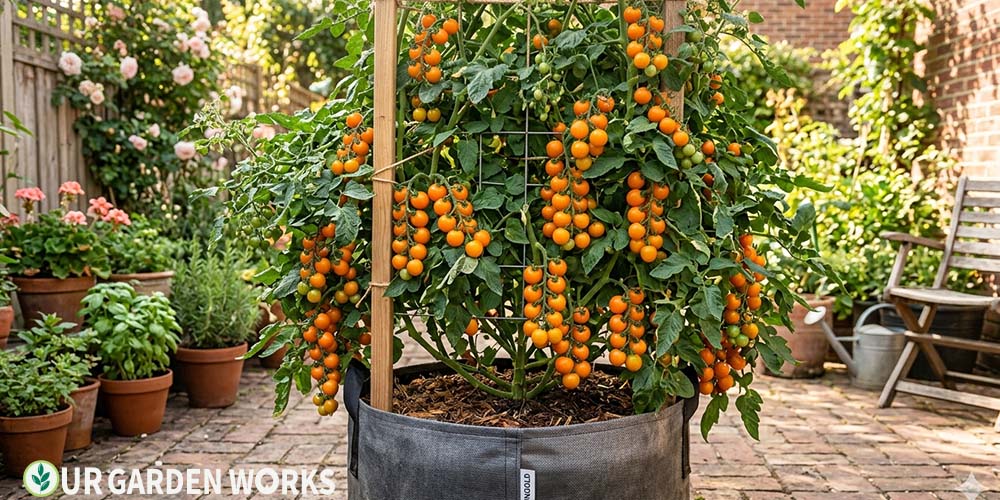
Container tomatoes are one of the best ways to grow your own food without a dedicated garden bed — and they’re dramatically underestimated.
A well-set-up 15-gallon pot with the right variety can produce 8–12 lbs of tomatoes over a season.
The catch: containers demand more consistent attention than in-ground growing. Once you understand what that means in practice, container tomatoes become genuinely satisfying rather than frustrating.
The two mistakes that kill most container tomato attempts are too-small pots and too-inconsistent watering.
We’re going to solve both right here — then walk you through the complete setup from pot selection to harvest.
How to grow Tomatoes in Containers: Use minimum 15-gallon containers for indeterminate (vining) varieties; 10-gallon for compact determinates; 5-gallon for cherry tomatoes only. Use premium potting mix — never garden soil. Water daily in summer (sometimes twice). Feed every 7–10 days with liquid fertilizer. Choose compact or determinate varieties for the most reliable results.
The Pot Size Problem — The Most Common Container Tomato Mistake
Let’s be direct: a 5-gallon bucket is too small for most tomato varieties.
It’s the most common container gardening mistake, and it explains why so many people say container tomatoes “never worked” for them.
Small containers restrict root development, dry out within hours in summer heat, and can’t hold enough nutrients for a full-season crop.
| Container Size | Best For | Watering Frequency (Summer) |
|---|---|---|
| 5 gallon | Cherry tomatoes (dwarf/compact only), herbs | 1–2x daily in heat |
| 10 gallon | Compact determinate varieties (Patio, Bush Early Girl) | Daily |
| 15 gallon | Most determinate and smaller indeterminate varieties | Daily, sometimes twice |
| 20+ gallon / grow bag | Full-size indeterminate (Early Girl, Celebrity, Sungold) | Daily in heat, every other day when cool |
Fabric grow bags are our top recommendation for container tomatoes. They air-prune roots (preventing root circling), drain freely, and never overheat the root zone the way dark plastic pots can. A 20-gallon fabric grow bag is significantly cheaper than an equivalent plastic pot and often outperforms it. Search “fabric grow bags” — a pack of 5 runs about $25.
Determinate vs Indeterminate — Why It Matters More in Containers
The determinate-versus-indeterminate distinction matters in any tomato growing situation, but it has outsized consequences in a container.
Determinate varieties grow to a genetically fixed size, set their fruit over a relatively concentrated window, and then taper off — a predictable, compact growth habit that suits the limited root volume of a pot well.
Indeterminate varieties keep growing and producing new fruit clusters until frost kills them, which means a bigger plant, a longer harvest window, and a correspondingly bigger container and root system required to support it.
This is why so many of the most reliable container tomato varieties on the market are determinate or compact indeterminate hybrids bred specifically for patio growing.
They’re not a downgrade from a full-size garden tomato — they’re a deliberate match between plant habit and the realistic limits of root space in a pot.
A full-size indeterminate variety can absolutely be grown in a large enough container, but it needs the 20-gallon-plus end of the size range and a stronger commitment to consistent watering and feeding to support its larger, longer-producing frame.
Best Tomato Varieties for Containers
| Variety | Type | Min Container | Notes |
|---|---|---|---|
| Tumbling Tom | Determinate, cascading | 5 gal | Designed for hanging baskets and small pots |
| Patio | Determinate, compact | 5–10 gal | Classic patio container variety; reliable |
| Bush Early Girl | Determinate | 10 gal | Early production; compact; full slicing tomato size |
| Celebrity | Determinate | 15 gal | Disease-resistant; excellent producer in large containers |
| Sungold | Indeterminate cherry | 15–20 gal | Best container cherry tomato — prolific and extraordinary flavor |
| Early Girl | Indeterminate | 20 gal | Full-season producer in a large container; needs staking |
Setting Up Your Container for Success
Step 1 — Choose the Right Potting Mix
Never use garden soil in containers. Garden soil compacts in containers, drains poorly, and introduces disease organisms into a confined root environment.
Use a premium potting mix (not “potting soil” — premium potting mix is a meaningful distinction that indicates a lighter, more porous formulation).
Improve your potting mix before planting:
- Add 10–15% perlite by volume to improve drainage and prevent compaction over the season
- Add 10% worm castings for slow-release nutrients and beneficial microbes
- Mix in a slow-release granular fertilizer (Osmocote or equivalent) at the package rate — this feeds the plant for the first 3–4 months
Step 2 — Plant Deep and Install Support Immediately
Directions
- Fill the container 2/3 full with amended potting mix.
- Plant the tomato seedling deep — burying the stem up to the lowest set of leaves. Roots develop along the buried stem, strengthening the plant. This is even more important in containers because the confined root zone benefits from every additional inch of root development.
- Install your stake, cage, or trellis support immediately. Driving a stake into a container later risks damaging roots in the confined space.
- Fill in around the plant, leaving 1–2 inches of headspace at the top for watering.
- Water until it drains from the bottom — this ensures all the potting mix is thoroughly wet from the start.
Step 3 — The Container Watering Routine
This is the most demanding part of container tomato growing, and being honest about it upfront prevents disappointment later. In summer heat, a large container tomato needs 1–2 gallons of water daily. The soil should be consistently moist — not soggy, not dry. Let the top inch dry slightly between waterings, but the deeper soil should stay evenly moist.
Two ways to reduce watering labor:
- Self-watering containers or reservoirs: Pots with built-in water reservoirs can reduce watering to every 2–3 days
- Mulch the container surface: 1–2 inches of wood chips or straw on top of the potting mix reduces evaporation significantly
⚠️ The most common container tomato failure
Skipping one or two days of watering in July or August. The plant wilts, recovers, and appears fine — but the stress triggers blossom end rot and inconsistent fruit development that shows up weeks later. Set a daily reminder. Container tomatoes don’t forgive inconsistency the way in-ground plants do.
Step 4 — Fertilizing Every 7–10 Days
Container plants flush nutrients through the drainage holes every time you water — which, in summer, is daily. The slow-release fertilizer you mixed in at planting helps but won’t be sufficient for a full season. Supplement with liquid fertilizer every 7–10 days through the growing season.
The fertilizing progression:
- Before flowering: Balanced fertilizer (10-10-10 or fish emulsion) — builds structure
- Once flowering begins: Low-nitrogen, high-potassium liquid (5-10-10 or tomato-specific) — directs energy to fruit
- Fruiting season: Continue with high-potassium feed every 7–10 days until end of season
Frequently Asked Questions
Can I reuse container potting mix for tomatoes next year?
Yes, with refreshing. Remove all old roots and plant material. Add 30% fresh potting mix and a full dose of slow-release fertilizer. Check pH (should be 6.0–6.8) and adjust if needed. Never reuse mix where a plant died from disease — discard it and sterilize the container with a diluted bleach solution.
What's the best location for a container tomato?
South-facing wall or patio that receives 8+ hours of direct sun. Against a light-colored wall is ideal — it reflects additional light onto the plant. Avoid windy spots — containers dry out faster in wind and the plants can topple if not secured. Keep containers on a wheeled base so you can move them to maximize sun exposure.
Why are my container tomatoes getting blossom end rot?
Inconsistent watering is the cause in 90% of cases — it’s not a calcium deficiency in the potting mix, it’s a calcium uptake failure caused by irregular moisture. Fix your watering schedule first. If the problem persists after establishing consistent watering, add a liquid calcium supplement or crushed eggshells to the soil surface.
How is growing tomatoes in containers different from growing cucumbers or peppers in containers?
Tomatoes are the most water-demanding and nutrient-hungry of the common container vegetables, which is why the watering and feeding schedule here is more aggressive than what peppers typically need. Peppers actually tolerate slight dry-down between waterings better than tomatoes do, and cucumbers fall somewhere in between, needing very consistent moisture but slightly less fertilizer overall. If you’re growing several container vegetables side by side, tomatoes are usually the ones that will show stress first if your watering routine slips.
Related Articles in Our Vegetable Gardening Guide:
Final Thoughts
We hope this guide has given you a clear picture of what successful container tomato growing actually looks like — consistent attention, the right pot size, and the right variety makes all the difference. For all our tomato and vegetable growing guides, our vegetable gardening guide is always a good place to start.
Share this post with a fellow gardener who’s ready to grow their own — and let us know in the comments which container size and variety you’re trying this season. Happy growing!
