

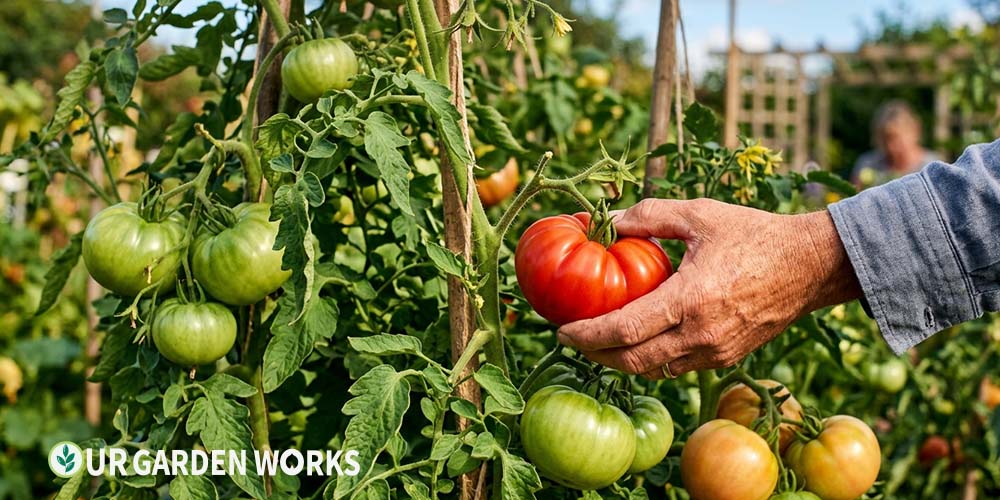
The tomato you grow yourself is always better than anything from the supermarket — but only if you pick it at the right moment.
Pick too early, and the sugars and flavor compounds have not yet developed. Leave it too long and it becomes mealy, splits, or attracts every pest in the garden. The window is wider than most gardeners realize, but the peak is specific.
When to Pick Tomatoes: Tomatoes are ready to pick when they have reached their full mature color (red, orange, yellow, purple — depends on variety), give slightly when gently squeezed, and release easily from the vine with a light twist. For the best flavor, ripen fully on the vine in temperatures below 85°F. Above 85°F, harvest at the breaker stage and ripen indoors on a counter — not in the refrigerator.
Why Picking Time Matters More Than People Realize
It’s tempting to think of tomato ripeness as a simple yes-or-no question, but the truth is the fruit keeps developing flavor compounds right up until the moment you pick it — and for a short window even after, if conditions are right.
A tomato pulled a few days too early will still turn fully red on the counter, but it never develops the same sugar and acid balance it would have built up while still attached to the plant.
This is the entire reason “tastes like a real tomato” has become such a specific compliment — it usually means someone waited for that final window rather than picking at the first hint of color the way commercial growers, who need fruit to survive shipping, are forced to.
On the other hand, waiting too long carries its own costs that go beyond the fruit splitting or turning mealy. An overripe tomato left on the vine signals the plant to slow production of new flowers and fruit elsewhere on the same plant, since the plant’s energy is being directed toward a fruit that, from its perspective, is already finished.
Harvesting consistently at peak ripeness — rather than letting a few stragglers linger — actually helps keep the rest of the plant productive through the season.
The 5 Ripeness Tests
Test 1 — Color
The most visible indicator. Each variety has a target mature color — knowing your variety’s color is the first requirement.
Red is not universal. A fully ripe Black Krim is deep purple-brown, a ripe Green Zebra is yellow-green with darker stripes, and a ripe Sun Gold is deep orange. Match the fruit color to the variety description, not to your expectation of “tomato red.” For variety selection before harvest even matters, our tomato varieties guide covers every type.
Test 2 — Give (Gentle Squeeze)
A ripe tomato yields slightly to gentle finger pressure — like a ripe peach. An underripe tomato is firm throughout with no give. An overripe tomato is soft and may have spots or wrinkling.
The ideal: slight give at the blossom end (opposite the stem), firmness everywhere else.
Test 3 — Smell
Ripe tomatoes smell like tomatoes — that distinctive warm, earthy, slightly acidic scent. An underripe tomato has almost no smell at the blossom end. If it smells like a tomato when you sniff the stem attachment point, it is ready.
Test 4 — Release from Vine
A ripe tomato releases from the vine with a gentle twist and very light upward pull — no force required. An underripe tomato requires pulling or tugging and may bring part of the vine with it. If you have to work to get it off, leave it for another day.
Test 5 — Days from Transplant
Use the seed packet’s “days to maturity” number as a planning anchor. Count from the date you transplanted outdoors. When you’re within 10–14 days of that number, start checking daily with the other four tests.
When to Pick by Tomato Type
| Type | Mature Colour | Days to Maturity | Pick at | Shelf Life Off Vine |
|---|---|---|---|---|
| Cherry tomatoes (red) | Bright red, uniform | 60–70 days | Fully red, slight give | 5–7 days at room temp |
| Sun Gold cherry | Deep orange | 57–65 days | Deep orange — not yellow-orange | 4–5 days |
| Grape tomatoes | Deep red or yellow | 70–75 days | Fully coloured, firm | 7–10 days |
| Roma / paste | Deep red, meaty | 70–80 days | Fully red, blossom end soft | 7–10 days |
| Slicing (standard) | Bright to deep red | 70–85 days | Full color, gives at blossom end | 4–7 days |
| Beefsteak | Deep red, heavy | 80–100 days | Full color, some give — do not leave overlong | 3–5 days |
| Heirloom (red types) | Varies — often not uniform | 75–90 days | Use smell + give — color unreliable for some | 2–4 days (short) |
| Black/purple types (Black Krim, Cherokee Purple) | Deep purple-brown shoulders | 75–85 days | Purple-brown at shoulders, slight give | 3–5 days |
| Yellow/orange types (Lemon Boy, Yellow Pear) | Clear yellow, no green | 72–80 days | Full yellow, slight give | 4–6 days |
| Green types (Green Zebra) | Yellow-green, yellow stripes | 78 days | Yellow-green base color, use smell + give | 4–6 days |
What to Do When Several Tomatoes Ripen at Once
Tomatoes have an inconvenient habit of ripening in waves rather than one at a time, especially once a plant has several fruit clusters going simultaneously in midsummer.
If you come back from a few warm days away to find a dozen ripe tomatoes at once, don’t feel obligated to use them all immediately at the cost of quality.
Fully ripe tomatoes held at room temperature out of direct sun stay good for several days, and slightly underripe ones pulled early to beat a heat wave or rainstorm will continue ripening at a similar pace.
If a genuine glut arrives, prioritize using or processing the softest, most fully ripe fruit first — they have the shortest remaining shelf life — and let the firmer ones sit a day or two longer on the counter.
Tomatoes that are clearly past their best for fresh eating (slightly wrinkled skin, very soft) are usually still excellent for sauce, where texture matters far less than flavor.
This is also a good moment to check the vine itself: a flush of simultaneous ripening often means several more fruits are close behind, so a quick walk-through to spot the next wave saves you from being caught off guard again in a few days.
How Weather Changes the Picking Decision
The 5 ripeness tests above describe the fruit itself, but the weather forecast should also factor into your decision, particularly in two situations.
Heavy rain is the bigger of the two — a tomato that’s nearly ready but still firm can take on water rapidly during a downpour and crack from the inside out, especially if the preceding days were dry.
If significant rain is forecast and a tomato is showing real color, it’s usually better to pick a day early than risk losing it to splitting.
The second situation is an approaching heat wave. As covered in the breaker stage section below, tomatoes effectively stop developing flavor compounds above 86°F, so fruit that’s already showing color gains little by staying on the vine through several days of extreme heat — and it’s exposed to extra stress, increased pest interest, and sunscald risk in the meantime.
Picking proactively ahead of a known heat wave, rather than waiting and hoping for the best, tends to produce better-tasting tomatoes overall.
The Breaker Stage — Your Summer Heat Lifeline
When summer temperatures consistently exceed 85°F, ripening on the vine stalls, and tomatoes may be mealy and bland even when fully colored.
This is because lycopene (the compound that creates red color and flavor) does not develop above 86°F.
In a heat wave, the solution is the breaker stage: harvest when tomatoes show first color blush (10–30% coloured) and ripen them indoors on a counter at room temperature.
Counter-ripened tomatoes — harvested at the breaker stage and finished indoors at 65–75°F — often taste better than vine-ripened tomatoes during summer heat. The flavor compounds develop fully at room temperature; they do not require vine attachment after the breaker stage is reached.
⚠️ Never refrigerate tomatoes
Cold temperatures (below 55°F) permanently damage tomato cell structure and destroy the flavor compounds that make homegrown tomatoes worth growing. Refrigerated tomatoes become mealy and flavorless. Store at room temperature, stem side down, out of direct sun. Use within 4–7 days, depending on variety.
Frequently Asked Questions
My tomatoes are fully red but still firm — are they ripe?
Full color with firm flesh is the breaker stage — they are ripe enough to pick and will continue developing full flavor at room temperature over 2–4 days.
Leaving them on the vine for that extra development time is ideal if temperatures are below 85°F and there is no rain forecast. In hot weather or ahead of rain (which causes cracking), pick at full color and finish on the counter.
My tomatoes are splitting before I can pick them — how do I prevent this?
Cracking and splitting is caused by inconsistent moisture — specifically, a dry period followed by heavy rain or overwatering. The fruit expands rapidly from sudden moisture after the skin has already set firmly around a smaller fruit.
Consistent soil moisture — the exact method covered in our vegetable garden watering guide — (deep watering every 2–3 days) and mulch prevent most splitting. Harvest ripe tomatoes before heavy rain is forecast — they will finish ripening on the counter without the splitting risk.
First frost is coming and I still have green tomatoes — what now?
Pick everything showing any hint of colour change (even a faint blush) before frost hits, since frost-damaged fruit won’t ripen properly and often rots instead.
Fully green, mature-sized tomatoes (firm, full size for the variety, glossy skin) can still ripen indoors over several weeks if wrapped individually in newspaper and stored in a cool, dark spot — check every few days and pull out any that ripen or show rot.
Truly immature small green tomatoes won’t ripen well regardless of storage method, but they’re excellent used as fried green tomatoes or in chutney while still green.
Related Articles:
Final Thoughts
We hope this takes the guesswork out of one of summer gardening’s most rewarding moments.
The color, give, and smell tests together take about 10 seconds per tomato — and getting the timing right is the difference between a good tomato and a great one. For all our vegetable growing guides, our vegetable gardening guide links to every article we have published.
Share this with a fellow gardener who has been picking tomatoes early or letting them go overripe because they could not tell when they were actually ready — and let us know in the comments how it went for you. Happy growing!
