

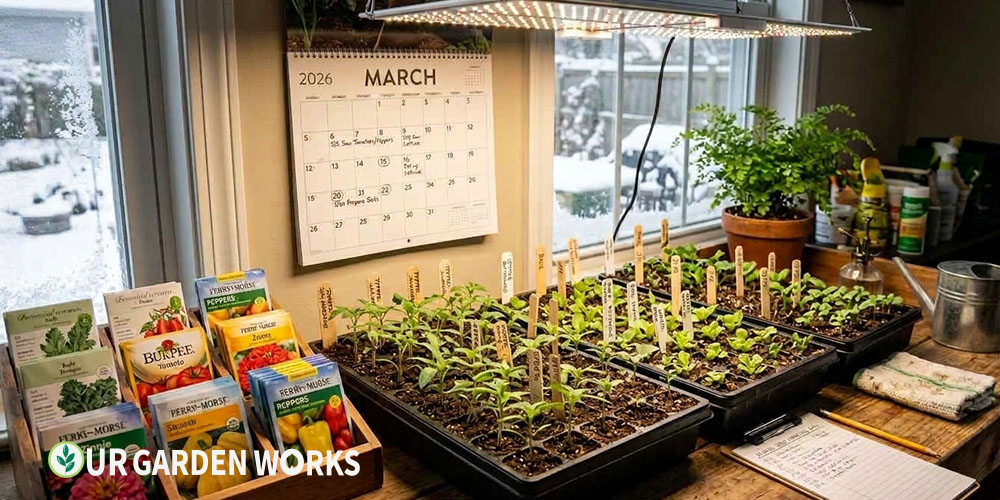
Every seed packet says “start indoors 6–8 weeks before last frost.” But when is your last frost? And does that 6–8 week window apply to every crop the same way? The answer to both questions is: it depends — and getting it wrong in either direction costs you weeks of growing season.
Start too early and you end up with root-bound, stressed seedlings sitting in tiny cells waiting for outdoor conditions that won’t arrive for another month. Start too late and you lose the head start that indoor growing is supposed to give you. The target is a well-timed seedling that goes into warm outdoor soil at exactly the right stage of development.
In this guide, we’ll give you a region-by-region last frost reference, a crop-by-crop timing chart, and the key rules that make indoor seed starting actually work.
Quick Answer: Find your last average frost date using our free Frost Dates Lookup Tool — enter your ZIP code and get your exact spring and fall dates in seconds. Then count back from that date using the crop-specific timing chart below. Most warm-season vegetables start 6–8 weeks before last frost. Cool-season crops start 4–6 weeks before. Some crops (beans, carrots, beets) should not be started indoors at all.
Step 1 — Find Your Last Frost Date
Your last average frost date is the anchor point for your entire seed-starting calendar. Every crop timing works backward from this single number.
The fastest way to find yours: use our free Frost Dates Lookup Tool — enter your ZIP code and get your exact spring and fall frost dates at three probability levels in about 10 seconds. Far more precise than a regional zone table.
| USDA Zone | Region Examples | Last Frost Date (avg) | First Frost (fall) |
|---|---|---|---|
| Zone 3 | North Dakota, northern Minnesota, Alaska | May 15 – June 15 | Sept 1–15 |
| Zone 4 | Montana, Vermont, northern Wisconsin | May 1–15 | Sept 15–30 |
| Zone 5 | Chicago, Denver, Boston, central Iowa | April 15 – May 1 | Oct 1–15 |
| Zone 6 | New York City, St. Louis, Kansas City | April 1–15 | Oct 15–31 |
| Zone 7 | Washington D.C., Nashville, Oklahoma City | March 15 – April 1 | Nov 1–15 |
| Zone 8 | Seattle, Portland, Atlanta, Dallas | Feb 15 – March 15 | Nov 15–30 |
| Zone 9 | Los Angeles, Phoenix, Houston, Tampa | Jan 30 – Feb 15 | Dec 1–15 |
| Zone 10–11 | Miami, Hawaii, southern Texas | Frost-free or near-frost-free year-round | — |
🛠️ Get your exact frost dates — free tool
Zone averages are starting points. Your specific microclimate — elevation, proximity to water, urban heat island — can shift your actual last frost by 1–3 weeks from the zone average. Use our free Frost Dates Lookup Tool to enter your ZIP and get precise dates from 30-year NOAA climate data. It also shows your first fall frost date — useful for planning your fall garden and knowing your total growing season length.
Step 2 — Crop-by-Crop Indoor Timing Chart
This is your master reference. Count backward from your last frost date using the “Start Indoors” column.
| Crop | Start Indoors | Transplant Outside | Direct Sow Instead? |
|---|---|---|---|
| Tomatoes | 6–8 weeks before last frost | 2 weeks after last frost | No |
| Peppers | 8–10 weeks before last frost | 2–3 weeks after last frost | No |
| Eggplant | 8–10 weeks before last frost | 2 weeks after last frost | No |
| Basil | 6 weeks before last frost | 2 weeks after last frost | Yes (direct sow when warm) |
| Broccoli | 4–6 weeks before last frost | 2–4 weeks before last frost | Yes (for fall crop) |
| Cauliflower | 4–6 weeks before last frost | 2–4 weeks before last frost | Yes (for fall crop) |
| Cabbage | 4–6 weeks before last frost | 2–4 weeks before last frost | Yes (for fall crop) |
| Kale | 4–6 weeks before last frost | 3–4 weeks before last frost | Yes |
| Lettuce | 4–6 weeks before last frost | 4 weeks before last frost | Yes (preferred) |
| Spinach | 4–6 weeks before last frost | 4–6 weeks before last frost | Yes (preferred) |
| Celery | 10–12 weeks before last frost | 2 weeks after last frost | No |
| Onions | 10–12 weeks before last frost | 4–6 weeks before last frost | Yes (sets) |
| Leeks | 10–12 weeks before last frost | 4 weeks before last frost | No |
| Cucumbers | 3–4 weeks before transplant | When soil hits 70°F | Yes (preferred) |
| Squash / Zucchini | 3–4 weeks before transplant | When soil hits 65°F | Yes (preferred) |
| Melons | 3–4 weeks before transplant | When soil hits 70°F | Yes |
| Pumpkins | 2–3 weeks before transplant | When soil hits 65°F | Yes (preferred) |
| Beans | Do NOT start indoors | Direct sow only | Yes — required |
| Carrots | Do NOT start indoors | Direct sow only | Yes — required |
| Beets | Do NOT start indoors | Direct sow only | Yes — required |
| Radishes | Do NOT start indoors | Direct sow only | Yes — required |
| Peas | Do NOT start indoors (usually) | Direct sow 4–6 wks before LFD | Yes — preferred |
| Corn | Do NOT start indoors | Direct sow only | Yes — required |
⚠️ Do NOT start these crops indoors
Beans, carrots, beets, radishes, corn, and peas perform significantly worse when transplanted than when direct-sown. Their root systems are sensitive to disturbance and they gain no meaningful benefit from indoor head-starting. Starting them indoors wastes seed-starting space and produces inferior plants. Direct sow directly into the garden at the correct time.
🛠️ Skip the math — use the free calculator
Rather than counting backward from your frost date by hand for every crop, our free Seed Starting Calculator does it automatically.
Just enter your ZIP code, select your crops, and it returns exact indoor start dates and outdoor transplant dates for each one — including Spring and Fall planting modes. Takes about 2 minutes for a full season plan.
Region-by-Region Seed Starting Calendar
Zone 3 — Northern States (ND, MN, MT, VT highlands, Alaska)
Last frost: May 15 – June 15
| Month | What to Start Indoors |
|---|---|
| Early March | Onions, leeks, celery |
| Mid March | Peppers, eggplant |
| Early April | Tomatoes, broccoli, kale, cabbage |
| Late April | Basil, cucumbers, squash (only if last frost is June 1+) |
| Direct sow outdoors (late May–June) | Beans, carrots, beets, radishes, peas |
Zone 4–5 — Upper Midwest, Northeast (Chicago, Boston, Minneapolis, Denver)
Last frost: April 15 – May 15
| Month | What to Start Indoors |
|---|---|
| Late January | Onions, leeks, celery (Zone 5 only) |
| Early February | Peppers, eggplant |
| Late February | Tomatoes |
| Early March | Broccoli, cabbage, kale, cauliflower |
| Late March | Basil, lettuce (for transplant) |
| Early April | Cucumbers, squash (3–4 wks before soil warms) |
| Direct sow (late April–May) | Peas, spinach, lettuce; then beans, carrots, beets when frost risk passes |
📅 Zone 5 peak seed-starting season: February
For Zone 5 gardeners, late February is the busiest seed-starting month. Peppers go in first (they’re the slowest), followed by tomatoes 2 weeks later. Missing February means smaller, less established seedlings at transplant time in May. Use our Seed Starting Calculator to get your exact dates — it’s set up specifically for Zone 5 timing and tells you the precise week for each crop.
Zone 6–7 — Mid-Atlantic, Mid-South (NYC, DC, Nashville, Dallas)
Last frost: March 15 – April 15
| Month | What to Start Indoors |
|---|---|
| Early January | Onions, leeks, celery |
| Mid January | Peppers, eggplant |
| Early February | Tomatoes, broccoli, cabbage |
| Late February | Basil, kale, lettuce |
| Early March | Cucumbers, squash |
| Direct sow (March–April) | Peas, spinach (March); beans, carrots, beets (April) |
Zone 8–9 — Pacific Coast, South (Seattle, Atlanta, Houston, LA, Phoenix)
Last frost: January 30 – March 15
| Month | What to Start Indoors |
|---|---|
| November–December | Onions, leeks for spring crop; broccoli, cabbage, kale for winter garden |
| Late December | Peppers, eggplant (spring crop) |
| January | Tomatoes, basil (spring crop) |
| February | Cucumbers, squash, melons |
| June–July | Start fall/winter crops: broccoli, kale, spinach, lettuce |
Zone 8–9 gardeners have the advantage of a fall/winter garden season. After summer crops are pulled in August–September, a second planting of cool-season crops (kale, spinach, broccoli, lettuce) produces through winter. Start these cool-season seeds indoors in June–July while summer crops are still producing.
The Rules That Apply in Every Zone
- Peppers always go in before tomatoes — 2 weeks earlier. They’re slower to grow and slower to mature. A pepper started at the same time as tomatoes will be noticeably behind at transplant.
- Cucumbers, squash, and melons need only 3–4 weeks indoors — they grow fast. Starting them 8 weeks early produces root-bound, struggling plants. Time them specifically to soil temperature, not frost date.
- Onions and leeks need the longest head start — 10–12 weeks. In most zones this means starting in January. They’re slow and thin for weeks before bulking up — don’t be alarmed.
- When in doubt, start later rather than earlier — a plant transplanted on the right date into warm soil outperforms one planted 3 weeks early into cold soil. The wait is always worth it.
For the complete guide to setting up your indoor seed-starting system — lights, trays, timing, and hardening off — see our how to start seeds indoors guide. For the difference between seed-starting mix and potting soil, see our seed starting mix vs potting mix guide.
And if you want to see your full growing season laid out month by month — from first indoor sowing through fall harvest — our free Planting Calendar builds that schedule automatically for your ZIP code.
Frequently Asked Questions
What if I miss my ideal seed-starting window?
Start anyway — a 2–3 week delay is recoverable for most crops. A 6-week delay for tomatoes means buying transplants from a garden center instead of growing from seed, which is a perfectly fine fallback.
For cool-season crops (broccoli, lettuce, kale), missing the spring window means shifting to a fall planting — start them in July for harvest in October. Not sure if you’ve missed your window? Check your remaining days to last frost using our Frost Dates Tool and then run your crops through the Seed Starting Calculator to see what’s still viable.
Can I start seeds without a grow light?
A south-facing window can work for some crops in some climates — but the results are consistently worse than grow lights for most gardeners. Seedlings without adequate light become leggy and weak before they even go outside.
A basic LED grow light ($30–50) is the single most impactful investment in seed starting. See our complete seed-starting guide for recommendations.
My seedlings are ready but it's still too cold outside — what do I do?
Pot them up into larger containers (3–4 inch pots) to prevent root-binding and continue growing indoors under lights. Feed with diluted liquid fertilizer. This buys you 2–3 additional weeks without the plants going backward.
If they’re still ahead of outdoor conditions after potting up, the only option is to wait — rushing transplanting into cold soil does more harm than the slight stress of a larger pot indoors.
Do I need to adjust timing for unusual weather years?
Seed-starting timing is based on average frost dates, not the actual calendar. In a late spring year, stick to the soil temperature rule for transplanting (not the date) — 60°F for tomatoes, 65°F for peppers. Your seed-starting date stays the same; your outdoor planting date shifts with actual conditions. A soil thermometer removes all guesswork.
Check our related Seed Starting Guides:
🛠️ Try Free Garden Planning Tools:
Final Thoughts
We hope this regional calendar takes all the guesswork out of your seed-starting season.
The single most useful thing you can do right now: use our free Frost Dates Tool to get your exact dates, run your crop list through the Seed Starting Calculator for a personalized schedule, and then check the Planting Calendar to see your full season laid out month by month. That one planning session — about 10 minutes with the tools — sets up your whole growing season.
Also, check out our seed starting guides hub – A hub link to all seed starting articles. Share this post with a fellow gardener who’s ready to get growing — and let us know in the comments which zone you’re in and what you’re starting first this season. Happy growing!
