

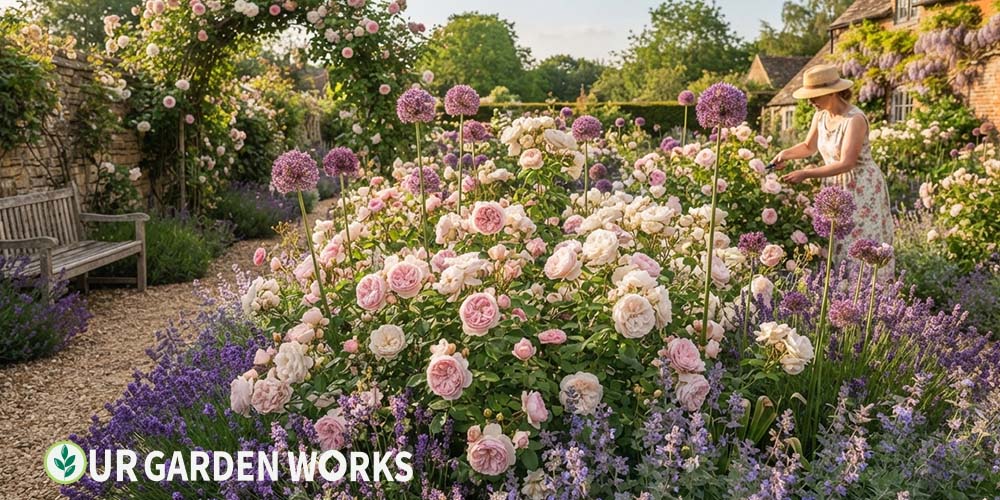
Roses have a reputation for being demanding — and honestly, some of it is earned. They attract aphids, Japanese beetles, black spot, and the occasional rabbit. They need regular feeding, good drainage, and enough air circulation to stay disease-free.
But here’s something most rose guides don’t tell you: the right plants growing nearby solve or reduce almost every one of those problems. Naturally, without spraying.
Companion planting around roses isn’t about cramming more plants into a bed. It’s about choosing specific plants that earn their space — by repelling the pests that target roses, attracting the beneficial insects that eat those pests, improving soil health, and filling in the blooming gaps between rose flushes so the bed looks beautiful all season.
We’ve grown roses alongside most of the companions on this list, and the difference in pest pressure and bloom quantity is genuinely significant.
Quick Answer: The best companion plants for roses are lavender, catmint, alliums (garlic, chives, ornamental alliums), yarrow, and salvia. Together they repel aphids and Japanese beetles, attract beneficial predatory insects, deter rabbits, and fill in the visual gaps between rose flushes. Geraniums, marigolds, and parsley complete a well-rounded rose companion planting scheme. Plant companions 12–18 inches from rose canes to allow air circulation.
Why Companion Planting Works for Roses — The Actual Mechanisms
Before the plant list, a word on honesty: not every claim made about companion planting holds up under scrutiny. Some are folklore. Some are genuinely proven.
For each plant we recommend below, we’ve noted what the evidence actually supports — so you can decide what to plant for confirmed reasons rather than garden myths.
The mechanisms that are well-supported by observation and research:
- Aromatic confusion: Strongly scented plants near roses make it harder for flying pests (aphid-laying insects, Japanese beetle moths) to locate rose plants by scent. Lavender, catmint, and alliums all work this way.
- Beneficial insect attraction: Many companion plants provide nectar and pollen that sustain and attract ladybugs, parasitic wasps, lacewings, and hoverflies — all of which prey on aphids and other soft-bodied pests. Yarrow and sweet alyssum are particularly effective.
- Physical ground coverage: Low-growing companions planted below rose canes reduce soil splash — one of the primary ways black spot spores travel from infected soil onto lower leaves. This is the most underrated practical benefit of ground-level companions.
- Rabbit deterrence: Strongly aromatic plants create a scent barrier that reduces rabbit interest in crossing into the rose bed. See our full rabbit deterrent plants guide for the complete list of options.
The Best Companion Plants for Roses
1. Lavender — The Classic Partner
Lavender is the most universally recommended rose companion, and it earns its reputation. The relationship works on multiple levels: the fragrant volatile oils in lavender foliage and flowers confuse and deter aphids, thrips, and the insects that lay eggs on rose plants. Bees visiting lavender spill over to pollinate roses.
The grey-green foliage provides a visual rest between rose flushes and contrasts beautifully with almost any rose color. And lavender is reliably avoided by rabbits — which is a genuine bonus if you garden where rabbits are active.
Best varieties for rose companions: Hidcote and Munstead (English lavender, compact at 12–18 inches) fit between rose plants without competing. Full-sized English lavender or Spanish lavender works as a border edging in front of the rose bed.
Spacing: 12–18 inches from rose canes. Lavender needs excellent drainage — if your rose bed retains moisture, plant lavender slightly raised or at the leading edge of the bed where drainage is best.
Zones: 5–8 reliably. Zone 4 with protection.
💡 The lavender–rose combination also deters rabbits
If rabbits are visiting your roses, lavender planted as a continuous border around the rose bed creates a scent barrier that significantly reduces rabbit crossings.
This pairs well with the methods in our do rabbits eat roses guide for complete protection. One plant is not enough — plant lavender in a continuous line so there are no gap points for rabbits to navigate around.
2. Catmint (Nepeta) — Long Bloom, Big Pest Deterrence
Catmint may be the single most practical rose companion available. It blooms for 8–10 weeks in early summer — before, during, and after the first rose flush — filling the visual gaps that keep rose beds looking sparse in May and June. Its aromatic foliage deters aphids and rabbits.
And it is one of the best plants available for attracting bees and predatory wasps that patrol for aphids. Cut it back hard after the first bloom and it flushes again in late summer, coordinating with the second rose flush.
Best varieties: Walker’s Low (2–3 feet, long bloom period), Six Hills Giant (larger, more dramatic), Purrsian Blue (compact at 18 inches, excellent for front of border).
Spacing: 18–24 inches from rose canes. Catmint spreads moderately — divide every 3 years to keep it from crowding cane bases.
Zones: 3–8 — more cold-hardy than lavender, excellent for northern gardens where lavender struggles.
3. Alliums — The Underground and Above-Ground Pest Solution
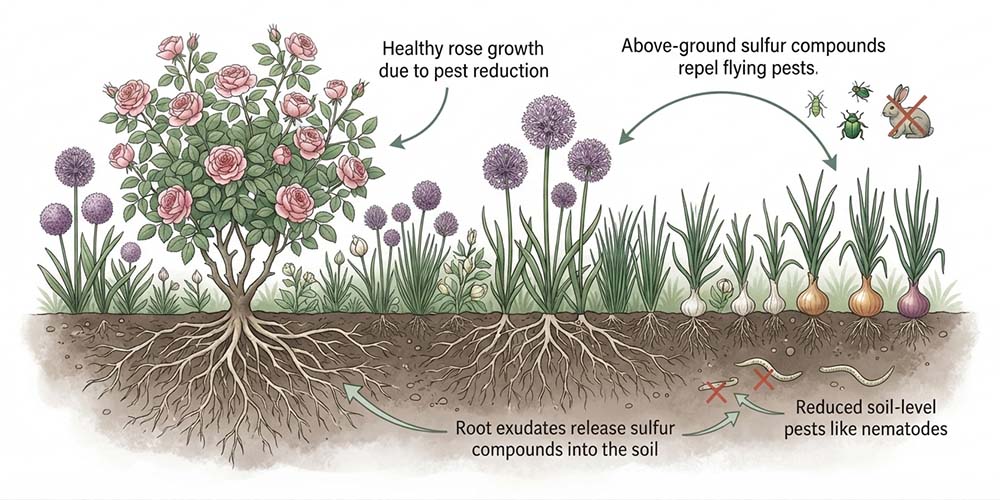
The allium family — which includes ornamental alliums, chives, garlic, and onions — is the most scientifically supported companion plant for roses.
Alliums contain sulfur compounds that are mildly toxic to and strongly repellent to aphids, nematodes, Japanese beetles, and rabbits. When planted around rose bases, the sulfur is present both in the above-ground foliage (which deters flying pests and rabbits by scent) and in the soil via root exudates (which reduce soil-level pests).
| Allium Type | Bloom Time | Height | Best Use with Roses |
|---|---|---|---|
| Ornamental allium (A. giganteum) | Late spring | 3–4 ft | Spectacular purple globes rise above rose foliage — dramatic combination |
| Chives (A. schoenoprasum) | Spring, reblooms | 12–18 in | Best edging plant — purple pom-pom flowers, edible, very low maintenance |
| Garlic (planted in fall) | Spring foliage | 18–24 in | Most potent pest deterrent — interplant at rose bases |
| Society garlic (Tulbaghia) | Summer | 18 in | Zone 7+ perennial — garlic fragrance without the harvest commitment |
Practical note on garlic: Plant garlic cloves in fall (October–November) between rose canes, 6 inches deep. By spring, the green shoots emerge and provide pest deterrence through the peak aphid season.
Harvest in June before summer heat — the empty spaces are perfect for a summer annual to fill in. This interplanting strategy costs almost nothing and provides season-long allium protection exactly when rose pest pressure is highest.
4. Yarrow — The Beneficial Insect Magnet
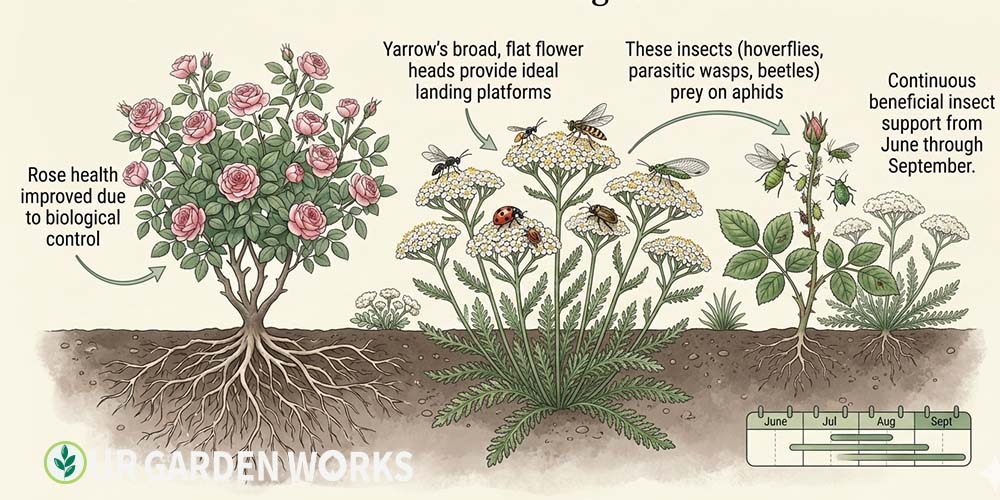
If you could only plant one companion plant specifically to attract the insects that eat aphids, plant yarrow.
Its broad, flat flower heads are one of the most effective landing platforms for parasitic wasps, hoverflies, and predatory beetles — all of which prey on aphids, caterpillars, and other soft-bodied rose pests.
Yarrow blooms from June through September in most climates, providing continuous beneficial insect support through the entire rose-growing season.
Additional practical benefits: Yarrow is drought-tolerant once established (ideal next to roses that dislike wet soil), deer-resistant, and long-lasting as a cut flower. The ferny foliage provides textural contrast to rose foliage.
Best colours with roses: White yarrow (Achillea millefolium) has the strongest beneficial insect attraction and pairs with any rose colour. Warm shades — salmon, coral, gold — complement pink and red roses beautifully.
Spacing: Plant 18–24 inches from rose canes. Yarrow spreads vigorously — divide every 2–3 years and keep it from the crown of the rose.
5. Salvia — Color, Pollinators, and Long Season
Hardy salvia (Salvia nemorosa and Salvia × sylvestris) is one of the most useful plants for filling the visual and temporal gaps in a rose bed.
It blooms in early summer before the main rose flush, attracts bees and bumblebees that then move to pollinate roses, and its aromatic foliage provides mild pest deterrence. Cut back after first bloom and it flushes again in late summer.
Best varieties alongside roses: Caradonna (deep purple, very upright — excellent contrast with full-petalled roses), May Night (deep violet-blue, prolific), East Friesland (compact, excellent for front-of-border). Avoid annual salvias in hot colors — they compete with rose colors rather than complementing them.
Zones: 4–8 for most hardy salvias.
6. Marigolds — Japanese Beetle Distraction and Nematode Control
The relationship between marigolds and roses is more nuanced than most garden advice acknowledges.
The two most reliable benefits are: the scent of French marigolds (Tagetes patula) confuses and deters Japanese beetle moths from locating rose plants, and specific marigold varieties (particularly ‘Nemagold’ and ‘Golden Guardian’) planted as a cover crop before roses have demonstrated measurable reduction in soil nematode populations.
What marigolds do not reliably do: they do not repel aphids directly, and the evidence that they deter Japanese beetle adults (as opposed to preventing the laying of eggs that become grubs) is mixed.
Plant them for Japanese beetle deterrence and nematode management — and enjoy the color as a bonus.
Best varieties with roses: French marigolds (Tagetes patula) at 8–10 inches are most fragrant and most practical as an edge plant. African marigolds (Tagetes erecta) are bolder but can compete visually with rose blooms.
⚠️ One marigold caution
Marigolds attract spider mites in hot, dry conditions — the same conditions that stress roses. In drought years or very hot climates, monitor marigolds carefully and remove any that show mite damage before it spreads to nearby rose plants.
7. Geraniums (Hardy/Perennial Geranium, not Pelargonium)
Hardy perennial geraniums — Geranium sanguineum, Geranium × cantabrigiense, and similar — are genuinely underused rose companions. Their spicy-scented foliage is reported by many rose gardeners to deter Japanese beetles and rabbits.
They are low-growing (6–12 inches), make excellent weed-suppressing ground cover below rose canes, and bloom reliably for 4–6 weeks in late spring. Their magenta, pink, or white flowers complement most rose colours without competing.
Most important practical benefit: As a low, dense ground cover below rose canes, hardy geraniums significantly reduce soil splash — the mechanism by which black spot spores move from infected soil to lower rose leaves. This practical disease management benefit is their most underrated quality.
Note: These are not annual Pelargoniums (the tender “geraniums” sold in hanging baskets). Hardy perennial geraniums are completely different plants — cold-hardy to Zone 3–4 and permanent fixtures in the garden.
8. Sweet Alyssum — The Ground-Level Beneficial Insect Carpet
Sweet alyssum (Lobularia maritima) planted at the base of rose plants attracts hoverflies — small flies whose larvae are voracious aphid predators. Its honey scent at ground level draws hoverflies in from a significant distance.
As a low-growing (4–6 inches) annual, it also provides ground coverage that reduces soil splash onto lower rose leaves, helping manage black spot pressure.
Plant sweet alyssum from seed directly in the rose bed in early spring — it germinates in cool soil and begins providing beneficial insect support before aphid pressure peaks. Shear back in midsummer when it goes spare and it will reflush in cooler autumn weather.
9. Parsley — The Beneficial Insect Host Plant
Parsley allowed to flower (second-year parsley bolts into small yellow flower clusters) becomes one of the best host plants available for parasitic wasps — the tiny insects that lay eggs inside aphids and whiteflies, killing them from the inside.
Plant one or two parsley plants between rose canes and allow them to flower without harvesting. The investment is minimal and the beneficial insect support through aphid season is real.
10. Russian Sage — For Full Sun Beds with Strong Heat
Russian sage (Perovskia atriplicifolia) provides the same aromatic, silver-foliaged, pollinator-attracting qualities as lavender but with better heat and drought tolerance — making it the better choice in Zone 7–9 where English lavender sometimes struggles.
Its airy blue flower spikes complement rose foliage and bloom heavily from July through September, filling the midsummer gap between rose flushes perfectly.
Zones: 4–9, significantly more adaptable than lavender across climates.
What NOT to Plant with Roses
A few plants consistently cause problems when planted near roses and should be avoided.
| Avoid | Why |
|---|---|
| Fennel | Allelopathic — secretes chemicals from its roots that inhibit growth in many plants including roses. Keep fennel in a pot or isolated bed. |
| Brassicas (cabbage, broccoli, Brussels sprouts) | Heavy feeders that compete with roses for nutrients. Also attract aphids of their own species that can move to roses. |
| Tall grasses within 18 inches | Trap moisture against rose canes and create still-air conditions that encourage fungal disease. Low ornamental grasses at a distance are fine. |
| Invasive mints (without containment) | Mint runners spread aggressively and will penetrate rose root zones. Plant mint in buried containers or far from rose beds. |
| Other roses (very close together) | Roses planted under 3 feet apart create poor air circulation — the single most important factor in black spot prevention. Space at minimum 3 feet, ideally 4. |
Sample Rose Companion Planting Layout
Here is how we would plant a typical 6×8 foot mixed rose border using companions from this list:
A Simple 6×8 Rose + Companion Bed
Back row (tallest): 1 shrub rose or climbing rose on a support · Russian sage or tall ornamental alliums on either side
Middle row: 2 standard roses, 3 feet apart · Catmint planted between and behind them · Salvia at either end
Front edge: Continuous ribbon of lavender or chives as edging · Sweet alyssum tucked between plants to fill gaps and provide soil coverage
Base of canes: Hardy perennial geranium as ground cover under the roses · Garlic cloves interplanted in fall between canes
Result: Continuous bloom from April through October · Aphid pressure significantly reduced by alliums + catmint + yarrow attracting predators · Ground coverage minimizing black spot soil splash · Rabbit deterrence from lavender + alliums border
Rose Companion Planting and Pest Management Together
Companion planting reduces pest pressure — it does not eliminate it. In a year with high Japanese beetle populations or severe aphid pressure, you will still need to intervene even with a well-planted companion scheme.
The value of companion planting is that your baseline pest load is lower, beneficial insects are present and active, and the plants themselves are stronger from better soil ecology — meaning they tolerate pest pressure better and recover faster.
For the pest control side of rose care, our best insecticides for roses guide covers the most effective treatments when companion planting alone is not enough.
For the fungal disease side — the other major rose challenge — our best fungicide for roses guide has specific product recommendations.
And for keeping rabbits specifically away from your rose bed, our how to keep rabbits out of garden guide covers fencing and repellent methods that work alongside companion planting.
Frequently Asked Questions
How close should companion plants be to rose canes?
Keep companions 12–18 inches from rose canes as a general rule. Closer than that and you restrict the air circulation around the cane base — the most important factor in black spot prevention.
You also make it harder to access the cane base for mulching, spraying, and pruning. Ground-covering companions like sweet alyssum and hardy geraniums can be closer, but should not press against the cane itself.
Will lavender really keep aphids off my roses?
It reduces aphid pressure — it does not prevent it entirely. Lavender’s volatile oils interfere with the ability of flying aphids and aphid-laying insects to locate rose plants by scent.
In a year with moderate aphid pressure, lavender companions combined with catmint and alliums can keep populations below damaging levels without spraying. In a high-pressure year or when aphids are already established on the plant, you will need to intervene directly.
Our how to get rid of aphids on plants guide covers the most effective methods.
Can I plant companion plants in containers around potted roses?
Yes — this is actually very effective. Plant a ring of chives, sweet alyssum, or compact lavender (Hidcote or Munstead) in the same large container as the rose, or in separate smaller pots clustered around the main rose pot.
The companion plants in the surrounding pots provide the same aromatic deterrence as in-ground planting, and the arrangement is much easier to manage for space-limited balcony and patio gardeners.
Do companion plants work for knockout roses the same as for hybrid teas?
Yes, with one difference in priority. Knockout roses are significantly more disease-resistant than hybrid teas, so the soil-splash management benefit of ground-cover companions (geraniums, sweet alyssum) is less critical.
However, pest deterrence companions — lavender, catmint, alliums, yarrow — provide the same benefits regardless of rose type. If you grow knockout roses, prioritise companions for aphid and Japanese beetle management over disease management.
What can I plant under roses to suppress weeds?
Hardy perennial geranium is the best dual-purpose ground cover — it suppresses weeds, reduces soil splash, and provides mild pest deterrence. Sweet alyssum is effective for one season.
A 3-inch layer of mulch (shredded bark, wood chips) under companions is the most reliable weed suppressor — it works with the companion plants rather than competing with them. Avoid deep-rooted ground covers that compete with rose roots for water and nutrients.
Part of Our Companion Planting Guide
- Companion Planting Chart — What Grows Well Together
- Best Companion Plants for Tomatoes
- Plants Rabbits Won’t Eat — Rabbit-Resistant Garden Guide
- How to Keep Rabbits Out of Your Garden
- Do Rabbits Eat Roses? – A Guide To Keep Rabbits From Eating Flowers
- 10 Best Insecticides For Roses – Reviews & Top Picks (2026)
- Plant Care Guide: Keep Every Plant Thriving Year-Round
Final Thoughts
We hope this guide helps you build a rose bed that does more with less intervention — because the right companions genuinely take some of the pest management burden off your hands. The lavender–catmint–allium combination is where we always start, and it makes a visible difference by mid-June every year.
For the full companion planting picture across all plants in your garden, our companion planting chart maps the best and worst combinations for every common garden plant.
Share this with a fellow rose gardener who has been fighting aphids and Japanese beetles on their roses every year and does not know that the plants next to the roses are part of the solution — and let us know in the comments which companion plants have made the biggest difference in your rose bed. Happy growing!
