

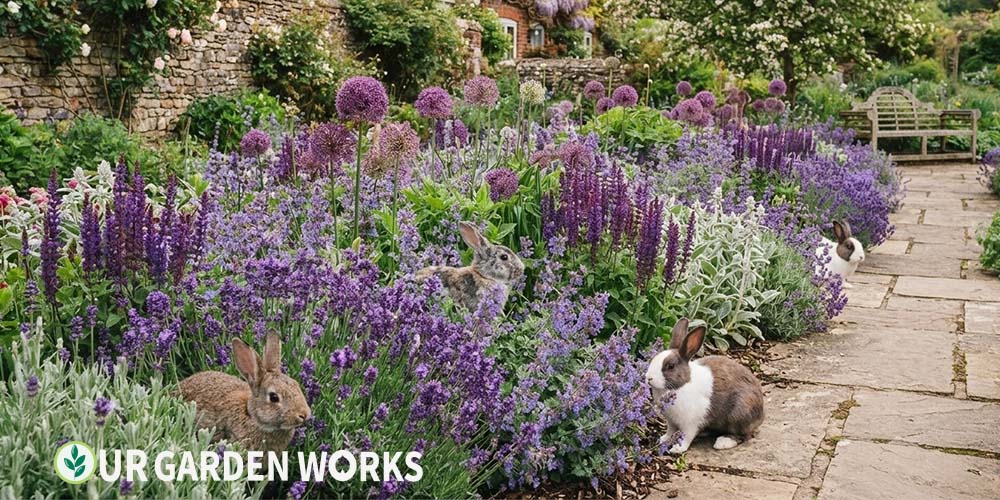
Designing a garden that rabbits naturally avoid isn’t about planting a defensive perimeter of ugly deterrents — it’s about understanding what rabbits dislike and using that to your advantage while building something genuinely beautiful.
Some of the most attractive garden plants in existence are reliably rabbit-resistant: lavender, catmint, salvia, ornamental alliums, daffodils, foxglove.
This guide covers 25 plants that rabbits consistently avoid, organized by type, with growing notes and the reason each plant deters rabbits.
Use this list to supplement or replace vulnerable plants in your garden — and to build the border plantings that reduce rabbit interest in your remaining favorites.
Quick Answer: Rabbits consistently avoid strongly aromatic plants (lavender, catmint, sage, rosemary), alliums (garlic, ornamental onions, chives), toxic or milky-sapped plants (daffodil, foxglove, euphorbia), and plants with very fuzzy or prickly foliage (lamb’s ear, globe thistle). No plant is 100% rabbit-proof, but these 25 are the most reliable choices for low-rabbit-pressure gardening.
Why Rabbits Avoid Certain Plants
Understanding the mechanism helps you extend the list beyond what’s here. Rabbits avoid plants for one of four reasons:
- Intense aromatic oils that overwhelm their sensitive nasal passages
- Toxic compounds they’ve evolved to recognize and avoid
- Unpleasant texture — fuzzy, spiny, very leathery, or sticky foliage
- Extremely bitter alkaloids that are immediately unpalatable
Aromatic Herbs and Perennials (Most Reliable Category)
These are your most dependable rabbit deterrents — all highly aromatic, all reliably avoided, and most of them genuinely beautiful in the garden.
| Plant | Zones | Sun | Notes |
|---|---|---|---|
| Lavender (Lavandula spp.) | 5–9 | Full sun | The gold standard rabbit deterrent. Use as a perimeter border. See our lavender and rabbits guide. |
| Catmint (Nepeta spp.) | 3–8 | Full to part sun | Works in partial shade where lavender won’t. Walker’s Low variety is excellent. Long bloom season. |
| Russian sage (Perovskia) | 4–9 | Full sun | Silver stems, lavender-blue flowers, extremely aromatic. Drought-tolerant once established. |
| Sage (Salvia officinalis) | 4–8 | Full sun | Culinary sage and ornamental salvias both deter rabbits. Huge family with enormous variety. |
| Rosemary (Salvia rosmarinus) | 7–10 | Full sun | Reliably avoided. Hardy only in warmer zones; treat as annual in Zone 6 and colder. |
| Wormwood (Artemisia absinthium) | 3–9 | Full sun | One of the strongest deterrents available. Extremely bitter and aromatic. Silver foliage. |
| Mint (Mentha spp.) | 3–9 | Full sun to shade | Plant in containers to contain spreading. Intensely aromatic — rabbits won’t cross a mint border. |
| Thyme (Thymus spp.) | 4–9 | Full sun | Ground-cover thyme creates rabbit-deterrent pathways through garden beds. |
Alliums (Bulbs That Deter Rabbits)
The entire allium family — onions, garlic, leeks, chives, and ornamental alliums — contains sulfur compounds mildly toxic to rabbits. They instinctively avoid these plants and the scent acts as a local deterrent for surrounding plants.
| Plant | Zones | Type | Notes |
|---|---|---|---|
| Ornamental allium (Allium giganteum) | 4–8 | Spring bulb | Spectacular purple globe flowers. Plant bulbs in fall. After bloom, foliage deters rabbits through summer. |
| Chives (Allium schoenoprasum) | 3–9 | Perennial herb | Return every year. Edible bonus. Very effective deterrent when used as border edging. |
| Garlic (Allium sativum) | 3–9 | Annual crop | Planted fall, harvested summer. Strongly deters rabbits during entire growing period. |
| Society garlic (Tulbaghia violacea) | 7–10 | Perennial | Garlic-scented foliage, lavender flowers. Excellent warm-climate rabbit deterrent. |
Toxic and Milky-Sapped Plants
Rabbits have evolved to recognize and avoid plants with compounds harmful to them. These plants are generally very safe to grow around children and pets (check individual toxicity for each) but are reliably avoided by rabbits.
| Plant | Zones | Sun | Notes |
|---|---|---|---|
| Daffodil (Narcissus spp.) | 3–8 | Full sun | Toxic to rabbits — reliably avoided. Naturalize in lawns and beds for long-term rabbit deterrence. |
| Foxglove (Digitalis spp.) | 4–8 | Part sun to shade | Toxic to rabbits. Biennial — reseeds readily. Tall spires of tubular flowers. |
| Bleeding heart (Lamprocapnos spectabilis) | 3–9 | Shade to part sun | Mildly toxic. Excellent for shaded rabbit-damage areas. Dies back in summer heat. |
| Euphorbia (Euphorbia spp.) | 4–9 | Full to part sun | Milky sap is intensely irritating. Rabbits avoid the entire genus. Wear gloves when handling. |
| Monkshood (Aconitum spp.) | 3–7 | Part shade | Very toxic — avoided by rabbits completely. Also toxic to humans if ingested. Good for mature gardens away from children. |
Texture-Based Deterrents
Plants rabbits find physically unpleasant to eat — very fuzzy, spiny, or leathery foliage.
| Plant | Zones | Sun | Notes |
|---|---|---|---|
| Lamb’s ear (Stachys byzantina) | 4–8 | Full sun | Soft but extremely fuzzy — rabbits dislike the texture. Silver foliage. Ground-cover habit. |
| Globe thistle (Echinops ritro) | 3–8 | Full sun | Spiny blue globes. Rabbits avoid anything prickly. Excellent pollinator plant. |
| Sea holly (Eryngium spp.) | 4–9 | Full sun | Spiny, metallic blue. Architectural plant consistently avoided by rabbits. |
| Yarrow (Achillea spp.) | 3–9 | Full sun | Bitter and aromatic. Very drought-tolerant. Long season of colourful bloom. |
Shrubs and Grasses
| Plant | Zones | Sun | Notes |
|---|---|---|---|
| Ornamental grasses (most varieties) | Varies | Full sun | Rabbits rarely eat established grasses. Miscanthus, Pennisetum, Panicum all reliable. |
| Barberry (Berberis spp.) | 4–8 | Full to part sun | Very thorny shrub — physical deterrent as a hedge plant. Check invasive status in your region. |
| Forsythia (Forsythia spp.) | 4–8 | Full to part sun | Reliably avoided by rabbits. Bright yellow early spring bloom. |
Using Rabbit-Resistant Plants Strategically
Rather than replacing your entire garden with rabbit-resistant species, use them strategically in combination with protection for your favorite plants:
- Perimeter borders: Ring vulnerable beds with lavender, catmint, or chives. The scent barrier reduces rabbit interest in crossing into the bed.
- Interplanting: Plant alliums between roses and hostas. The mixed scent profile is less attractive than a block of pure rabbit-preferred plants.
- Foundation plantings: Use rabbit-resistant shrubs (barberry, forsythia) and perennials (Russian sage, ornamental grasses) in areas you can’t fence.
Combined with repellents from our best rabbit repellent guide and physical protection from our rabbit control guide, a thoughtfully planted rabbit-resistant garden reduces rabbit pressure significantly without requiring fencing everywhere.
A Sample Rabbit-Resistant Garden Design
Here’s how to combine plants from this list into a functional, attractive planting that reduces rabbit damage without looking like a defensive installation:
Sunny Border (Full Sun, Zones 5–8)
- Back row: Russian sage or ornamental grasses for height.
- Middle: English lavender (Hidcote), catmint (Walker’s Low), yarrow in mixed colors.
- Front edge: ornamental alliums in spring bulbs, chives as living edging.
- Interspersed: daffodil bulbs for early spring interest and early-season rabbit deterrence.
This combination provides bloom from early spring through late autumn, attracts pollinators heavily, and forms a continuous aromatic perimeter that keeps rabbits out of beds beyond it.
Shaded Border (Part to Full Shade, Zones 4–8)
In shade where lavender won’t thrive, anchor with catmint at the sunniest edges, bleeding heart for spring, astilbe for midsummer, ferns for season-long foliage, and foxglove for vertical accent.
All of these are reliably avoided by rabbits and all perform well in the same shaded conditions where hostas — a prime rabbit target — grow best. Interplanting them with hostas reduces rabbit pressure on the hostas significantly.
For complete protection of your most vulnerable plants beyond just using resistant species, our how to keep rabbits out of your garden guide covers fencing and repellent strategies that pair with these plantings.
Frequently Asked Questions
Is any plant truly 100% rabbit-proof?
No plant is completely rabbit-proof in a starving population. The plants on this list are reliably avoided under normal conditions — when rabbits have alternative food sources.
During extreme food scarcity (deep winter, drought, high population), rabbits will eat plants they normally avoid. The most rabbit-resistant planting strategy combines resistant plants with physical fencing or repellents for high-value areas.
Do deer-resistant plants also deter rabbits?
Sometimes — but not always. Deer and rabbits avoid some of the same plants (strongly aromatic herbs, toxic plants) but diverge on others. Deer avoid some plants rabbits eat readily, and vice versa. The lists overlap significantly for aromatic herbs and alliums.
If you’re dealing with both deer and rabbits, focus on those overlapping categories for maximum protection.
My rabbits ate my lavender — is that normal?
Lavender seedlings in their first few weeks are more vulnerable than established plants because the essential oil concentration is still developing.
If established lavender was eaten, it usually indicates extreme food scarcity (winter, drought) or an unusually large/hungry rabbit population. Protect new lavender plantings for the first 8–12 weeks until they’re established and producing full oil content.
Part of Our Rabbit Garden Pest Guide
Final Thoughts
We hope this list helps you build a garden that’s both beautiful and naturally less attractive to rabbits — because the best rabbit deterrent is one that’s also a pleasure to look at.
For the full rabbit control picture including fencing and repellents, our how to keep rabbits out of your garden guide covers everything else you need.
Share this with a fellow gardener who is building a new garden bed and wants to choose plants that won’t be eaten before they establish — and let us know in the comments what rabbit damage looks like in your garden this season. Happy growing!
