

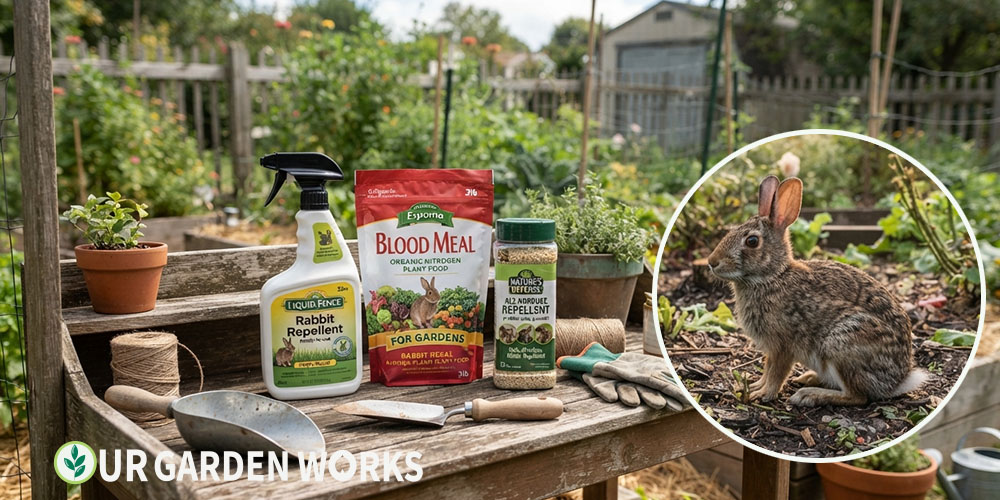
There are dozens of rabbit repellents on the market and an equal number of home remedies that gardeners swear by. Some work reliably. Many work briefly then stop. A few never work at all.
The difference usually comes down to the active ingredient, how consistently you reapply, and whether your rabbit pressure level is within what repellents can actually handle.
This guide reviews the most effective rabbit repellent options honestly — what works, what doesn’t, and when repellents alone aren’t enough and physical fencing is necessary.
For the complete rabbit protection picture including fencing and companion plantings, see our how to keep rabbits out of your garden guide.
Quick Answer: The most reliably effective rabbit repellents are blood meal (granular perimeter barrier), Liquid Fence (spray formula, egg and garlic based), and Bobbex-R (spray, most weather-resistant). All require consistent reapplication — every 7–14 days and after rain. Rotate between two products to prevent habituation. No repellent matches hardware cloth fencing for serious infestations.
How Rabbit Repellents Work
Rabbit repellents work through two mechanisms — scent deterrence and taste deterrence:
- Scent repellents make the area smell like predator presence (blood meal, predator urine) or intensely unpleasant to rabbit nasal passages (garlic, hot pepper, putrescent egg)
- Taste repellents coat foliage with compounds rabbits find intensely bitter or irritating, discouraging return visits
The most effective commercial products combine both mechanisms. The key limitation of all repellents: they must be reapplied consistently, and determined or hungry rabbits will overcome them eventually.
Best Spray Repellents
1. Liquid Fence Deer & Rabbit Repellent — Best Overall Spray
The most widely used and consistently reviewed rabbit repellent on the market. The active ingredients — putrescent whole egg solids and garlic — create a scent that triggers a predator-response in rabbits at a biological level.
Dries clear and becomes rain-resistant once dry (apply in dry weather and allow 24 hours to dry before expected rain).
Reapplication: Weekly for the first month to establish the deterrent pattern; every 2 weeks after. Reapply immediately after significant rainfall.
Best for: Ornamental beds — roses, hostas, perennial borders. Safe on edibles but check the label for pre-harvest intervals on food crops.
Check Price on Amazon →2. Bobbex-R Animal Repellent — Best Weather Resistance
Bobbex-R uses a blend of putrefied egg, fish meal, and garlic — a formula specifically designed to remain effective longer between reapplications. It’s particularly well reviewed for wet climates where standard repellents wash off quickly. The smell is intense during application but fades within a day on dry plants.
Reapplication: Every 2 weeks in dry conditions, weekly in rainy periods. More weather-resistant than Liquid Fence.
Best for: Rainy climates, areas where you can’t reapply frequently, ornamental plants.
Check Price on Amazon →3. Repels-All Animal Repellent Spray — Best for Multiple Pests
If you’re dealing with rabbits plus deer, squirrels, or groundhogs simultaneously, Repels-All’s broad-spectrum formula targets all of them. The trade-off: the smell is notably more intense than rabbit-specific products. Most effective when alternated with another repellent to prevent habituation.
Check Price on Amazon →Best Granular Repellents
1. Blood Meal — Best Natural Granular Deterrent
Blood meal does two jobs simultaneously: it acts as a high-nitrogen fertilizer and deters rabbits by creating the scent of predator activity. Scatter around the perimeter of beds rather than on plants themselves. It’s water-soluble, so it also feeds your soil as it breaks down — making it the most cost-effective organic option.
Reapplication: Every 2–3 weeks and after rain. The scent fades quickly in heat.
Limitation: Intense smell for 24–48 hours after application. Dogs are attracted to blood meal — keep pets away from treated areas until it settles.
Check Price on Amazon →2. Liquid Fence Granules — Best Granular for Convenience
The granular version of the Liquid Fence formula. Scatter around bed perimeters, along fence lines, and near known rabbit entry points. Granules last slightly longer than sprays between applications because they’re not exposed directly to sunlight and wind. Easy to apply without any mixing or sprayer equipment.
Check Price on Amazon →Quick Comparison — All Repellents at a Glance
| Product | Type | Effectiveness | Rain Resistance | Reapply | Best Use |
|---|---|---|---|---|---|
| Liquid Fence spray | Spray | 🟢🟢🟢🟢 High | Good once dry | 7–14 days | Ornamental beds, roses, hostas |
| Bobbex-R spray | Spray | 🟢🟢🟢🟢 High | Very Good | 14 days | Rainy climates, ornamentals |
| Repels-All spray | Spray | 🟢🟢🟢 Good | Good | 14 days | Multi-pest (deer + rabbits) |
| Blood meal granules | Granular | 🟢🟢🟢 Good | Poor (washes away) | Weekly | Organic gardens, perimeter scatter |
| Liquid Fence granules | Granular | 🟢🟢🟢 Good | Moderate | 14–21 days | Convenience, no sprayer needed |
| Garlic spray (homemade) | Spray | 🟡🟡 Moderate | Poor | 5–7 days | Budget option, light pressure |
| Irish Spring soap shavings | Granular | 🟡 Light pressure | Poor | Weekly | Very light rabbit presence only |
The Habituation Problem — Why You Must Rotate
The most common reason repellents “stop working” is habituation — rabbits investigate, find the repellent harmless, and learn to ignore it. This happens with every single repellent product over time, regardless of brand or formula.
The solution is rotation: alternate between two different products every 2–3 applications. When you switch, the new scent resets the rabbit’s wariness. A simple rotation schedule:
- Weeks 1–2: Liquid Fence spray + blood meal granules at perimeter
- Weeks 3–4: Bobbex-R spray + Liquid Fence granules at perimeter
- Weeks 5–6: Back to Liquid Fence spray + blood meal
Natural and Home Remedy Options
| Remedy | How to Use | Effectiveness | Reapply |
|---|---|---|---|
| Irish Spring soap shavings | Scatter shavings around bed edges | 🟡 Light pressure only | Weekly |
| Cayenne pepper/chilli flakes | Sprinkle around plant bases | 🟡 Short-term only | After every rain |
| Garlic spray (homemade) | Blend garlic + water + a little dish soap, spray foliage | 🟡 Moderate | Every 5–7 days |
| Human hair in mesh bags | Hang around garden perimeter | 🔴 Inconsistent | Weekly (degrades fast) |
| Predator urine granules | Scatter around perimeter | 🟡 Moderate | Every 2 weeks |
When Repellents Aren’t Enough
Repellents have a ceiling of effectiveness. If you’re experiencing daily rabbit damage despite consistent repellent application, the rabbit pressure is beyond what repellents alone can handle. The indicators that fencing is necessary:
- Daily damage despite twice-weekly repellent application
- Evidence of a rabbit burrow or nest near the garden
- Multiple rabbits observed in or near the garden
- Damage to multiple plant types simultaneously (rabbits eating everything, not selecting preferred plants)
In these situations, hardware cloth fencing is the necessary solution — see our complete fencing guide for specifications and installation instructions.
Frequently Asked Questions
Are rabbit repellents safe around vegetable gardens?
Most commercial spray repellents are safe to use around vegetables but should not be applied directly to edible portions of food crops. Use them on the soil surface, on ornamental companion plants, and on non-edible plant parts (stems, non-edible leaves).
Always check the label for edible crop guidance. Granular repellents are the safest option around food gardens — scatter around bed perimeters, not on plants.
Do repellents work in winter when rabbits are hungriest?
Winter is when repellents are least effective and physical protection is most needed. Hungry rabbits in food-scarce winter conditions will push through repellent barriers they’d avoid in summer.
For winter-specific concerns — especially bark damage on young trees — hardware cloth tree guards installed before the first snow are significantly more reliable than any repellent product.
How quickly do repellents work after the first application?
Most spray repellents begin working immediately — rabbits that encounter the treated area usually turn away on their first visit. The first 2–3 weeks of consistent application establish the deterrent pattern most effectively.
Don’t judge a repellent’s effectiveness after a single application; give it 3–4 applications on the right schedule before deciding whether it’s working for your situation.
Part of Our Rabbit Garden Pest Guide
Final Thoughts
Before choosing your repellent strategy, it helps to know specifically which plants rabbits are targeting. If it’s ornamentals like hostas or roses, spray repellents applied directly to foliage work well.
If it’s your vegetable garden, granular perimeter barriers are safer around edible crops. Matching the repellent type to the plant type makes a real difference in effectiveness.
We hope this review helps you choose the right combination of repellents for your rabbit pressure level — and helps you avoid spending money on products that won’t match your situation.
Rotate between two products every 3–4 applications to prevent habituation, and pair repellents with companion plantings from our plants rabbits won’t eat guide for the strongest combined deterrence without fencing.
Share this with a fellow gardener who has tried one rabbit repellent and given up — when rotating products might have been all they needed — and let us know in the comments what rabbit damage looks like in your garden this season. Happy growing!
