

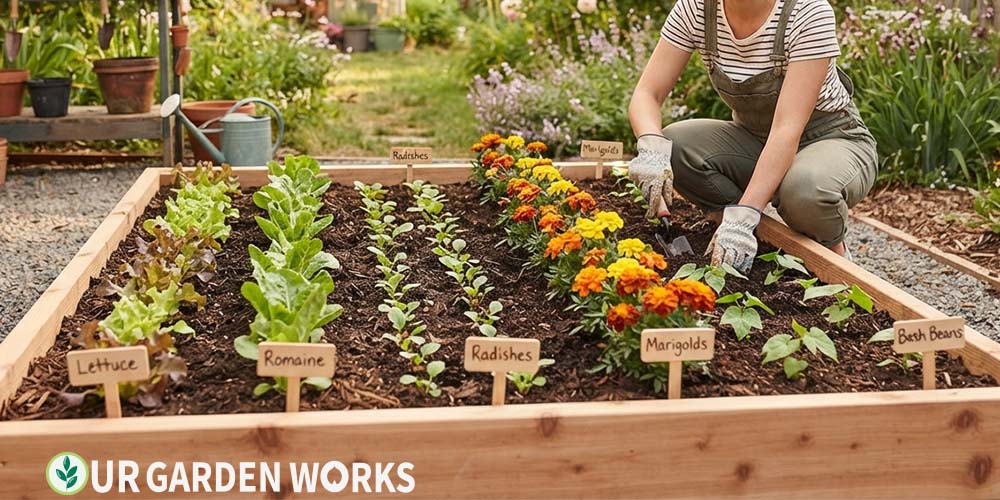
Every gardener remembers their first planting day — and the slight panic of staring at a seed rack with forty options, none of which mean anything yet.
The good news is that a small handful of crops are so forgiving, so fast, and so visually rewarding that they’ve earned a permanent spot on every “start here” list for a reason.
This guide isn’t about growing everything at once. It’s about choosing the 5–8 plants that will actually succeed in your first season, build your confidence, and teach you the fundamentals before you take on anything trickier.
Quick Answer: For a first garden, start with radishes, bush beans, lettuce, marigolds, and zucchini or summer squash. All five germinate reliably, tolerate beginner mistakes, and give visible results within 3–8 weeks. Hold off on anything that needs precise timing or heavy disease management — tomatoes and peppers are rewarding but far less forgiving.
Why Some Plants Are “Beginner-Friendly” and Others Aren’t
The plants that work best for a first garden share a few specific traits: fast germination, a wide tolerance for soil and watering mistakes, and a short path from seed to something you can actually see or eat.
None of that is about the plant being “easy” in some vague sense — it’s about how much margin for error it gives you while you’re still learning to read your own garden.
A tomato plant, by contrast, asks a lot up front: consistent watering, staking, pruning, and a fairly narrow temperature window to avoid blossom drop. None of that is hard once you know it.
But a first-time gardener doesn’t know it yet, and a string of small mistakes on a finicky crop is exactly the kind of experience that convinces people gardening “isn’t for them.” Starting with forgiving plants flips that script — mistakes barely show, and the wins come fast enough to keep you going.
What “Margin for Error” Actually Looks Like in Practice
It’s worth getting specific about what separates a forgiving plant from a finicky one, since the difference isn’t always obvious from a seed packet alone.
Radishes, for example, tolerate inconsistent watering reasonably well during most of their growth, only really needing steady moisture in the final week or two as roots size up — a beginner who waters somewhat irregularly still gets a usable harvest.
Carrots sit at the opposite end of that same spectrum. They need genuinely even moisture from the moment seeds are sown through germination, since any drying-out period during that window can kill emerging seedlings outright or produce stunted, forked roots later.
The plant itself isn’t dramatically harder to grow in any general sense — it’s just less tolerant of the exact kind of inconsistency a first-time gardener is statistically likely to produce.
This is the lens worth applying to any plant you’re considering for a first season: not “is this hard” in the abstract, but “how much room does this give me to learn as I go.”
The Best First Plants — And Why Each One Works
#1 Radishes — Fastest Payoff
Radishes go from seed to harvest in as little as 25 days, making them the single fastest confidence-builder in the garden.
Direct sow ½ inch deep, thin to 2 inches apart once they sprout, and keep soil consistently moist. There’s very little to get wrong, and the speed means you’ll know within a week whether germination worked at all.
#2 Bush Beans — No Trellis, No Fuss
Unlike pole beans, bush varieties need no support structure at all — just sun, warm soil, and water.
They also fix their own nitrogen, meaning they’re more tolerant of average soil than most vegetables. For the full growing breakdown including variety picks, see our how to grow green beans guide.
#3 Loose-Leaf Lettuce — Cut-and-Come-Again
Lettuce tolerates partial shade, cooler temperatures, and inconsistent watering better than most greens, and loose-leaf types let you harvest outer leaves repeatedly rather than pulling the whole plant.
This single technique can stretch one sowing into a month or more of salads, and it’s a genuinely good first lesson in how much more productive a garden becomes once you understand harvest technique, not just planting technique.
#4 Marigolds — Nearly Impossible to Kill
Marigolds germinate in days, bloom within weeks, and tolerate poor soil, irregular watering, and high heat better than almost any other annual flower.
They’re also widely used as companion plants, since their scent is believed to deter several common garden pests — a useful bonus while you’re still building your vegetable beds, though the evidence for this is more specific than the broad reputation suggests.
#5 Zucchini or Summer Squash — Maximum Visual Reward
Few plants reward a beginner’s effort as dramatically as squash — explosive growth, large obvious flowers, and a harvest you genuinely cannot miss.
The tradeoff is that one or two plants produce more than most households can eat, so plan for fewer plants than the seed packet might suggest. This is also one of the few crops where a beginner’s enthusiasm (planting too many) causes a real, if pleasant, problem. Once you’re ready to grow it properly, our complete zucchini growing guide covers the harvest-timing detail that trips up most first-timers.
How These Five Plants Teach Different Skills
It’s worth noticing that these five aren’t just individually easy — together, they cover a genuinely useful range of gardening fundamentals without overwhelming a first-time grower with too many techniques at once.
Radishes teach you to read germination and thinning. Bush beans introduce the idea of a plant that improves its own soil. Lettuce teaches harvest technique and the concept of extending a single planting’s productive life. Marigolds introduce companion planting as a concept, even before you fully understand the mechanisms behind it.
And squash teaches the most important lesson of all — that plants grow faster and more dramatically than most beginners expect, which reshapes how you think about spacing in every future season.
What to Hold Off On for Now
None of these are bad plants — they’re simply better attempted once you’ve got a season of basic experience behind you.
- Tomatoes: Rewarding, but staking, pruning, and watering consistency all matter more than beginners expect — our tomato growing guide covers exactly what they need once you’re ready.
- Peppers: Slow to germinate and slow to fruit — patience-testing for a first season.
- Carrots: Need loose, rock-free soil and very even moisture during germination, or they come out twisted and stunted.
- Brassicas (broccoli, cauliflower): Narrow temperature windows and heavy pest pressure from cabbage worms make these trickier than they look.
None of this means these crops are off-limits forever — most gardeners add one or two of them in their second season, once they’ve already learned the basics of watering, spacing, and reading their specific garden’s light and soil conditions on the more forgiving crops above.
Adding a harder crop to an already-working routine is a very different experience from trying to learn everything at once.
💡 Plant in a raised bed if you can
A raised bed sidesteps two of the most common first-season problems — poor native soil and uncertain drainage — by giving you full control over the growing medium from day one. If you’re setting one up, our raised bed growing guide covers sizing and soil mix in detail.
A Simple First-Season Layout
For a 4×4 or 4×8 starter bed, a reasonable split looks like this: one section of radishes (succession-sown every 2 weeks), a short row of bush beans, a block of loose-leaf lettuce, a border of marigolds along the edge, and one or two squash plants given their own generous corner.
This combination covers a root crop, a legume, a leafy green, a companion flower, and a fruiting vegetable — a small but genuine cross-section of what a vegetable garden actually does.
It’s also small enough that daily watering and weeding takes only a few minutes, which matters more than it sounds like it should during a first season when motivation and habit are still being built.
As the radishes finish their fast cycle, that same space can be resown with a second round, or used to add a late-season planting of lettuce as the weather cools — your first real introduction to the idea of succession planting, covered in more depth in our succession planting guide once you’re ready to stretch a single bed’s productivity further.
Frequently Asked Questions
Can I start all of these from seed, or should I buy transplants?
All five can be direct-sown from seed with no transplanting needed, which is part of why they’re good beginner choices — fewer steps means fewer chances to make a mistake. If you want a head start, squash and lettuce transplants are widely available and transplant easily.
How much sun do these plants actually need?
Radishes, beans, marigolds, and squash all want 6–8 hours of direct sun for best results. Lettuce is the exception — it tolerates partial shade and actually benefits from afternoon shade in hot climates, since it bolts and turns bitter in sustained heat.
What's the single most common mistake first-time gardeners make?
Overcrowding. It’s tempting to plant everything the seed packet allows in a small space, but overcrowded plants compete for light, water, and nutrients, and airflow problems invite disease. When in doubt, plant fewer seeds with more space between them than the packet suggests.
How do I know if my first garden is actually getting enough sun?
Watch the space across a full day before planting anything, noting roughly how many hours receive direct, unobstructed sunlight rather than dappled or filtered light. Most of the plants on this list want 6+ hours; if your space genuinely can’t provide that, lettuce is the most shade-tolerant option here and a reasonable anchor for a partly shaded first bed.
Related Articles in Our Beginner Gardening Guide
- How to Grow a Vegetable Garden: Complete Beginner’s Setup Guide (2026)
- How to Grow Vegetables in Raised Beds — Complete Setup & Planting Guide
- How to Grow Green Beans: Bush and Pole Varieties Compared (2026)
- How to Grow Zucchini: The Complete No-Fail Guide (2026)
- How to Grow Tomatoes From Seed to Harvest (Complete 2026 Guide)
- Vegetable Gardening Guide
Final Thoughts
We hope this guide takes the guesswork out of your very first planting day. Start small, start with these five, and you’ll have real harvests to show for it before you know it. For everything else, our vegetable gardening guide links to every topic as you’re ready for it.
One last thing worth remembering as you get started: nearly every experienced gardener you’ll ever meet killed something in their first season, sometimes several somethings. That’s not a sign you’re doing it wrong — it’s simply part of how the skill gets built.
The five plants in this guide are specifically chosen to make that learning curve gentle, but even a forgiving plant occasionally fails for reasons that have nothing to do with anything you did. Treat early setbacks as information rather than failure, adjust, and try again — that loop, repeated a few times, is genuinely the fastest path to becoming a confident gardener.
Share this post with a fellow gardener who’s ready to get growing — and let us know in the comments which of these you’re starting with this season. Happy growing!
